Fast pyrolysis is a thermochemical process that rapidly heats organic materials, such as biomass or plastic waste, to moderate temperatures in the complete absence of oxygen. Unlike slow pyrolysis which maximizes solid char, or gasification which maximizes combustible gas, fast pyrolysis is specifically engineered to break down complex molecules and immediately cool the resulting vapors to produce the highest possible yield of a liquid product known as bio-oil.
The core principle of fast pyrolysis is not just heating biomass, but precisely controlling the speed of heating and cooling. This method is designed to rapidly vaporize the organic material and then "freeze" the chemical reaction, capturing a high-value liquid fuel before it can degrade into less valuable gases and solids.
How Fast Pyrolysis Works: The Core Principles
The effectiveness of fast pyrolysis hinges on maintaining several critical conditions within the reactor. These parameters are tightly controlled to favor the production of liquids over solids or gases.
The Feedstock
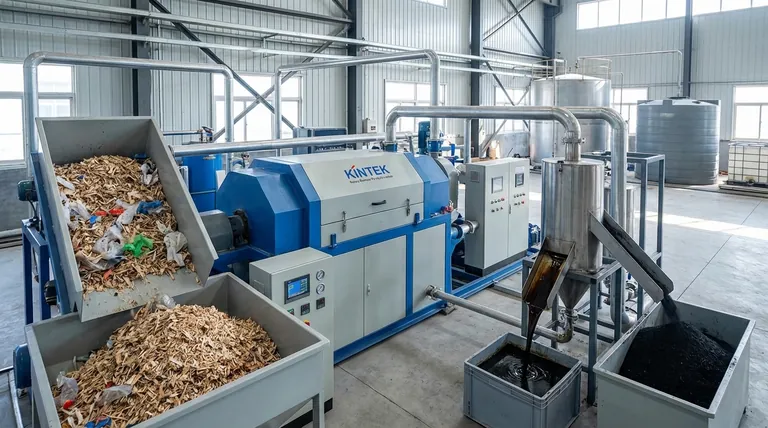
The process begins with a feedstock, which is typically some form of organic matter. Common examples include agricultural residues, wood chips, dried sewage sludge, and certain types of plastic waste. The material is usually dried and ground into small particles to ensure rapid and uniform heating.
The Critical Conditions
To achieve high liquid yields (often 60-75% by weight), the process must adhere to three strict parameters:
- High Heating Rate: The biomass particles are heated extremely quickly, bringing them to the target temperature in seconds or even milliseconds.
- Controlled Temperature: The process operates at moderate temperatures, typically between 450°C and 600°C. This is hot enough to break down the material but cool enough to prevent the valuable liquid vapors from breaking down further (cracking).
- Short Vapor Residence Time: The hot gases and vapors created during the decomposition are removed from the reactor almost instantly—usually in less than two seconds. They are then rapidly quenched and cooled to condense them into a liquid.
The Three Primary Products
The output of fast pyrolysis is a mix of liquid, solid, and gaseous products, each with its own use.
- Bio-oil: This dark, viscous liquid is the main product. It is an energy-dense, transportable fuel that can be combusted for heat and power or upgraded into higher-grade transportation fuels and chemicals.
- Bio-char: This is the solid, carbon-rich residue left behind. It can be burned as fuel, used as a feedstock for producing activated carbon, or applied to soil as an amendment to improve fertility and sequester carbon.
- Syngas: This is a mixture of non-condensable gases (like carbon monoxide, hydrogen, and methane). This gas stream has a low heating value but is almost always recycled to provide the energy needed to power the pyrolysis process itself, making the system more self-sufficient.
Why "Fast" Matters: Maximizing Liquid Yield
The speed of the process is its defining characteristic and the key to its primary function. It represents a deliberate engineering choice to manipulate the chemical reaction pathway.
A Race Against Secondary Reactions
In slower thermal processes, the initial vapors produced from decomposition have time to react further. These "secondary reactions" break the vapors down into simpler, smaller gas molecules or repolymerize them into solid char. Fast pyrolysis outruns these secondary reactions, pulling the valuable vapors out of the hot zone before they have a chance to degrade.
The Role of Reactor Design
Achieving such rapid heat transfer requires specialized equipment. Reactor designs like circulating fluidized beds and ablative reactors are engineered to expose small biomass particles to a hot surface or medium with extreme efficiency, ensuring the conditions for maximizing liquid yield are met.
The Advantage of Mobility
Because fast pyrolysis can be built at a relatively small scale, it enables a decentralized processing strategy. Small, even mobile, pyrolysis units can be deployed near the source of biomass (e.g., a farm or forest), converting bulky, hard-to-transport waste into energy-dense, liquid bio-oil. This liquid can then be easily transported to a central refinery for upgrading.
Understanding the Trade-offs and Challenges
While highly promising, fast pyrolysis is not without its technical hurdles. Understanding these limitations is critical for evaluating its role.
Raw Bio-oil Quality
The raw bio-oil produced is not a "drop-in" replacement for crude oil. It is highly acidic, contains significant water, is corrosive to standard pipes and engines, and is chemically unstable, tending to thicken over time. It almost always requires further processing, known as upgrading, to become a stable, usable fuel or chemical feedstock.
Feedstock Sensitivity
The process efficiency and the quality of the bio-oil are sensitive to the characteristics of the feedstock, particularly its moisture content. Drying the biomass to the required level (typically below 10% moisture) consumes energy and adds to the operational cost.
Scaling and Economics
While reactor technology is well-established, scaling up to large, commercially competitive facilities faces economic challenges. The logistics of sourcing and pre-processing large volumes of biomass, coupled with the cost of upgrading the bio-oil, remain key factors in its broader adoption.
How to Apply This to Your Project
The strategic value of fast pyrolysis lies in its unique ability to convert low-value, decentralized solid biomass into a transportable, energy-dense liquid.
- If your primary focus is renewable fuel production: Fast pyrolysis offers the most direct pathway for converting solid biomass into a liquid intermediate (bio-oil) that can be refined into transportation fuels.
- If your primary focus is waste valorization: The process is a powerful tool for converting challenging organic waste streams into valuable energy products and materials, supporting a circular economy.
- If your primary focus is carbon sequestration: The bio-char co-product is a highly stable form of carbon that can be used to improve soil health while locking carbon out of the atmosphere for centuries.
Ultimately, fast pyrolysis acts as a critical technological bridge, converting distributed, low-density biomass into a fungible liquid commodity for a more flexible and sustainable energy future.
Summary Table:
| Key Aspect | Description |
|---|---|
| Primary Goal | Maximize production of liquid bio-oil (60-75% yield) |
| Process Conditions | High heating rate, 450-600°C temperature, short vapor residence time (<2 sec) |
| Main Products | Bio-oil (liquid fuel), Bio-char (solid), Syngas (recycled for process heat) |
| Key Advantage | Converts low-density biomass into an energy-dense, transportable liquid |
| Common Feedstocks | Agricultural residues, wood chips, certain plastic wastes |
Ready to harness the power of pyrolysis for your renewable energy or waste valorization project?
KINTEK specializes in providing robust laboratory equipment and consumables for pyrolysis research and process development. Whether you are testing feedstocks, optimizing reaction parameters, or scaling up your process, our precise heating systems and reactors can help you achieve reliable and reproducible results.
Contact our experts today to discuss how our solutions can accelerate your path to a sustainable energy future.
Visual Guide

Related Products
- Electric Rotary Kiln Small Rotary Furnace Biomass Pyrolysis Plant
- Electric Rotary Kiln Continuous Working Small Rotary Furnace Heating Pyrolysis Plant
- Electric Rotary Kiln Pyrolysis Furnace Plant Machine Calciner Small Rotary Kiln Rotating Furnace
- Customer Made Versatile CVD Tube Furnace Chemical Vapor Deposition Chamber System Equipment
- Spark Plasma Sintering Furnace SPS Furnace
People Also Ask
- What is a rotary kiln reactor? A Guide to Industrial Thermal Processing
- How are rotary kilns heated? Direct vs. Indirect Heating Methods Explained
- What are the characteristics of the slipping, slumping, and rolling modes of bed motion? Optimize Your Rotary Process
- At what temperature does pyrolysis occur? A Guide to Controlling Your Product Output
- What are the principles of a rotary kiln? Master the Mechanics of High-Temperature Processing