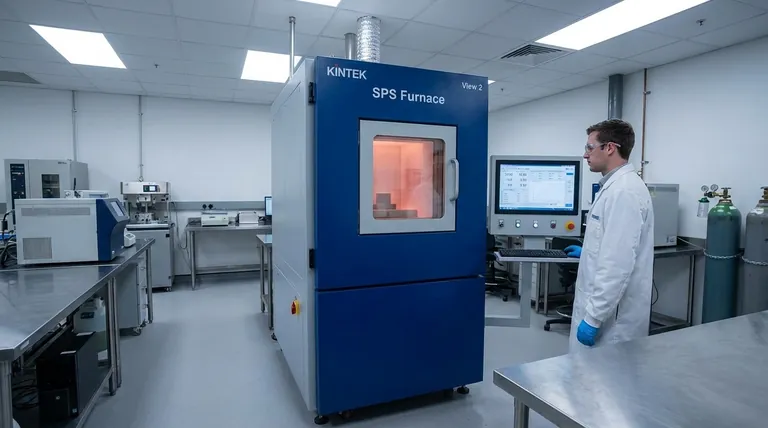
The pressure used in Spark Plasma Sintering (SPS) is not a single, fixed value but a critical and adjustable process parameter. For most materials and applications, the uniaxial pressure typically falls within a range of 30 to 100 megapascals (MPa). This pressure works in concert with rapid resistive heating to achieve densification far more effectively than conventional sintering methods.
The core challenge is not finding a single correct pressure, but understanding its role. Pressure in SPS is the primary mechanical force that complements thermal energy, and choosing the right level is a deliberate balance between driving densification, preserving microstructure, and respecting the physical limits of the equipment.
The Fundamental Role of Pressure in SPS
Pressure is not a passive variable; it is an active driver of the consolidation process. It works alongside the high temperatures generated by the pulsed DC current to transform loose powder into a dense solid.
Driving Particle Consolidation
At the very beginning of the cycle, pressure facilitates particle rearrangement. It breaks down soft agglomerates and forces individual particles into a more tightly packed arrangement, significantly reducing the initial porosity before significant heating even occurs.
Enabling Plastic Deformation
As the temperature rises, the material's yield strength decreases. The applied pressure forces the now-malleable particles to deform at their contact points. This plastic flow is a dominant mechanism in SPS that physically closes the voids between particles, leading to rapid densification.
Enhancing Mass Transport
The stress gradients created by the applied pressure increase the driving force for diffusional processes, such as grain boundary and volume diffusion. This means that atoms move more readily to fill the remaining microscopic pores, a process essential for achieving near-full theoretical density.
Key Factors That Determine Optimal Pressure
The "right" pressure is entirely dependent on your material, your goals, and your equipment. Blindly applying a standard value will lead to suboptimal results.
Material Type: Brittle vs. Ductile
Hard, brittle materials like ceramics (e.g., silicon carbide, boron carbide) have high resistance to plastic flow. They often require higher pressures (70-100 MPa or more) to induce the necessary deformation for densification.
Conversely, ductile materials like aluminum or copper deform easily. They can often be fully densified at lower to moderate pressures (30-60 MPa) without requiring extreme temperatures.
Desired Microstructure: Density vs. Grain Size
One of the primary advantages of SPS is its ability to produce dense materials while suppressing grain growth. Using a higher pressure can often allow for densification at a lower temperature or for a shorter time. This is a key strategy for preserving fine-grained or nanostructured microstructures.
Equipment Limitations: The Graphite Die
The vast majority of SPS experiments are conducted using graphite dies and punches. Standard grades of graphite have a limited compressive strength at high temperatures, which typically caps the usable pressure at around 100-120 MPa. Exceeding this limit risks catastrophic failure of the die, which can damage the equipment and ruin the sample.
Understanding the Trade-offs: The Pressure Dilemma
Choosing a pressure setting involves balancing competing factors. What helps in one area may be a detriment in another.
Risks of Using Too Much Pressure
Applying excessive pressure can lead to several problems. The most immediate is die failure. Furthermore, the uniaxial nature of the force can create an anisotropic microstructure, where grains are elongated or preferentially oriented, leading to mechanical properties that vary with direction. For brittle powders, applying pressure too aggressively can also induce cracking in the sample.
Consequences of Using Too Little Pressure
Insufficient pressure is a common cause of poor results. If the pressure is too low, it may not be enough to induce the plastic flow and particle rearrangement needed to close all porosity. This results in a sample with low final density and, consequently, poor mechanical properties. To compensate, you might be forced to use a higher temperature, which increases the risk of undesirable grain growth.
Selecting the Right Pressure for Your Application
There is no universal formula, but there are clear guidelines based on your primary objective. Start with a baseline from literature on similar materials, then optimize based on your specific goal.
- If your primary focus is achieving maximum density in hard ceramics: Start toward the higher end of your die's capability (e.g., 80-100 MPa) to ensure you overcome the material's intrinsic resistance to densification.
- If your primary focus is preserving a nanostructure: Use the lowest pressure that achieves consolidation (often 30-50 MPa) and pair it with very high heating rates and minimal hold times to prevent grain coarsening.
- If your primary focus is sintering ductile metals: A moderate pressure (e.g., 40-60 MPa) is typically sufficient to induce plastic flow and achieve full density without needing extreme temperatures.
Ultimately, pressure is the essential lever you pull in tandem with temperature to precisely engineer the final state of your material.
Summary Table:
| Material Type | Typical Pressure Range (MPa) | Primary Goal |
|---|---|---|
| Brittle Ceramics (e.g., SiC) | 70 - 100+ | Maximum Density |
| Ductile Metals (e.g., Al, Cu) | 30 - 60 | Full Densification |
| Nanostructured Materials | 30 - 50 | Grain Growth Suppression |
Ready to Optimize Your SPS Process?
Choosing the right pressure is just one piece of the puzzle. KINTEK specializes in lab equipment and consumables, providing the expertise and tools you need to master Spark Plasma Sintering. Whether you're working with advanced ceramics, metals, or nanomaterials, we can help you achieve superior densification and precise microstructural control.
Contact us today to discuss your specific application and discover how our solutions can enhance your research and development. Get in touch via our contact form – let's engineer the future of materials together.
Visual Guide

Related Products
- Spark Plasma Sintering Furnace SPS Furnace
- Vacuum Dental Porcelain Sintering Furnace
- Vacuum Heat Treat and Sintering Furnace with 9MPa Air Pressure
- Dental Porcelain Zirconia Sintering Ceramic Vacuum Press Furnace
- Dental Porcelain Zirconia Sintering Ceramic Furnace Chairside with Transformer
People Also Ask
- Why are Spark Plasma Sintering (SPS) furnaces or hot presses utilized in the preparation of Li3PS4 solid electrolytes?
- What are the advantages of CAMI/SPS for W-Cu composite preparation? Reduce cycles from hours to seconds.
- What technical advantages does a Spark Plasma Sintering (SPS) furnace offer for LZP ceramics? Enhance Ionic Conductivity
- What is the theory of spark plasma sintering? A Guide to Rapid, Low-Temperature Densification
- What are the fundamentals of spark plasma sintering process? Unlock Rapid, High-Performance Material Consolidation