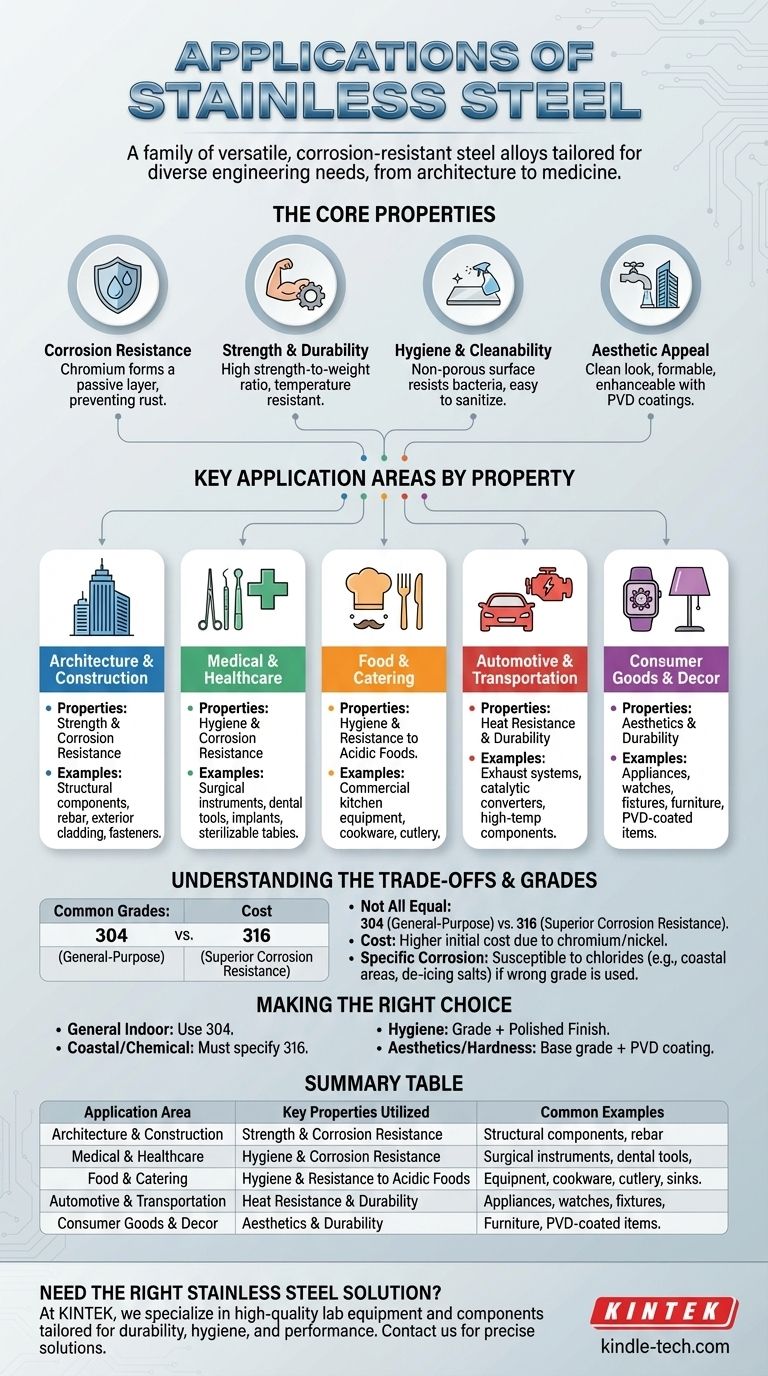
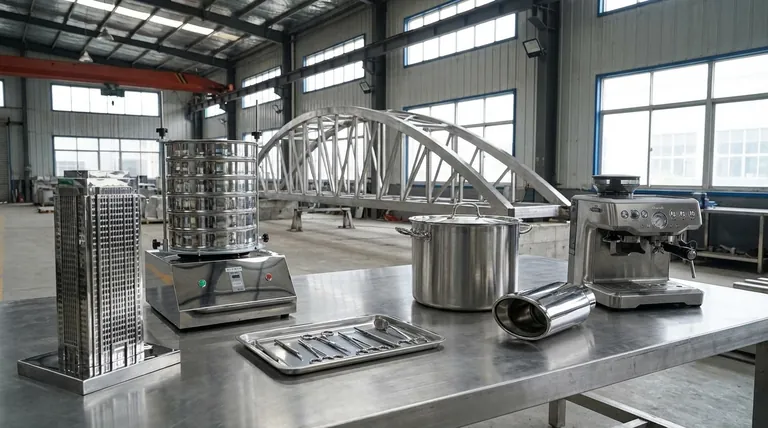
In short, stainless steel is one of the most versatile materials in modern engineering, with applications spanning from massive architectural structures and sterile medical devices to everyday kitchen cutlery and decorative fixtures. Its use is so widespread because it is not a single material, but a family of corrosion-resistant steel alloys, each tailored for a specific environment and purpose.
The specific application of stainless steel is always dictated by its underlying properties. Its value comes not just from being "stainless," but from a unique combination of corrosion resistance, strength, hygiene, and aesthetic flexibility that can be fine-tuned for nearly any task.
The Foundation: Why Stainless Steel is So Versatile
To understand where stainless steel is used, you must first understand the core properties that make it so adaptable. These characteristics work in combination, making it the default choice for thousands of applications.
The Core Property: Corrosion Resistance
The defining feature of stainless steel is its ability to resist rust and corrosion. This is achieved by adding a minimum of 10.5% chromium to the steel alloy.
The chromium reacts with oxygen to form a thin, invisible, and self-healing "passive layer" on the material's surface. This layer protects the iron underneath from attack.
Strength and Durability
Despite its refined appearance, stainless steel possesses excellent mechanical properties. It offers a high strength-to-weight ratio, performs well under both high and low temperatures, and is highly resistant to impact and fatigue.
Hygiene and Cleanability
The surface of stainless steel is non-porous. This means it provides no purchase for bacteria, viruses, or mold to grow, making it exceptionally easy to clean and sanitize.
This property is non-negotiable in environments where sterility is paramount.
Aesthetic Appeal and Formability
Stainless steel has a clean, modern aesthetic that is valued in architecture and consumer product design. It can be easily formed, welded, and finished with various textures, from a matte bead blast to a mirror polish.
Furthermore, its surface can be enhanced with coatings like Physical Vapor Deposition (PVD), which adds color and increases surface hardness for decorative and functional items.
Key Application Areas by Property
Different industries leverage different properties of stainless steel. The material's true strength lies in selecting the right grade for the right job.
Architecture and Construction
Driven by its strength and corrosion resistance, stainless steel is used for structural components, fasteners, rebar, and exterior cladding that must withstand the elements for decades.
Medical and Healthcare
Here, hygiene and corrosion resistance are critical. Surgical instruments, dental tools, operating tables, and medical implants are all made from specific grades of stainless steel because they can be repeatedly sterilized and will not react with bodily fluids.
Food and Catering
The combination of hygiene and resistance to acidic foods makes stainless steel the standard for commercial kitchens, food processing equipment, cutlery, cookware, and sinks.
Automotive and Transportation
Heat resistance and durability are key for the automotive sector. Stainless steel is essential for exhaust systems, catalytic converters, and various structural and decorative components that must endure high temperatures and road salt.
Consumer Goods and Decor
For consumer products, aesthetics and durability are the primary drivers. You find it in appliances, watches, and smaller-scale fixtures like display cases, furniture, lighting, door handles, and taps, where PVD coatings are often used for enhanced visual appeal.
Understanding the Trade-offs
While highly versatile, stainless steel is not a universal solution. Understanding its limitations is crucial for proper application.
Not All Stainless Steel is Equal
The term "stainless steel" refers to a family of over 150 different grades. The most common are austenitic (like 304 and 316) and ferritic (like 430).
Grade 304 is a general-purpose workhorse, while grade 316 contains molybdenum for superior corrosion resistance, making it essential for marine or chemical applications. Choosing the wrong grade can lead to premature failure.
Cost as a Primary Factor
The alloying elements, particularly chromium and nickel, make stainless steel significantly more expensive upfront than common carbon steel. Its long-term value comes from its durability and low maintenance requirements, but the initial investment is higher.
Susceptibility to Specific Corrosion
While highly resistant, most stainless steel grades are not completely immune to corrosion. Environments with high concentrations of chlorides (like coastal areas or de-icing salts) can cause pitting or crevice corrosion if the wrong grade is selected.
Making the Right Choice for Your Application
Your final selection depends entirely on balancing performance requirements, environmental conditions, and budget.
- If your primary focus is general-purpose indoor use: A standard austenitic grade like 304 provides an excellent balance of cost, formability, and corrosion resistance.
- If your primary focus is performance in a coastal or chemical environment: You must specify a grade with higher corrosion resistance, such as 316, to prevent failure.
- If your primary focus is hygiene for food or medical use: The grade is important, but a smooth, polished surface finish is equally critical for ensuring cleanability.
- If your primary focus is aesthetics and surface hardness for fixtures: Consider a suitable base grade with an enhanced finish like PVD coating for both appearance and durability.
Understanding these core principles empowers you to choose not just a material, but the precise solution for your engineering challenge.
Summary Table:
| Application Area | Key Properties Utilized | Common Examples |
|---|---|---|
| Architecture & Construction | Strength, Corrosion Resistance | Structural components, cladding, rebar |
| Medical & Healthcare | Hygiene, Corrosion Resistance | Surgical tools, implants, sterilizable equipment |
| Food & Catering | Hygiene, Acid Resistance | Kitchen equipment, cutlery, processing machinery |
| Automotive & Transportation | Heat Resistance, Durability | Exhaust systems, catalytic converters |
| Consumer Goods & Decor | Aesthetics, Durability | Appliances, fixtures, PVD-coated items |
Need the right stainless steel solution for your specific application? At KINTEK, we specialize in providing high-quality lab equipment and consumables, including stainless steel components tailored for durability, hygiene, and performance. Whether you're in medical, food processing, or research, our expertise ensures you get the precise grade and finish for your needs. Contact us today to discuss how we can support your project with reliable, corrosion-resistant stainless steel products!
Visual Guide