Blog Beyond Brute Force: Why the Strongest Materials Fail and How Your Lab Can Predict It
Beyond Brute Force: Why the Strongest Materials Fail and How Your Lab Can Predict It

Beyond Brute Force: Why the Strongest Materials Fail and How Your Lab Can Predict It

2 weeks ago

It’s a scenario that plays out in labs and production floors all too often. You've selected a high-strength alloy, the spec sheet promises superior performance, and simulations look perfect. Yet, in physical testing—or worse, in the field—the component fails well below its expected threshold. You’re left staring at a fractured part and a spreadsheet of inconsistent data, wondering, "What went wrong? The material was supposed to be strong enough."

This frustrating gap between a material's specification and its real-world performance is a common and costly problem.

The Familiar Cycle of Trial and Error

When a material unexpectedly fails, the immediate reaction is to look for a culprit. Was it a bad batch from the supplier? A flaw in the testing protocol? A one-off anomaly?

So begins the expensive cycle of troubleshooting:

  • More Testing: You run the same tests again and again, hoping to isolate the variable.
  • Swapping Suppliers: You switch to a different material vendor, only to face similar inconsistencies down the line.
  • Over-Engineering: You start using thicker, heavier, or more exotic materials "just to be safe," driving up costs and compromising design efficiency.

These actions all stem from the same assumption: that the problem is with the material's stated properties. But they rarely solve the underlying issue. The commercial consequences are severe: project timelines are derailed, R&D budgets are wasted on redundant testing, and the risk of product recalls looms. You’re generating more data, but you’re no closer to a real answer.

The Real Culprit: It’s Not the Strength, It’s the Structure

The search for the "strongest" material often distracts us from the real question. To understand why, let’s look at the most powerful machines on Earth: giant forging presses.

When asked to name the world's strongest press, most people point to the 80,000-ton behemoth in China. It can exert a force equal to the weight of an aircraft carrier. But experts know that its raw power is only half the story. That press is a "closed-die" forge, designed to stamp out thousands of identical parts. For creating massive, one-of-a-kind components for spacecraft, manufacturers turn to a "weaker" 60,000-ton "open-die" press in California.

Why? Because the method of applying force is more important than the amount of force itself.

How True Strength is Forged

Forging doesn't just squeeze metal into a new shape; it fundamentally transforms it. Under immense pressure, the material's internal grain structure is refined. Imagine the difference between a pile of loose gravel and a solid concrete slab. The forging process compacts these microscopic "grains," eliminating internal voids and aligning them in a way that dramatically increases strength and resistance to fatigue.

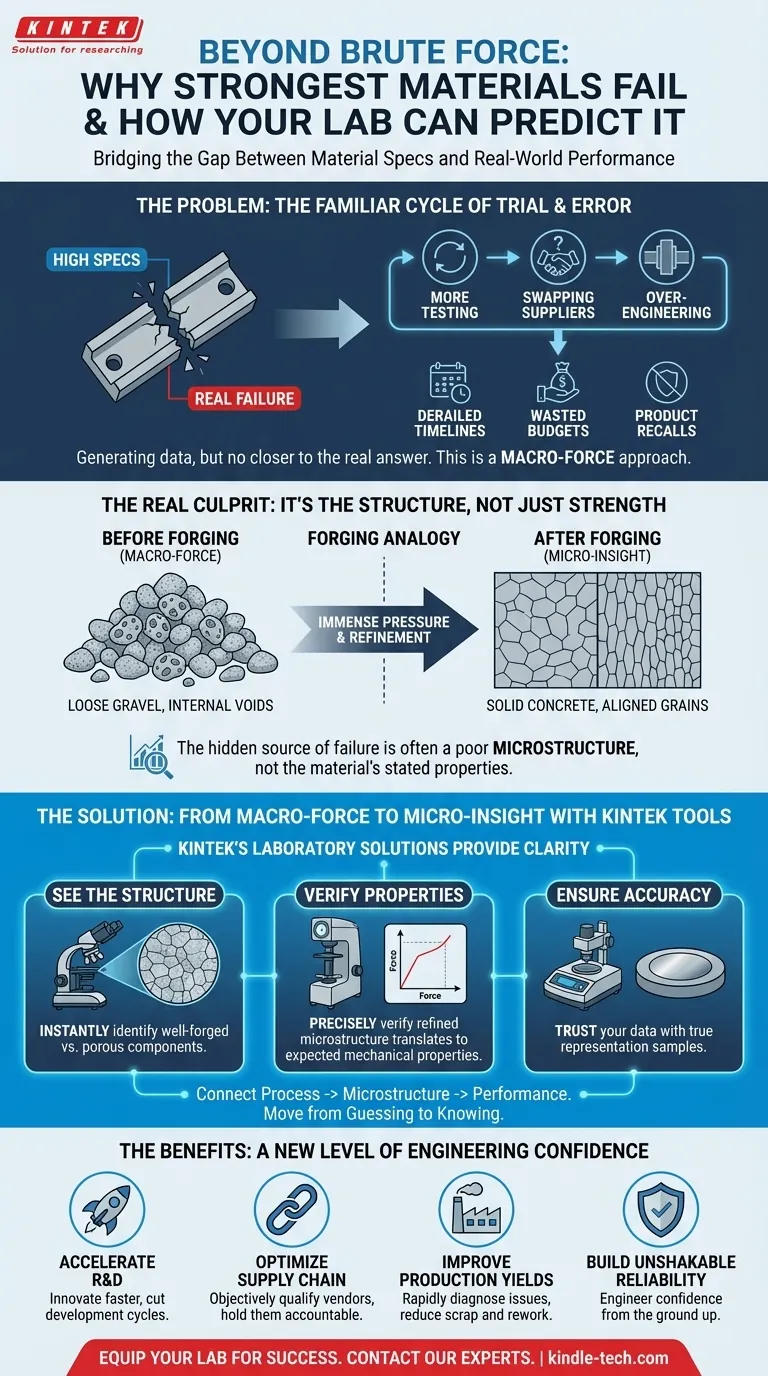
A simple diagram showing loose, random grain structure on one side and a dense, aligned grain structure on the other side, labeled 'Before Forging' and 'After Forging'.

This is the hidden source of failure. A component made from a cast or poorly processed material might have the right chemical composition, but its internal structure is like that loose gravel. It's riddled with microscopic weaknesses waiting for the right stress to cause a fracture.

This is why the common solutions fail. Running more tensile tests on a material with a poor microstructure is like repeatedly testing the strength of a badly made concrete block. You're just documenting the problem, not understanding its source.

From Macro-Force to Micro-Insight: The Right Tool for the Job

You don't need an 80,000-ton press in your facility. What you need are the tools to see and verify the results of processes like forging, heat-treating, and casting at a microscopic level. To truly solve the problem of unpredictable material failure, you must be able to connect the manufacturing process to the resulting microstructure and, finally, to the component's real-world performance.

This is where KINTEK's laboratory solutions become indispensable. Our equipment is not just about testing; it's about providing clarity.

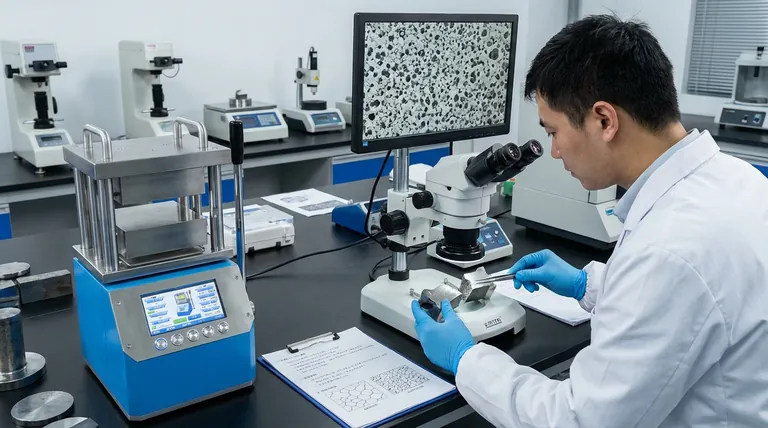
  • Metallurgical Microscopes let you see the grain structure with your own eyes. You can instantly tell a well-forged, reliable component from a porous, brittle one.
  • Hardness Testers and Tensile Testers allow you to precisely verify that the refined microstructure has translated into the expected mechanical properties across the entire component.
  • Sample Preparation Equipment ensures that what you see and test is a true representation of the material, giving you data you can trust.

Our instruments are designed based on a deep understanding of this principle: that true material quality is determined at the micro-level. They are the essential link that lets you move from guessing to knowing.

Beyond Pass/Fail: A New Level of Engineering Confidence

When you stop chasing inconsistent test results and start analyzing the fundamental structure of your materials, everything changes. The "old problem" of unexplained failures is replaced by a new world of potential.

With the ability to quickly and reliably analyze material microstructure, you can:

  • Accelerate R&D: Innovate faster by immediately seeing how process changes impact material quality, cutting down development cycles from months to weeks.
  • Optimize Your Supply Chain: Objectively qualify vendors and hold them accountable for providing consistently high-quality materials, not just spec sheets.
  • Improve Production Yields: Rapidly diagnose production-line issues related to heat treatment or forming, reducing scrap and rework.
  • Build Unshakable Reliability: Engineer confidence into your products from the ground up, knowing that every component is structurally sound for the most demanding applications.

You gain control over the very foundation of your product's quality.

This deeper understanding transforms your lab from a simple quality checkpoint into a strategic engine for innovation and reliability. If you're ready to move beyond documenting failures and start engineering success, our team is here to help you equip your lab with the right tools for the job. Let's discuss your specific material challenges and how a micro-level perspective can solve your macro-level problems. Contact Our Experts.

Visual Guide
Beyond Brute Force: Why the Strongest Materials Fail and How Your Lab Can Predict It Visual Guide

Related Products

Related Articles

Related Products

Heated Hydraulic Press Machine with Integrated Manual Heated Plates for Lab Use

Heated Hydraulic Press Machine with Integrated Manual Heated Plates for Lab Use

Efficiently process heat-pressing samples with our Integrated Manual Heated Lab Press. With a heating range up to 500°C, it's perfect for various industries.

Manual Heated Hydraulic Press Machine with Heated Plates for Laboratory Hot Press

Manual Heated Hydraulic Press Machine with Heated Plates for Laboratory Hot Press

The Manual Heat Press is a versatile piece of equipment suitable for a variety of applications, operated by a manual hydraulic system that applies controlled pressure and heat to the material placed on the piston.

Automatic Heated Hydraulic Press Machine with Heated Plates for Laboratory Hot Press 25T 30T 50T

Automatic Heated Hydraulic Press Machine with Heated Plates for Laboratory Hot Press 25T 30T 50T

Efficiently prepare your samples with our Automatic Heated Lab Press. With a pressure range up to 50T and precise control, it's perfect for various industries.

Manual High Temperature Heated Hydraulic Press Machine with Heated Plates for Lab

Manual High Temperature Heated Hydraulic Press Machine with Heated Plates for Lab

The High Temperature Hot Press is a machine specifically designed for pressing, sintering and processing materials in a high temperature environment. It is capable of operating in the range of hundreds of degrees Celsius to thousands of degrees Celsius for a variety of high temperature process requirements.

Double Plate Heating Press Mold for Lab

Double Plate Heating Press Mold for Lab

Discover precision in heating with our Double Plate Heating Mold, featuring high-quality steel and uniform temperature control for efficient lab processes. Ideal for various thermal applications.

Touchscreen Automatic Vacuum Heat Press

Touchscreen Automatic Vacuum Heat Press

Precision vacuum heat press for labs: 800°C, 5-ton pressure, 0.1MPa vacuum. Ideal for composites, solar cells, aerospace.

Warm Isostatic Press WIP Workstation 300Mpa for High Pressure Applications

Warm Isostatic Press WIP Workstation 300Mpa for High Pressure Applications

Discover Warm Isostatic Pressing (WIP) - A cutting-edge technology that enables uniform pressure to shape and press powdered products at a precise temperature. Ideal for complex parts and components in manufacturing.

Metallographic Specimen Mounting Machine for Laboratory Materials and Analysis

Metallographic Specimen Mounting Machine for Laboratory Materials and Analysis

Precision metallographic mounting machines for labs—automated, versatile, and efficient. Ideal for sample prep in research and quality control. Contact KINTEK today!

Rubber Vulcanizer Vulcanizing Machine Plate Vulcanizing Press for Lab

Rubber Vulcanizer Vulcanizing Machine Plate Vulcanizing Press for Lab

The Plate vulcanizing press is a kind of equipment used in the production of rubber products, mainly used for the vulcanization of rubber products. Vulcanization is a key step in rubber processing.

Single Punch Electric Tablet Press Machine Laboratory Powder Tablet Punching TDP Tablet Press

Single Punch Electric Tablet Press Machine Laboratory Powder Tablet Punching TDP Tablet Press

The single-punch electric tablet press is a laboratory-scale tablet press suitable for corporate laboratories in pharmaceutical, chemical, food, metallurgical and other industries.

Single Punch Electric Tablet Press Machine TDP Tablet Punching Machine

Single Punch Electric Tablet Press Machine TDP Tablet Punching Machine

The electric tablet punching machine is a laboratory equipment designed for pressing various granular and powdery raw materials into discs and other geometric shapes. It is commonly used in pharmaceutical, healthcare products, food, and other industries for small batch production and processing. The machine is compact, lightweight, and easy to operate, making it suitable for use in clinics, schools, laboratories, and research units.

Single Punch Manual Tablet Press Machine TDP Tablet Punching Machine

Single Punch Manual Tablet Press Machine TDP Tablet Punching Machine

Single punch manual tablet punching machine can press various granular, crystal or powdery raw materials with good fluidity into disc-shaped, cylindrical, spherical, convex, concave and other various geometric shapes (such as square, triangle, ellipse, capsule shape, etc.), and can also press products with text and patterns.

Single Punch Tablet Press Machine and Mass Production Rotary Tablet Punching Machine for TDP

Single Punch Tablet Press Machine and Mass Production Rotary Tablet Punching Machine for TDP

Rotary tablet punching machine is an automatic rotating and continuous tableting machine. It is mainly used for tablet manufacturing in the pharmaceutical industry, and is also suitable for industrial sectors such as food, chemicals, batteries, electronics, ceramics, etc. to compress granular raw materials into tablets.

Laboratory Sterilizer Lab Autoclave Herbal Powder Sterilization Machine for Plant

Laboratory Sterilizer Lab Autoclave Herbal Powder Sterilization Machine for Plant

The herbal powder sterilization autoclave machine for Chinese medicine uses saturated steam for effective sterilization. It utilizes the heat and penetrative properties of steam, achieves sterilization after heat preservation, and maintains a good drying effect with a dedicated drying system.

Vacuum Hot Press Furnace Machine for Lamination and Heating

Vacuum Hot Press Furnace Machine for Lamination and Heating

Experience clean and precise lamination with Vacuum Lamination Press. Perfect for wafer bonding, thin-film transformations, and LCP lamination. Order now!

Vacuum Cold Mounting Machine for Sample Preparation

Vacuum Cold Mounting Machine for Sample Preparation

Vacuum Cold Mounting Machine for precise sample prep. Handles porous, fragile materials with -0.08MPa vacuum. Ideal for electronics, metallurgy, and failure analysis.

Desktop Fast Laboratory Autoclave Sterilizer 35L 50L 90L for Lab Use

Desktop Fast Laboratory Autoclave Sterilizer 35L 50L 90L for Lab Use

The desktop fast steam sterilizer is a compact and reliable device used for rapid sterilization of medical, pharmaceutical, and research items. It efficiently sterilizes surgical instruments, glassware, medicines, and resistant materials, making it suitable for various applications.

Laboratory Vibratory Sieve Shaker Machine for Dry and Wet Three-Dimensional Sieving

Laboratory Vibratory Sieve Shaker Machine for Dry and Wet Three-Dimensional Sieving

KT-VD200 can be used for sieving tasks of dry and wet samples in the laboratory. The screening quality is 20g-3kg. The product is designed with a unique mechanical structure and an electromagnetic vibrating body with a vibration frequency of 3000 times per minute.

High Temperature Constant Temperature Heating Circulator Water Bath Chiller Circulator for Reaction Bath

High Temperature Constant Temperature Heating Circulator Water Bath Chiller Circulator for Reaction Bath

Efficient and reliable, KinTek KHB Heating Circulator is perfect for your lab needs. With a max. heating temperature of up to 300℃, it features accurate temperature control and fast heating.

Small Injection Molding Machine for Lab Use

Small Injection Molding Machine for Lab Use

The small injection molding machinehas fast and stable movements; good controllability and repeatability, super energy saving; the product can be automatically dropped and formed; the machine body is low, convenient for feeding, easy to maintain, and no height restrictions on the installation site.


Leave Your Message