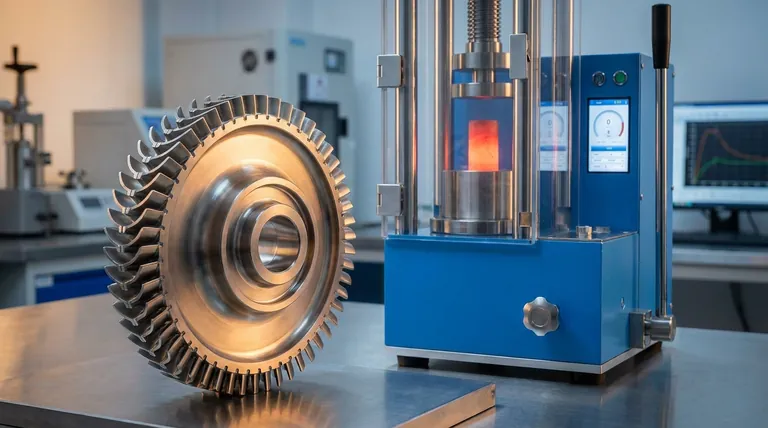
You’re looking at a newly forged component—an intricate, high-value part destined for a critical application. The process was textbook: the billet was heated perfectly, the die was immaculate, and the force applied was immense. Yet, post-production analysis reveals the grim truth: microscopic internal cracks or, worse, an incomplete fill in a crucial section of the die.
The entire component, forged from a block of expensive alloy, is now scrap. It’s not just a material loss; it's a setback that costs time, stalls projects, and casts doubt on your entire production process. If this scenario feels familiar, you’re not alone.
The Frustrating Cycle of Chasing Ghosts
When faced with forging failures like porosity, poor grain structure, or incomplete die filling, the instinctive reaction is to adjust the most obvious variables. The troubleshooting checklist is a familiar one:
- "We need more tonnage. Let's increase the force."
- "Maybe the impact isn't fast enough. Let's crank up the hammer speed."
- "Is the billet cooling too quickly? Let's increase the initial temperature."
You run the process again, tweaking these parameters in a frustrating loop. Sometimes you get a good part, but the results are inconsistent. You can't reliably reproduce the success, turning what should be a precise manufacturing science into a game of chance.
This isn't just a technical headache; it's a significant business problem. Every failed part contributes to:
- Spiraling Costs: Wasted high-performance alloys, consumed energy, and accelerated wear on expensive dies.
- Project Delays: Unpredictable output makes it impossible to meet client deadlines and production schedules reliably.
- Reputational Risk: For industries like aerospace, automotive, or defense, a single flawed component that slips through inspection can have catastrophic consequences, leading to product recalls and a loss of trust.
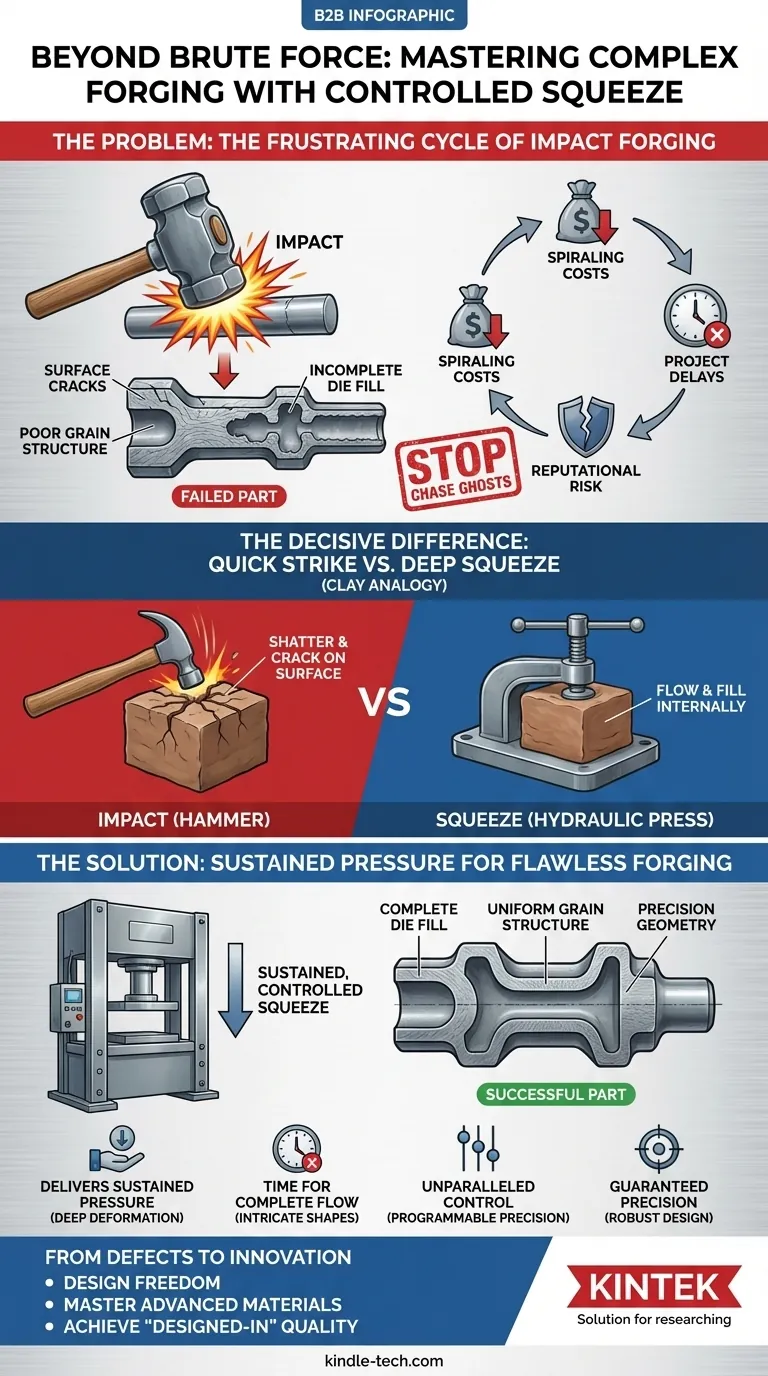
The reason these common fixes fail is simple: they are all attempts to solve the wrong problem. The issue isn't about the amount of force; it's about how that force is delivered.
The Decisive Difference: A Quick Strike vs. a Deep Squeeze
To understand the root cause of these failures, imagine working with a dense, cold lump of clay.
If you strike it with a hammer, the surface shatters and cracks. The energy is intense but brief, dissipating almost entirely on the outside. The interior of the clay lump remains largely untouched and un-formed. This is analogous to a forging hammer. It delivers a high-velocity impact, which is excellent for simple shapes but struggles to work the material deeply and uniformly. The metal's surface deforms, but its core may not.
Now, imagine taking that same lump of clay and placing it in a vise. As you slowly turn the handle, you apply a constant, growing squeeze. The clay doesn't crack; it begins to flow, deforming from the inside out until it perfectly fills the space you’ve constrained it to.
This is the fundamental principle of a hydraulic press. It doesn't strike; it squeezes.
By applying sustained, controlled pressure throughout its entire stroke, a hydraulic press gives the hot metal what it truly needs: time to flow. This continuous force penetrates deep into the workpiece, allowing the material's internal grain structure to realign uniformly. The metal behaves less like a solid being hammered and more like a viscous fluid being guided into every intricate detail of a mold.
This is why simply adding more hammer force often makes things worse—you're just hitting the "clay" harder, causing more surface-level stress without solving the core problem of incomplete internal deformation.
The Right Tool for a Controlled Squeeze
To move beyond the limitations of impact forging, you don’t need a stronger hammer; you need a tool specifically engineered to deliver that deep, controlled squeeze. This is precisely what a modern hydraulic forging press is designed to do. It is the physical embodiment of the solution to this fundamental problem.
A KINTEK hydraulic press isn't just a machine that applies force. It's an advanced system designed from the ground up to master the forging process:
- It Delivers Sustained Pressure, Not Just Impact: Our presses are built to apply full, constant tonnage throughout the stroke. This directly counteracts the root cause of poor internal structure by ensuring the material deforms deeply and uniformly, from core to surface.
- It Provides Time for Complete Die Fill: For complex geometries, the slow, powerful squeeze gives the metal ample time to flow into every sharp corner and intricate cavity of the die, eliminating the risk of incomplete parts.
- It Offers Unparalleled Control: Modern forging is about precision, not just power. Our presses integrate advanced PLC systems that allow you to precisely program and control every variable—pressure, speed, and dwell time. This transforms forging from a trial-and-error process into a repeatable science, giving your engineers ultimate control over the final metallurgical properties.
- It Guarantees Precision Under Load: The immense forces involved in forging can cause machine deflection, leading to die misalignment and inaccurate parts. Our presses utilize robust designs, like eight-point slide guide systems, to ensure perfect parallelism even under tens of thousands of tons of force, guaranteeing your part's dimensional accuracy.
From Fighting Defects to Engineering New Possibilities
When you stop fighting the symptoms of a flawed process and address the root cause, you unlock a new level of manufacturing potential. With the controlled power of a hydraulic press, the focus shifts from damage control to innovation.
Suddenly, your team can:
- Design with Greater Freedom: Engineers are no longer constrained by the limitations of impact forging. They can confidently design more complex, lightweight, and stronger components, knowing the manufacturing process can deliver them flawlessly.
- Master Advanced Materials: You can expand your capabilities to include next-generation alloys that are notoriously difficult to forge, as they require the exact thermal and pressure management that a hydraulic press provides.
- Achieve "Designed-In" Quality: Instead of relying on extensive post-production inspection to find defects, you build quality into the process itself, driving toward a zero-defect production environment. This isn't just an improvement; it's a competitive advantage that wins high-stakes contracts.
Solving your forging inconsistencies isn't about working harder; it's about working smarter with the right principles and the right tools. If you're ready to move beyond brute force and achieve total control over your most demanding forging projects, our team is here to help you design the right solution. Let's discuss the specific challenges you face and explore how the right press technology can transform your capabilities. Contact Our Experts.
Visual Guide