The Illusion of "Real Wood"
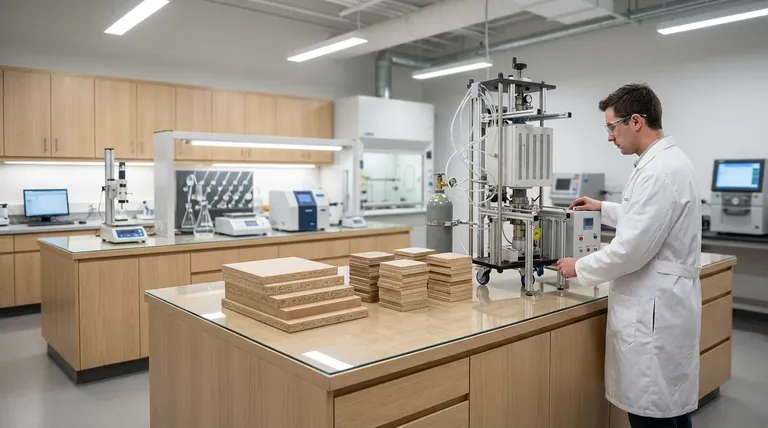
Walk into a modern laboratory. Notice the seamless cabinet faces, the perfectly flat benchtops, the large, unblemished panels that form the workstations. Everything feels precise, stable, and clean. We instinctively associate these qualities with high-tech polymers or metals.
The truth is often more surprising. The foundation of this controlled environment is frequently a material we might dismiss in other contexts: engineered wood.
We have a deep-seated psychological bias for things that are "solid" and "natural." We prize a solid oak table for its character—its knots, its grain, its imperfections. But in an environment where precision is paramount, that character becomes a liability. The romance of engineering isn't about mimicking nature; it's about transcending its limitations.
The Alchemy of Heat and Pressure
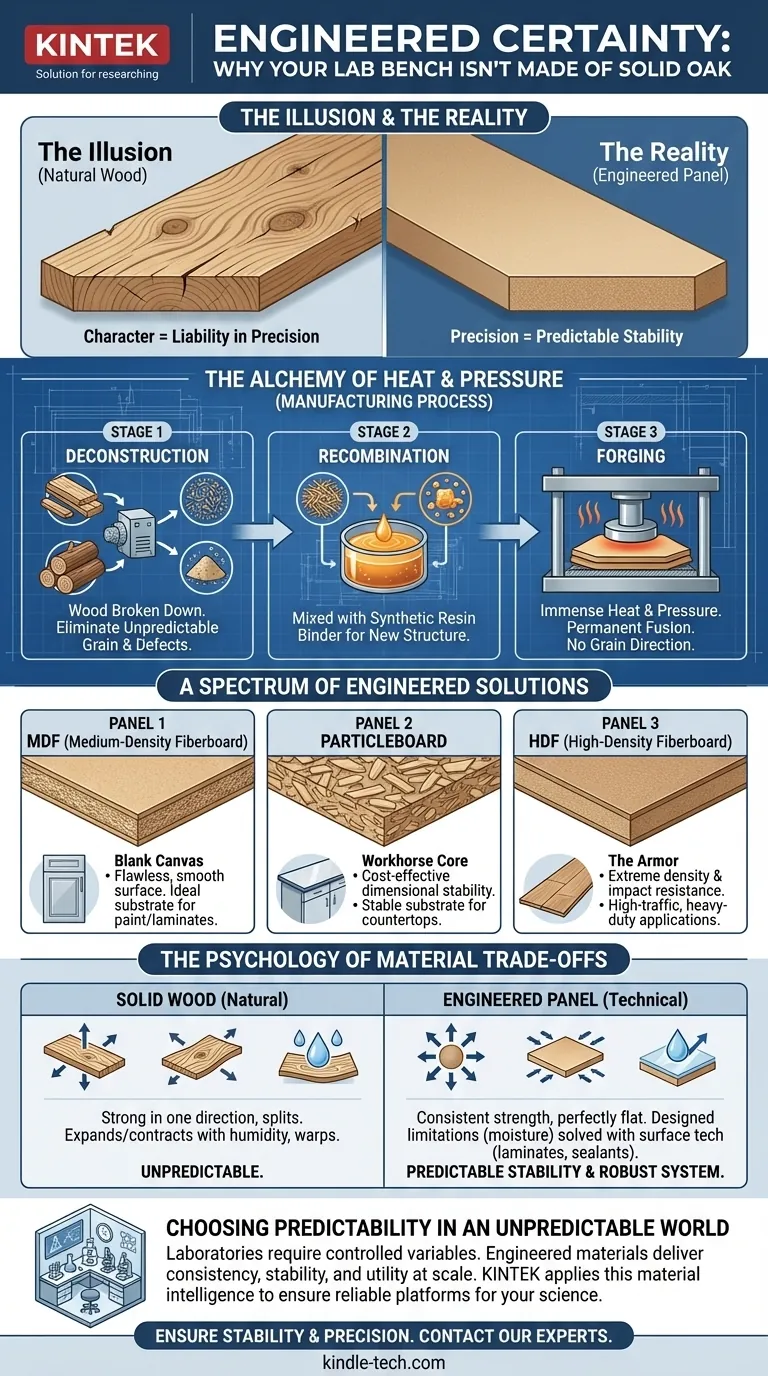
"Hot pressed board" is not a product. It's a philosophy of manufacturing. It describes the process of taking the chaotic byproducts of the timber industry—wood fibers, chips, and dust—and transforming them into something with absolute predictability.
The process is a form of industrial alchemy:
-
Deconstruction: Wood is broken down into its constituent elements. The unpredictable grain and potential for defects are eliminated from the start.
-
Recombination: These elements are mixed with a synthetic resin, a powerful binder that will become the new internal structure of the material.
-
Forging: The mixture is laid into a mat and subjected to immense heat and pressure inside a hydraulic press. This step is not just about compaction; it's about creating a permanent, monolithic fusion of wood and resin.
The result is a panel that is perfectly uniform. It has no grain direction to fight against, no hidden knots waiting to compromise its integrity, and no tendency to warp or twist with humidity. It is a blank slate, engineered for certainty.
A Spectrum of Engineered Solutions
This single process gives rise to a family of materials, each optimized for a different task. Understanding them is like a craftsman knowing the difference between a chisel and a gouge.
-
MDF (Medium-Density Fiberboard): The Blank Canvas
Made from incredibly fine wood fibers, MDF has a surface so smooth and dense it feels almost like a solid surface. Its uniformity makes it the ideal substrate for painted or laminated finishes, ensuring a flawless, easily sanitized surface for cabinet doors and lab furniture.
-
Particleboard: The Workhorse Core
Composed of larger wood chips, particleboard is the unseen hero of cost-effective construction. It serves as the stable, lightweight core for laminate countertops and ready-to-assemble furniture, providing dimensional stability where the surface layer provides durability and aesthetics.
-
HDF (High-Density Fiberboard): The Armor
As the name implies, HDF is MDF compressed to an even greater density. The result is a material with exceptional hardness and resistance to impact and moisture. This is why it forms the core of high-quality laminate flooring, designed to withstand years of heavy traffic.
| Type | Core Strength | Primary Application in a Precision Setting |
|---|---|---|
| MDF | Flawless, non-porous surface | Painted cabinet doors, panels, trim |
| Particleboard | Cost-effective dimensional stability | Substrate for laminate benchtops and shelving |
| HDF | Extreme density and impact resistance | High-traffic flooring, durable work surfaces |
The Psychology of Material Trade-offs
Choosing an engineered board over solid wood isn't a compromise; it's a strategic decision based on a clear understanding of priorities.
Certainty Over Raw Strength
Solid wood is incredibly strong along its grain, but it splits. It expands and contracts with humidity, causing surfaces to warp. An engineered panel has lower absolute strength, but it is consistent in every direction. For a large lab bench that must remain perfectly flat to prevent instruments from rocking or samples from spilling, this predictable stability is far more valuable than the brute force of oak.
Designed Limitations
Standard engineered woods are highly susceptible to moisture. This isn't a flaw; it's a known boundary condition. Engineers don't see this as a failure but as a problem to be solved with surface technology—laminates, veneers, and chemical-resistant sealants that protect the stable core. The system as a whole becomes robust.
In essence, you are trading the romantic, unpredictable nature of a natural material for the quiet, reliable performance of an engineered one.
Choosing Predictability in an Unpredictable World
A laboratory is a place dedicated to controlling variables. The pursuit of discovery depends on creating an environment where the only surprises are the ones you're looking for. The materials used to build that environment must reflect the same ethos.
Hot pressed boards represent a triumph of this philosophy. They are a solution designed specifically to deliver consistency, stability, and utility at scale. At KINTEK, we apply this same material intelligence to our laboratory equipment and consumables, ensuring that the platforms supporting your work are as reliable as the science you conduct on them.
For applications where material integrity and performance are non-negotiable, a deep understanding of these engineered solutions is key. To ensure your laboratory is built on a foundation of stability and precision, Contact Our Experts.
Visual Guide