The Illusion of a Simple Choice
An engineer holds two metal parts. They look identical—same shape, same finish. But one shatters with a sharp tap, while the other withstands immense stress.
They were made from the same metal powder. The difference was not the material, but the philosophy of its creation. One was formed with pressure alone; the other was forged with pressure and intense heat.
This is the core of the hot press versus cold press debate. It’s not about a thermostat setting. It’s a fundamental decision about the role of energy in transforming matter.
The Physics of Transformation: Heat as an Active Agent
The distinction is simple but profound.
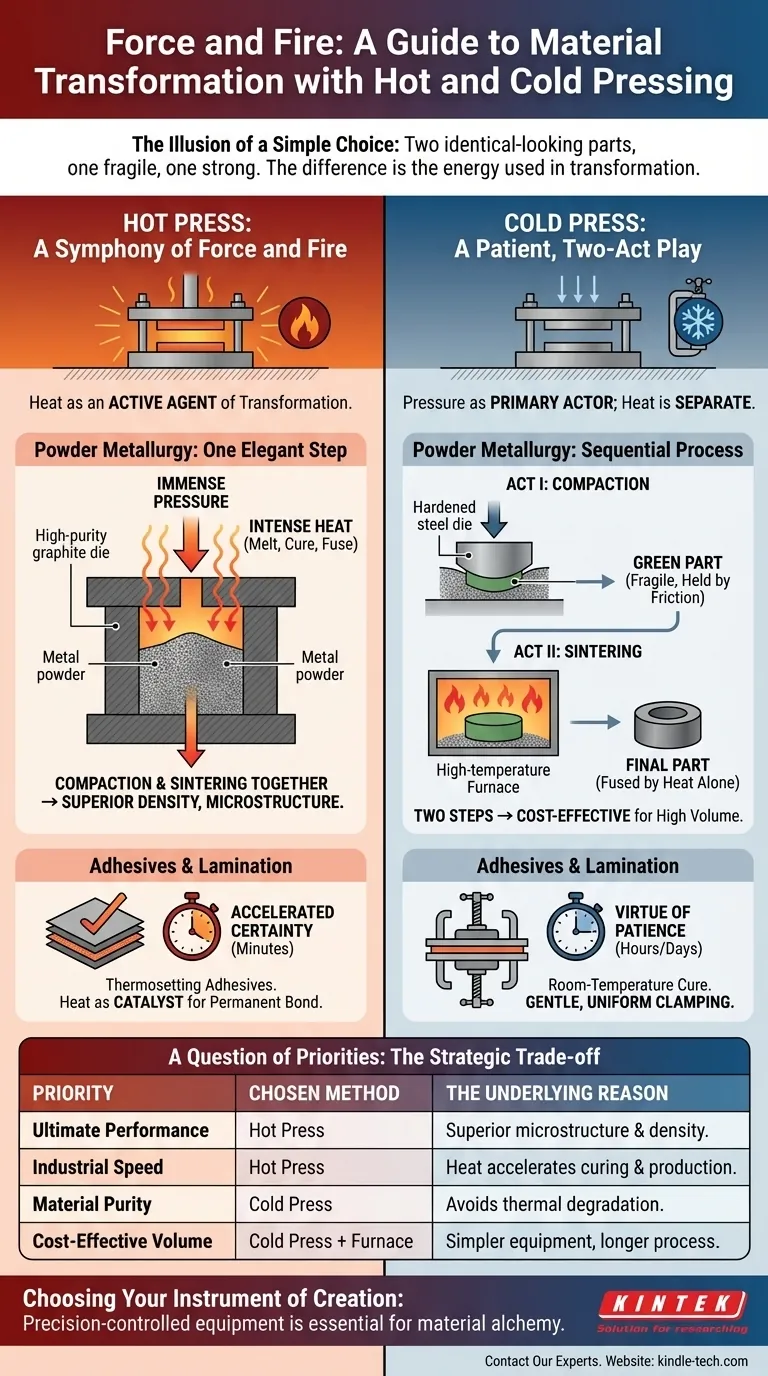
In a cold press, pressure is the primary actor. It compacts, shapes, and holds. Its job is to impose a new form on a material at room temperature. Any subsequent heating is a separate, later event.
In a hot press, heat is not a background condition; it is an active agent of transformation. It works in concert with pressure to melt, cure, or fuse particles together, creating a new material structure from the inside out.
Think of it like a blacksmith. Cold pressing is hammering a piece of cool iron into shape. Hot pressing is heating the iron in the forge until it glows, then hammering it—a process that doesn't just reshape the metal, but fundamentally changes its internal properties.
The Crucible of Creation: Powder Metallurgy
Nowhere is this distinction more critical than in turning fine powder into a dense, solid component for advanced applications. The goal is to eliminate the space between the grains, creating a single, monolithic part.
The Hot Press Approach: A Symphony of Force and Fire
A hot press performs a kind of industrial alchemy. It takes a container—often a high-purity graphite die capable of withstanding extreme temperatures—fills it with metal or ceramic powder, and then applies immense pressure and heat simultaneously.
This is a single, elegant step that combines two processes:
- Compaction: Squeezing the powder to reduce volume.
- Sintering: Fusing the particles into a solid mass.
By doing both at once, the heat helps the particles deform and bond more effectively under pressure, often resulting in a final part with superior density and mechanical strength.
The Cold Press Method: A Patient, Two-Act Play
The cold press approach is a sequential process.
Act I: Compaction. A hardened steel die presses the powder into a precisely shaped object. This is called a "green" part. It has the correct form but is fragile, held together by mechanical friction alone.
Act II: Sintering. The "green" part is carefully moved to a separate high-temperature furnace. Here, heat alone works to fuse the particles together, giving the part its final strength.
This two-step method can be more cost-effective for high-volume production, but it introduces more handling and may not achieve the same ultimate density as hot pressing.
The Bond of Industry: Adhesives and Lamination
The same principles apply when bonding layers, like in furniture or composite manufacturing. The goal is not to form a solid from dust, but to create an unbreakable bond between surfaces.
Accelerated Certainty with Heat
A hot press is used for thermosetting adhesives. These are resins that require heat to trigger a chemical cross-linking reaction, creating a permanent, rigid, and often waterproof bond.
Here, the heat isn’t just for speed. It is the catalyst that enables the bond to form. The result is a dramatically shorter production cycle—minutes instead of hours—which is essential for industrial throughput.
The Virtue of Patience with Pressure
A cold press is essentially a giant, perfectly uniform clamp. It is used with adhesives that cure at room temperature. Its only job is to apply consistent pressure, holding the parts immobile while the glue sets naturally over time.
This process is simpler and gentler, making it ideal for materials that might be damaged by the high temperatures of a hot press.
A Question of Priorities: The Psychology of the Trade-off
Choosing between these methods is less a technical decision than a strategic one. It requires balancing competing priorities of performance, speed, and cost. Your choice reveals what you value most in your process.
| Priority | Chosen Method | The Underlying Reason |
|---|---|---|
| Ultimate Performance | Hot Press | Simultaneous heat and pressure create a superior microstructure and density. |
| Industrial Speed | Hot Press | Heat acts as a catalyst, dramatically accelerating curing and production cycles. |
| Material Purity | Cold Press | The gentle process avoids thermal degradation of heat-sensitive materials. |
| Cost-Effective Volume | Cold Press + Furnace | The equipment for each step is simpler, though the overall process is longer. |
Choosing Your Instrument of Creation
The right machine is an extension of your ambition.
Are you pioneering a new ceramic composite where maximum density is non-negotiable? You need the transformative synergy of a laboratory hot press. Are you developing a process for a delicate biological sample? The firm, gentle force of a cold press is your ally.
The success of these ambitions relies on precision-controlled equipment. A laboratory press from a specialist like KINTEK isn't just a heater and a piston; it's a controlled environment for material alchemy. It provides the repeatable, accurate application of force and fire needed to turn raw materials into breakthrough discoveries.
Understanding the fundamental difference between these methods is the first step. The next is choosing the right instrument to bring your vision to life. If you are navigating these choices for your laboratory or production line, Contact Our Experts.
Visual Guide