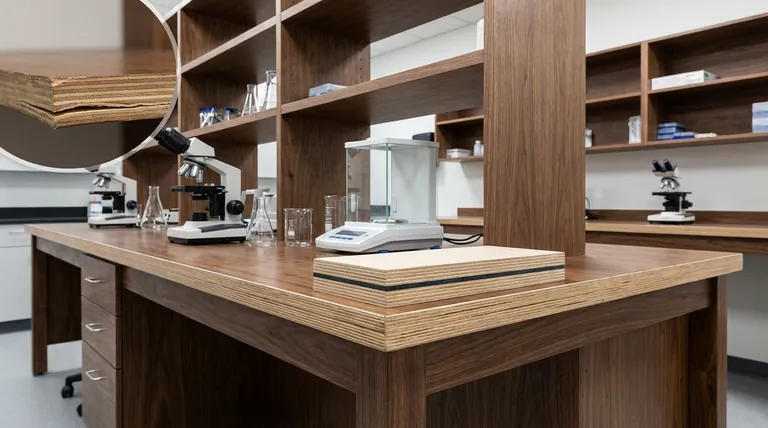
It’s a frustratingly common story. You’ve just invested time and budget into creating custom workbenches or shelving for your laboratory. For the first few months, they look perfect—sturdy, clean, and professional. Then, you start to notice it. An edge begins to swell. A surface starts to bubble. Before you know it, the layers are peeling apart like a soggy book, compromising the structural integrity of a once-perfect build.
You thought you chose a quality material. What went wrong?
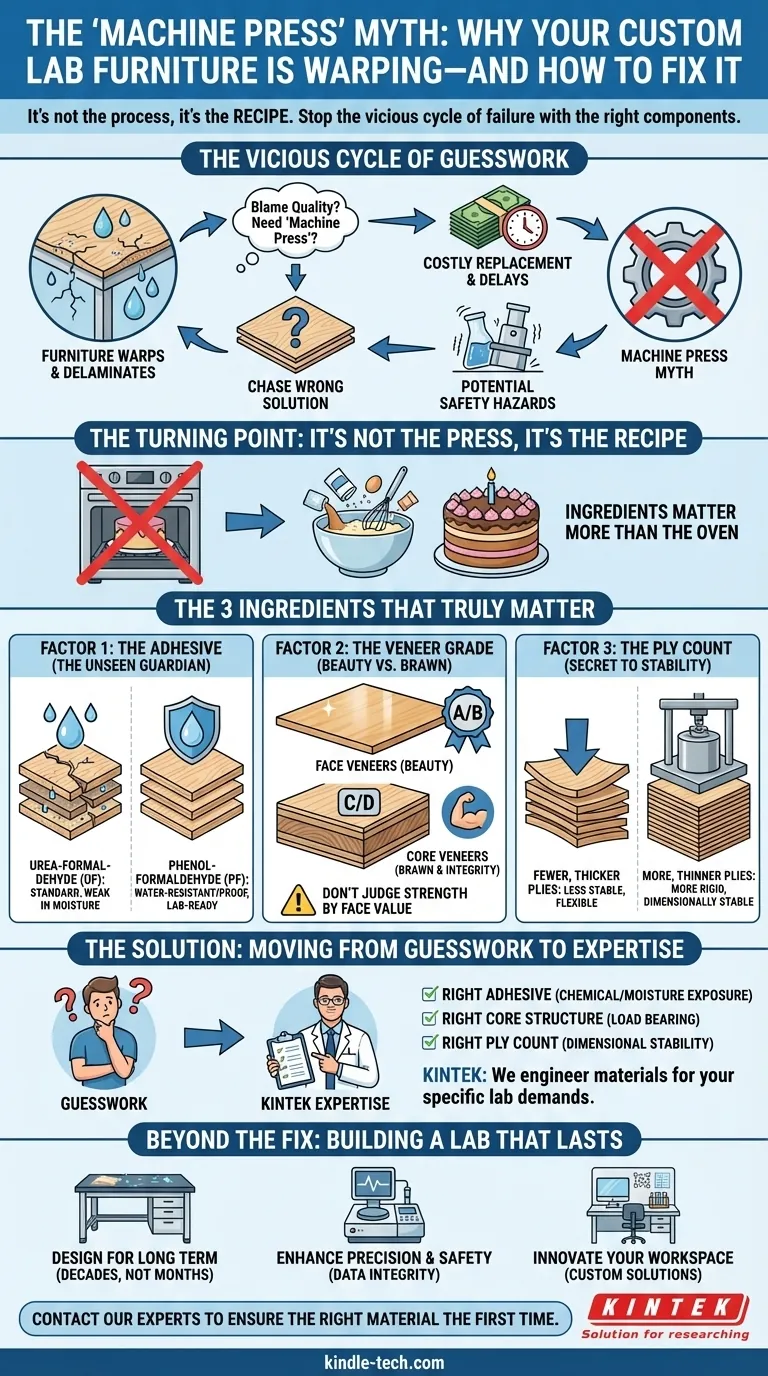
The Vicious Cycle of Chasing the Wrong Solution
When faced with warping or delaminating plywood, the first instinct is often to blame the general quality. "It must have been cheap plywood," you think. So, for the next project, you go back to the supplier and ask for something "better," often using a term you've heard associated with quality: "machine press plywood."
This is the start of a costly cycle of guesswork. Here’s how it typically unfolds:
- The Failed "Fix": You build the replacement, perhaps with a thicker or more expensive panel, only to see the same failure occur six months later.
- The Business Cost: Each failure means more than just wasted material. It means project delays, budget overruns for replacements, and potential safety hazards from unstable lab furniture. A wobbly shelf holding sensitive glassware or expensive equipment is a risk no lab can afford.
- The Lingering Frustration: The core problem remains unsolved, creating a constant, low-level anxiety about the reliability of your lab's infrastructure.
This cycle continues because the focus is misplaced. The problem isn't that you didn't get "machine press plywood." The reality is, you almost certainly did.
The Turning Point: It’s Not the Press, It’s the Recipe
Here is the fundamental truth that changes everything: "Machine press plywood" is not a special grade of plywood; it is the standard industrial process used to make almost all modern plywood.
The term describes the how—fusing thin wood veneers with adhesive under intense heat and pressure. It’s what turns flimsy wood sheets into a strong, stable panel. Focusing on the "press" is like judging a cake by the brand of the oven it was baked in. The oven is essential, but the quality of the final product is determined by the ingredients.
The common "solutions" fail because they ignore the real recipe. The true culprits behind plywood failure are almost always a mismatch between the material's specific components and the demands of its environment. Let's look at the three ingredients that truly matter.
Factor 1: The Adhesive — The Unseen Guardian Against Moisture
This is the single most common cause of failure in a lab setting. Plywood adhesives come in two main types:
- Urea-Formaldehyde (UF): Standard for interior use. It's strong in dry conditions but will break down when exposed to moisture or humidity.
- Phenol-Formaldehyde (PF): A water-resistant or waterproof adhesive used for exterior and marine-grade plywood.
A lab environment—with its potential for spills, cleaning protocols, and humidity from water baths—is a hostile environment for the wrong adhesive. Using a standard interior-grade panel for a workbench is a guaranteed recipe for delamination.
Factor 2: The Veneer Grade — The Difference Between Beauty and Brawn
Plywood veneers are graded like school report cards (A, B, C, D).
- Face Veneers (A/B): These are the smooth, beautiful outer layers you see. An "A" grade looks great but says nothing about the panel's strength or moisture resistance.
- Core Veneers (C/D): These are the hidden inner layers that provide the bulk of the panel's structural integrity.
A common mistake is choosing a panel with a beautiful A-grade face but an interior-grade adhesive and weak core—it looks the part but can't perform under stress.
Factor 3: The Ply Count — The Secret to Stability
For any given thickness, a panel with more, thinner plies will be more stable, more rigid, and hold screws better than a panel with fewer, thicker plies. For a heavy-duty lab bench that needs to remain perfectly flat under the weight of equipment, a 13-ply panel is vastly superior to a 7-ply panel of the same thickness.
The Solution Embodied: Moving From Guesswork to Expertise
To permanently solve this problem, you don't need a different "machine press." You need to match the plywood's recipe to your specific application. You need a method that ensures you are selecting:
- The right adhesive for your lab's moisture and chemical exposure.
- The right core structure for the structural load it will bear.
- The right ply count for the dimensional stability you require.
This is where expertise becomes the most valuable tool. At KINTEK, we function as expert advisors, not just suppliers. Our role is to ensure the materials you use are perfectly engineered for the demanding environment of a laboratory. We don't just sell consumables and equipment; we provide the foundational knowledge to make them last.
When you describe a project to us—whether it's a chemical-resistant countertop, a vibration-dampening base for a microscope, or high-capacity storage—we don't just point to a product in a catalog. We start by analyzing the underlying challenges—the "recipe"—and guide you to the material specification that directly solves them. Our value is rooted in a deep understanding of how these material properties prevent the very failures that cause so much frustration.
Beyond the Fix: Building a Lab That’s Built to Last
Once you stop worrying about your infrastructure failing, you unlock new potential. Instead of constantly reacting to maintenance issues, you can proactively build a more efficient, reliable, and specialized laboratory.
With the right materials strategy, you can confidently:
- Design for the long term: Build custom furniture and fixtures that will last for decades, not months, drastically reducing total cost of ownership.
- Enhance precision and safety: Create ultra-stable, non-warping platforms for sensitive analytical equipment, ensuring data integrity and operational safety.
- Innovate your workspace: Develop custom solutions for unique challenges, like benches with integrated chemical resistance or enclosures with specific acoustic properties, knowing the materials are engineered to succeed.
Your challenges are unique, and your laboratory's infrastructure deserves more than a guess. Our experts go beyond the catalog to understand the specific demands of your projects, from chemical exposure to load-bearing requirements. Let us help you move past the cycle of repair and build a resilient, high-performance environment from the ground up. To discuss your project and ensure you get the right material for the job, the first time, Contact Our Experts.
Visual Guide