Blog The Thermodynamics of Restraint: Precision, Entropy, and the Art of the Five-Port Cell
The Thermodynamics of Restraint: Precision, Entropy, and the Art of the Five-Port Cell

The Thermodynamics of Restraint: Precision, Entropy, and the Art of the Five-Port Cell

1 week ago

There is a seduction in laboratory hardware.

When you spend your days controlling variables on the atomic scale, you develop a natural confidence in your ability to control the macroscopic world. If you can model electron transfer, surely you can fix a water pump.

But in precision instrumentation, like the five-port water bath electrolytic cell, there is a distinct boundary between maintenance and repair.

Crossing it is often a matter of psychology, not engineering. We cross it because we confuse understanding how a machine works with the dexterity required to restore it.

Maintenance is a discipline. Repair is a surgery.

Understanding the difference protects two things: your physical safety and the integrity of your data.

The Architecture of Fragility

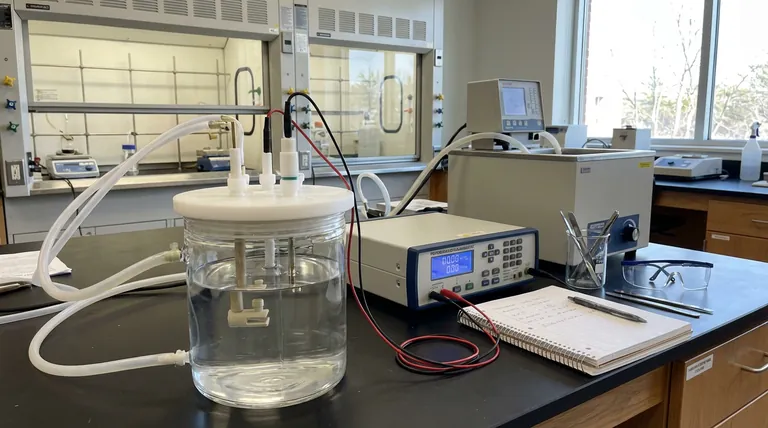
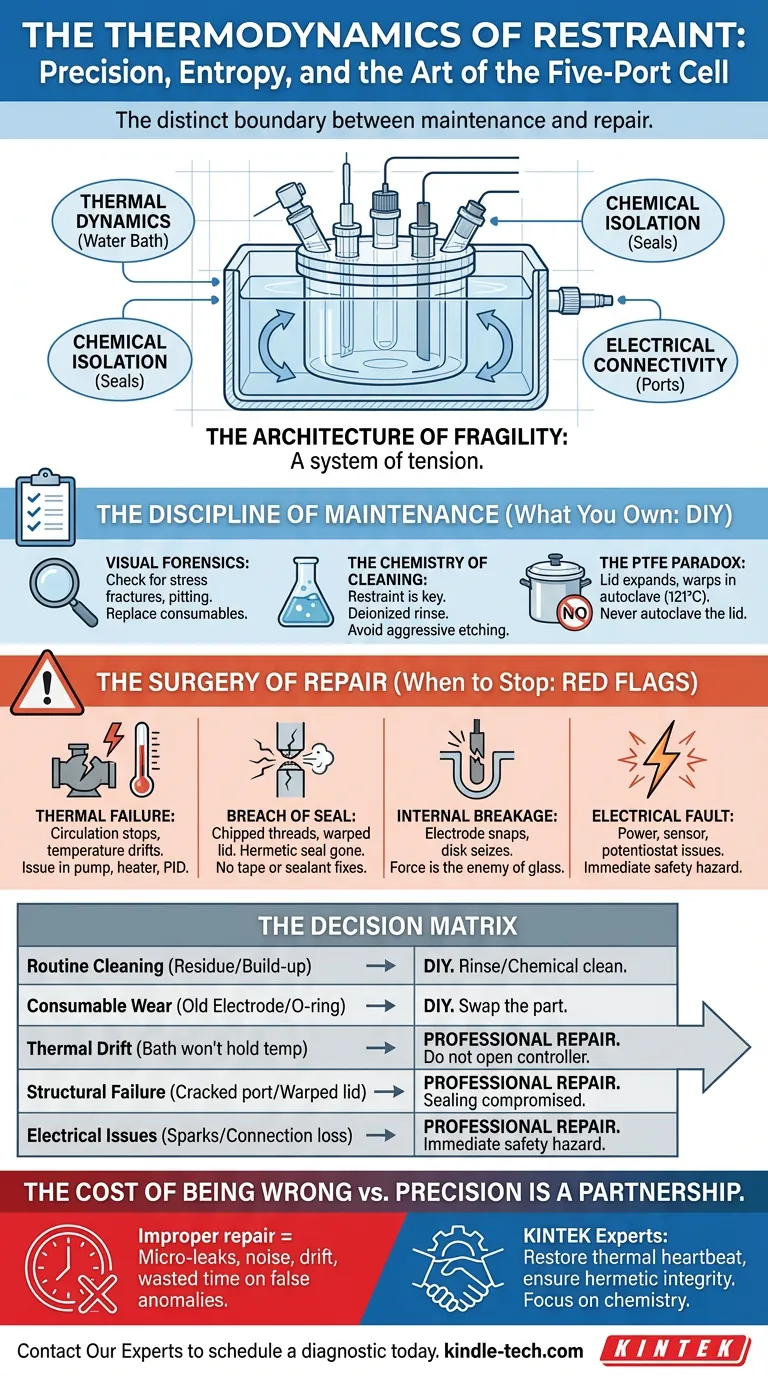
The five-port cell is a deceptive device. It looks like simple glassware, but it is actually a system of tension. It balances thermal dynamics (the water bath), chemical isolation (the seals), and electrical connectivity (the ports).

When these systems work, they are invisible. When they fail, they require a specific response.

To manage this equipment effectively, you must adopt a checklist mentality. You must separate the tasks that require diligence from the tasks that require intervention.

The Discipline of Maintenance (What You Own)

Your role is to fight entropy.

Glass chips. Residue builds up. Seals dry out. These are inevitable decays that require a routine, disciplined response.

1. Visual Forensics

Before every experiment, look at the glass. You are looking for stress fractures or chips near the ports.

Check the electrodes for pitting. If a standard electrode is damaged, replace it. This is not a repair; it is a consumables swap. It preserves the baseline of your experiment.

2. The Chemistry of Cleaning

Cleanliness is the absence of noise.

For most days, a rinse with deionized water is sufficient. When metal oxides persist, you escalate to dilute hydrochloric acid.

But here, you must exercise restraint. The concentration and duration must be exact. Too aggressive, and you etch the surface you are trying to save. Always follow with a thorough deionized rinse.

3. The PTFE Paradox

Here is a specific engineering constraint that trips up even experienced researchers.

The glass body can handle the autoclave at 121°C. The Polytetrafluoroethylene (PTFE) lid cannot.

PTFE is a remarkable material, but it has a high coefficient of thermal expansion. If you heat it, it expands. Unlike glass, it often refuses to return to its original geometry.

A warped lid is a broken seal. And a broken seal is a ruined experiment. Never autoclave the lid.

The Surgery of Repair (When to Stop)

Author Morgan Housel often writes that risk is what’s left over when you think you’ve thought of everything.

In lab equipment, risk is what happens when you attempt to fix a systemic failure with a screwdriver and optimism.

There are four specific "Red Flags" where the complexity of the problem exceeds the capacity of a generalist.

The Thermal Failure

The water bath is not a bucket; it is a dynamic thermal loop.

If the circulation stops or the temperature drifts, the issue lies deep within the pump, the heater coil, or the PID controller.

You cannot patch this. Inaccurate temperature control introduces a variable that renders your data useless. If the water stops moving, you stop working.

The Breach of Seal

The connection points are precision-engineered interfaces.

If the threads on a glass port are chipped, or the PTFE lid is warped, the hermetic seal is gone. You cannot fix this with tape or sealant. Any "fix" you invent will outgas or leak, contaminating the local atmosphere of your reaction.

The Internal Breakage

If an electrode snaps off inside a port, or a rotating disk assembly seizes, the geometry of the cell is compromised.

Force is the enemy of glass. Trying to extract a broken component often results in shattering the main vessel.

The Electrical Fault

This is the hard line.

Any issue with power, sensor integration, or the potentiostat connection is an immediate stop. The risk here shifts from "bad data" to "physical harm." Diagnostics on wet electrical circuits are for specialists only.

The Decision Matrix

To navigate these choices without emotion, use this simple heuristic:

Situation Diagnosis Action
Routine Cleaning Residue / Build-up DIY. Rinse or chemical clean.
Consumable Wear Old electrode / O-ring DIY. Swap the part.
Thermal Drift Bath won't hold temp Professional Repair. Do not open the controller.
Structural Failure Cracked port / Warped lid Professional Repair. Sealing is compromised.
Electrical Issues Sparks / Connection loss Professional Repair. Immediate safety hazard.

The Cost of Being Wrong

Why do we hesitate to call for help? Usually, it is a concern about cost or downtime.

But consider the alternative cost.

An improper repair introduces micro-leaks. These leaks may not be visible, but they appear in your results as noise, drift, or unexplainable variance. You might spend weeks chasing a scientific anomaly that is actually just a bad O-ring placement.

There is no nobility in struggling with broken tools. There is only lost time.

Precision is a Partnership

At KINTEK, we understand the "engineer's romance"—the desire to fix what is broken. But we also understand the physics of the materials we sell.

Our experts specialize in the architecture of five-port electrolytic cells. We can restore the thermal heartbeat of your water bath and ensure the hermetic integrity of your seals. We handle the complexity so you can focus on the chemistry.

If your equipment is showing signs of systemic failure, do not let your ego make the repair decision.

Contact Our Experts to schedule a professional diagnostic today.

Visual Guide
The Thermodynamics of Restraint: Precision, Entropy, and the Art of the Five-Port Cell Visual Guide

Related Products

Related Articles

Related Products

Electrolytic Electrochemical Cell with Five-Port

Electrolytic Electrochemical Cell with Five-Port

Streamline your laboratory consumables with Kintek's Electrolytic Cell with five-port design. Choose from sealed and non-sealed options with customizable electrodes. Order now.

Double Layer Five-Port Water Bath Electrolytic Electrochemical Cell

Double Layer Five-Port Water Bath Electrolytic Electrochemical Cell

Experience optimal performance with our Water Bath Electrolytic Cell. Our double-layer, five-port design boasts corrosion resistance and longevity. Customizable to fit your specific needs. View specs now.

Super Sealed Electrolytic Electrochemical Cell

Super Sealed Electrolytic Electrochemical Cell

Super-sealed electrolytic cell offers enhanced sealing capabilities, making it ideal for experiments that require high airtightness.

Customizable PEM Electrolysis Cells for Diverse Research Applications

Customizable PEM Electrolysis Cells for Diverse Research Applications

Custom PEM test cell for electrochemical research. Durable, versatile, for fuel cells & CO2 reduction. Fully customizable. Get a quote!

FS Electrochemical Hydrogen Fuel Cells for Diverse Applications

FS Electrochemical Hydrogen Fuel Cells for Diverse Applications

KINTEK's FS Electrochemical Cell: Modular PEM fuel cell stack for R&D and training. Acid-resistant, scalable, and customizable for reliable performance.

Customizable Swagelok Type Test Cells for Advanced Battery Research Electrochemical Analysis

Customizable Swagelok Type Test Cells for Advanced Battery Research Electrochemical Analysis

The KINTEK Swagelok-type test cell is a modular, T-shaped device constructed from high-quality, chemically inert materials.

Quartz Electrolytic Electrochemical Cell for Electrochemical Experiments

Quartz Electrolytic Electrochemical Cell for Electrochemical Experiments

Looking for a reliable quartz electrochemical cell? Our product boasts excellent corrosion resistance and complete specifications. With high-quality materials and good sealing, it's both safe and durable. Customize to meet your needs.

Electrolytic Electrochemical Cell Gas Diffusion Liquid Flow Reaction Cell

Electrolytic Electrochemical Cell Gas Diffusion Liquid Flow Reaction Cell

Looking for a high-quality gas diffusion electrolysis cell? Our liquid flow reaction cell boasts exceptional corrosion resistance and complete specifications, with customizable options available to suit your needs. Contact us today!

Electrolytic Electrochemical Cell for Coating Evaluation

Electrolytic Electrochemical Cell for Coating Evaluation

Looking for corrosion-resistant coating evaluation electrolytic cells for electrochemical experiments? Our cells boast complete specifications, good sealing, high-quality materials, safety, and durability. Plus, they're easily customizable to meet your needs.

PTFE Electrolytic Cell Electrochemical Cell Corrosion-Resistant Sealed and Non-Sealed

PTFE Electrolytic Cell Electrochemical Cell Corrosion-Resistant Sealed and Non-Sealed

Choose our PTFE Electrolytic Cell for reliable, corrosion-resistant performance. Customize specifications with optional sealing. Explore now.

H Type Electrolytic Cell Triple Electrochemical Cell

H Type Electrolytic Cell Triple Electrochemical Cell

Experience versatile electrochemical performance with our H-type Electrolytic Cell. Choose from membrane or non-membrane sealing, 2-3 hybrid configurations. Learn more now.

Double-Layer Water Bath Electrolytic Electrochemical Cell

Double-Layer Water Bath Electrolytic Electrochemical Cell

Discover the temperature-controllable electrolytic cell with a double-layer water bath, corrosion resistance, and customization options. Complete specifications included.

Side Window Optical Electrolytic Electrochemical Cell

Side Window Optical Electrolytic Electrochemical Cell

Experience reliable and efficient electrochemical experiments with a side window optical electrolytic cell. Boasting corrosion resistance and complete specifications, this cell is customizable and built to last.

H-Type Double-Layer Optical Electrolytic Electrochemical Cell with Water Bath

H-Type Double-Layer Optical Electrolytic Electrochemical Cell with Water Bath

Double-layer H-type optical water bath electrolytic cells, with excellent corrosion resistance and a wide range of specifications available. Customization options are also available.

Customizable CO2 Reduction Flow Cell for NRR ORR and CO2RR Research

Customizable CO2 Reduction Flow Cell for NRR ORR and CO2RR Research

The cell is meticulously crafted from high-quality materials to ensure chemical stability and experimental accuracy.

Thin-Layer Spectral Electrolysis Electrochemical Cell

Thin-Layer Spectral Electrolysis Electrochemical Cell

Discover the benefits of our thin-layer spectral electrolysis cell. Corrosion-resistant, complete specifications, and customizable for your needs.

Button Battery Disassembly and Sealing Mold for Lab Use

Button Battery Disassembly and Sealing Mold for Lab Use

The simple sealing and disassembly mold can be directly used on ordinary tablet presses, which can save costs, is convenient and fast, and can be used to encapsulate and disassemble button batteries. Other specifications can be customized.

Shaking Incubators for Diverse Laboratory Applications

Shaking Incubators for Diverse Laboratory Applications

Precision lab shaking incubators for cell culture & research. Quiet, reliable, customizable. Get expert advice today!

Flat Corrosion Electrolytic Electrochemical Cell

Flat Corrosion Electrolytic Electrochemical Cell

Discover our flat corrosion electrolytic cell for electrochemical experiments. With exceptional corrosion resistance and complete specifications, our cell guarantees optimal performance. Our high-quality materials and good sealing ensure a safe and durable product, and customization options are available.

Warm Isostatic Press WIP Workstation 300Mpa for High Pressure Applications

Warm Isostatic Press WIP Workstation 300Mpa for High Pressure Applications

Discover Warm Isostatic Pressing (WIP) - A cutting-edge technology that enables uniform pressure to shape and press powdered products at a precise temperature. Ideal for complex parts and components in manufacturing.


Leave Your Message