The Engineer's Dilemma: A Universe of Tiny Gaps
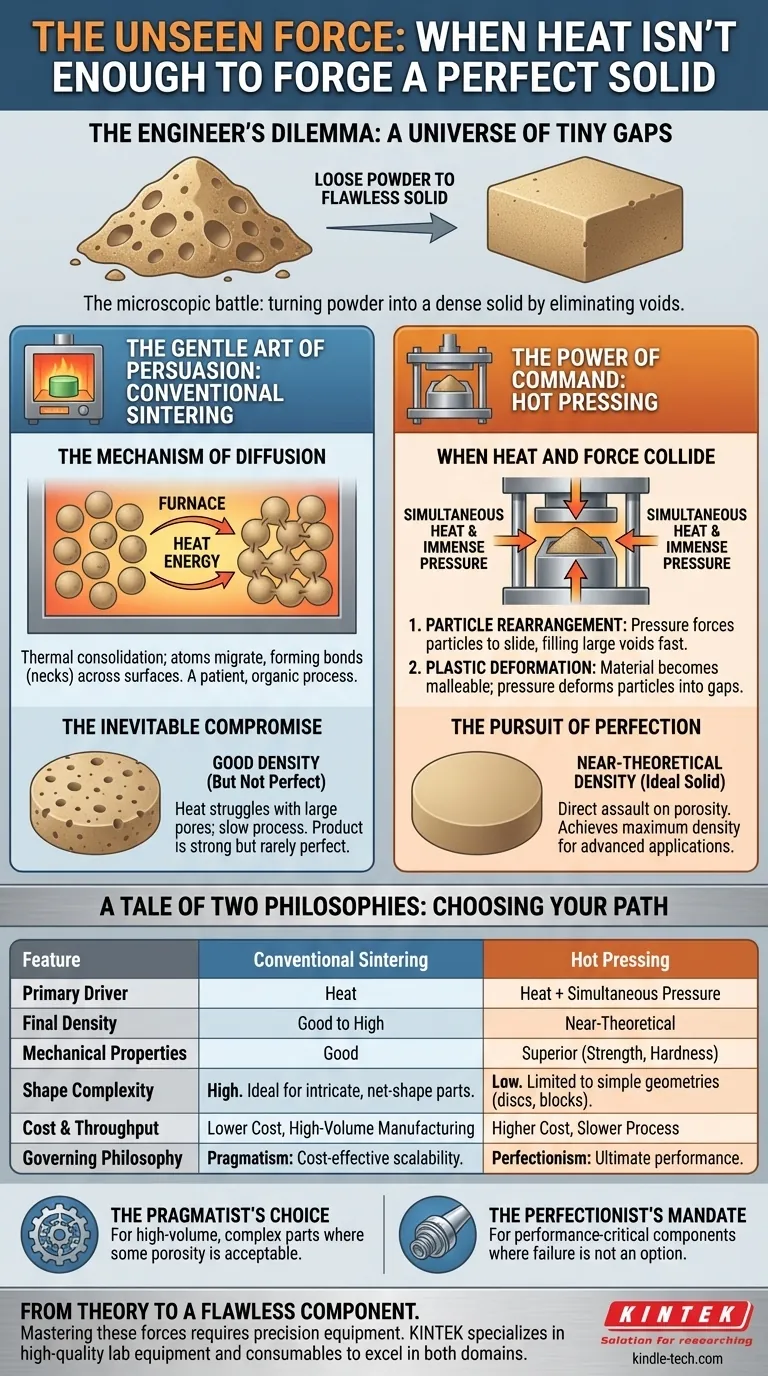
Imagine trying to build a perfectly solid wall from a pile of sand. You can heat it, hoping the grains fuse together, but tiny pockets of air—voids—will inevitably remain. This is the microscopic battle every materials engineer faces: turning a loose powder into a dense, flawless solid.
The first and most fundamental tool in this battle is heat. It energizes the atoms, persuading them to link arms across particle boundaries. This is the essence of sintering.
But sometimes, persuasion isn't enough. You need force. You need to physically compel the particles together, eliminating those last stubborn voids. This is the world of hot pressing.
The distinction seems subtle, but it's profound. All hot pressing is a form of sintering, but not all sintering is hot pressing. The difference lies in the deliberate application of an unseen, powerful force: pressure.
The Gentle Art of Persuasion: Conventional Sintering
Conventional, or "pressureless," sintering is a process of thermal consolidation. A powder is first pressed into a shape at room temperature, creating what's known as a "green" part. This part is fragile, held together only by friction.
The Mechanism of Diffusion
Inside a furnace, heat works its magic. It doesn't melt the material but excites the atoms enough that they begin to move, migrating across particle surfaces. This atomic diffusion builds solid "necks" where particles touch, slowly pulling them together and shrinking the voids between them. It's a patient, organic process of bonding.
The Inevitable Compromise
Yet, heat alone can be inefficient. It struggles to close the largest pores, and the process can be slow. The final product is strong and dense, but rarely perfect. For many applications, this is more than sufficient. But for the most demanding environments, every lingering void is a potential point of failure.
The Power of Command: Hot Pressing
Hot pressing is what happens when you refuse to compromise. It takes the thermal energy of sintering and combines it with immense, simultaneous mechanical pressure.
When Heat and Force Collide
Inside a hot press, powder isn't just heated; it's actively squeezed within a die. This force dramatically accelerates densification in two ways:
- Particle Rearrangement: Pressure physically forces particles to slide past one another, filling large voids much faster than diffusion alone could.
- Plastic Deformation: At high temperatures, the material becomes more malleable. Pressure deforms the particles, squashing them into the remaining gaps.
The result is a direct and overwhelming assault on porosity.
The Pursuit of Perfection
This method is chosen when the goal is a material that approaches its theoretical maximum density. It’s for creating advanced ceramics, superalloys, or composite materials where internal flaws could have catastrophic consequences. It's the pursuit of an ideal solid.
A Tale of Two Philosophies: Choosing Your Path
The decision between conventional sintering and hot pressing isn't about which is "better," but about balancing competing priorities: perfection versus pragmatism.
| Feature | Conventional Sintering | Hot Pressing |
|---|---|---|
| Primary Driver | Heat | Heat + Simultaneous Pressure |
| Final Density | Good to High | Near-Theoretical |
| Mechanical Properties | Good | Superior (Strength, Hardness) |
| Shape Complexity | High. Ideal for intricate, net-shape parts. | Low. Limited to simple geometries like discs or blocks. |
| Cost & Throughput | Lower Cost, High-Volume Manufacturing | Higher Cost, Slower Process |
| Governing Philosophy | Pragmatism: Cost-effective scalability for most needs. | Perfectionism: Ultimate performance for critical parts. |
The Pragmatist's Choice: Scalability and Complexity
For high-volume production of complex parts where some porosity is acceptable, conventional sintering is the undisputed champion. It's the cost-effective workhorse of the powder metallurgy world.
The Perfectionist's Mandate: Performance Above All
For performance-critical components where failure is not an option, hot pressing is the necessary choice. It's a specialist's tool, trading geometric freedom and throughput for unparalleled density and strength.
From Theory to a Flawless Component
Mastering the creation of advanced materials requires controlling these fundamental forces. The choice between gentle persuasion and forceful command dictates the final character of your component. This requires not just knowledge, but also precision equipment capable of reliably managing extreme temperatures and pressures.
KINTEK specializes in providing the high-quality lab equipment and consumables necessary to excel in both domains. Whether your work calls for the high-throughput efficiency of a sintering furnace or the uncompromising density from a hot press, our solutions are designed to support your goals.
To turn your material concepts into perfectly consolidated reality, you need the right process and the right tools. Contact Our Experts
Visual Guide