It’s a scenario every lab manager dreads. You’re running a critical process—perhaps a high-pressure synthesis or a high-G centrifugation. Everything seems normal. Then, without warning, a component gives way. A seal breaches, a vial shatters, or a fitting deforms. Just like that, weeks of work, expensive reagents, and irreplaceable samples are lost.
You inspect the failed part. It looks identical to the one that worked perfectly last week. You ask yourself the frustrating question: "Why did it fail this time?"
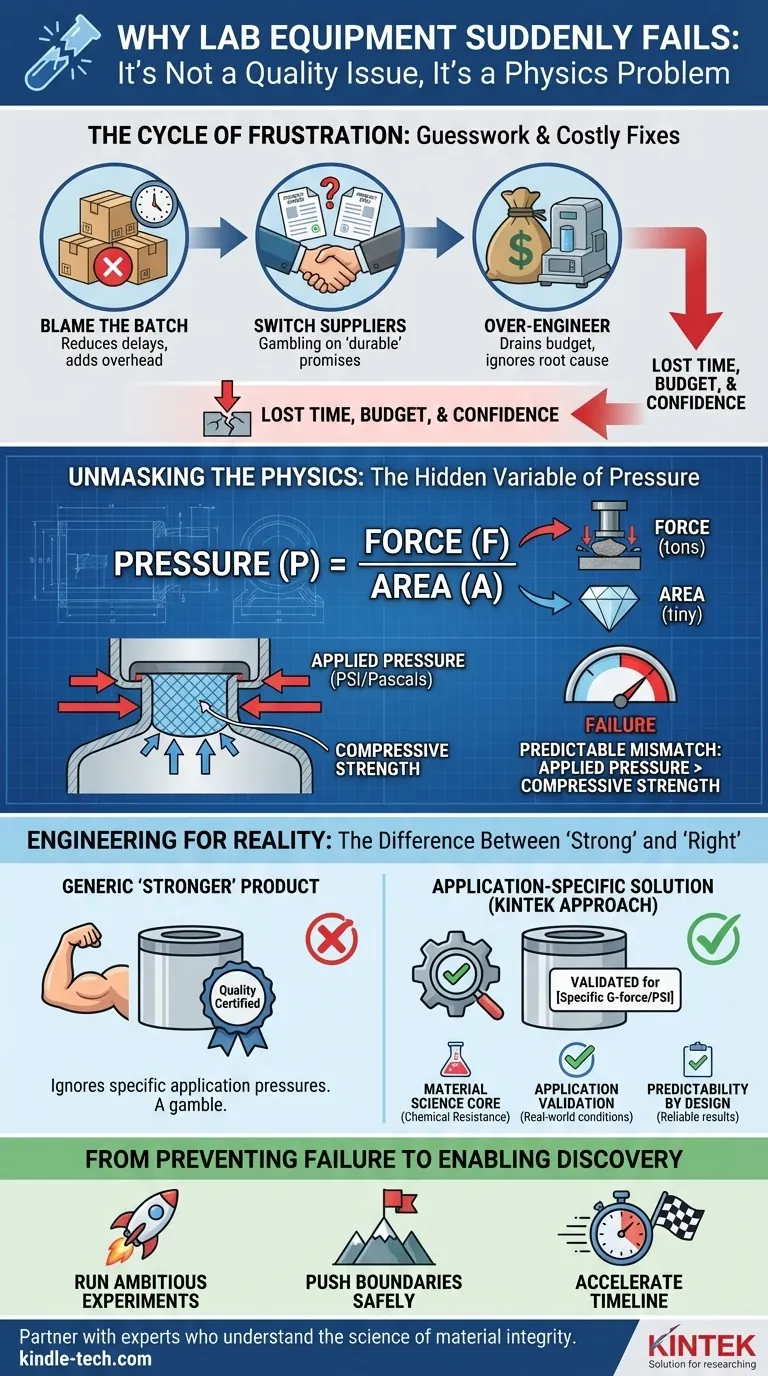
The Cycle of Frustration: Why 'Stronger' Isn't the Answer
When faced with these seemingly random failures, most labs fall into a predictable and costly pattern of troubleshooting:
- Blaming the Batch: The immediate assumption is a "bad batch" of consumables. You quarantine the remaining stock, order a new lot, and hope for the best. This introduces project delays and adds procurement overhead.
- Switching Suppliers: If the problem persists, you conclude your supplier's quality control is unreliable. You spend valuable time vetting new vendors, comparing spec sheets that all seem to promise "high quality" and "durability."
- Over-engineering the Solution: Tired of the guesswork, you decide to buy the most robust, over-specified, and expensive option on the market. This may reduce failures, but it drains your budget, applying a costly fix to a problem you don't fully understand.
The business consequences are severe. Unpredictable equipment failures lead directly to blown project timelines, spiraling costs, and, most critically, a loss of confidence in your lab's data and results. But what if these failures aren't random at all? What if they are predictable results of a physical principle most labs overlook?
The Real Culprit: Unmasking the Physics of Pressure
The common mistake is to think in terms of vague "strength" or "durability." The truth is far more precise, and it can be explained with a simple analogy: a hydraulic press.
You’ve seen videos of a hydraulic press crushing a block of steel. But you also know that a tiny diamond could likely survive the same press. Why? It’s not about which object is generically "stronger"; it's about a specific physical property: compressive strength versus applied pressure.
It's Not Force, It's Pressure: The Detail That Changes Everything
A hydraulic press generates immense force (measured in tons). But the destructive power comes from pressure, which is that force concentrated onto a specific area (Pressure = Force / Area).
This is the hidden variable behind your lab failures.
- The seal on your reactor vessel isn't just holding back a force; it's withstanding immense pressure (PSI or Pascals) generated by the contained fluids and gases.
- A centrifuge tube doesn't just spin; it endures incredible pressure as centrifugal force presses its contents against the walls.
- An HPLC fitting must maintain its integrity against the extreme pressure of the mobile phase.
The "common solutions" from the previous section fail because they ignore this crucial distinction.
- It wasn't a "bad batch." The material likely met its general quality specification, but its specific compressive strength was insufficient for the pressure of your application.
- Switching suppliers is a gamble. A new "durable" vial is useless if it's not rated for the specific pressure your experiment generates. You're just trading one unknown for another.
The failure wasn't a fluke. It was a predictable mismatch between the material’s physical limits and the operational demands you placed on it.
Engineering for Reality: The Difference Between 'Strong' and 'Right'
To permanently solve this problem, you don't need generically "stronger" equipment. You need equipment and consumables that are engineered with a precise understanding of the pressures they will face.
This is where the choice of a supplier becomes critical. You need a partner who doesn't just sell products, but understands the science behind them. A product born from this understanding isn't just a piece of hardware; it is the physical embodiment of the solution.
At KINTEK, our approach is rooted in this fundamental principle. We recognize that in a laboratory environment, "close enough" is never good enough. Our consumables and equipment are not just manufactured to a general "quality" standard; they are specified and validated based on their performance under real-world conditions.
- Material Science at the Core: We select and design materials based on their specific, measurable properties like compressive strength and chemical resistance, ensuring they match the demands of applications like high-pressure chromatography or extreme-temperature reactions.
- Application-Specific Validation: We don't just sell a "centrifuge tube." We provide a tube validated to maintain its integrity at a specific G-force, so you can run your protocols with confidence.
- Predictability by Design: By mastering the physics of failure, we build predictability into our products. The result is less uncertainty, less troubleshooting, and more reliable science.
This philosophy means you're no longer guessing. You're making an informed choice based on a clear understanding of your application's physical demands.
From Preventing Failure to Enabling Discovery
When you eliminate the fear of unpredictable equipment failure, something remarkable happens. Your lab's potential is unlocked. Resources previously wasted on troubleshooting and re-running experiments are now directed toward innovation.
With equipment you can trust, you can now:
- Run More Ambitious Experiments: Implement longer, more complex, or automated processes with the confidence that your setup will hold.
- Push the Boundaries of Your Research: Safely explore higher pressures, faster speeds, or more aggressive chemical reactions, knowing your components are the last thing you need to worry about.
- Accelerate Your Timeline to Market: Reduce rework and delays, leading to faster data acquisition, quicker insights, and a more direct path from discovery to publication or production.
Your research is too important to be derailed by a problem that physics has already solved. By partnering with an expert who understands the science of material integrity, you can move past the cycle of failure and focus on what truly matters: your next breakthrough. Let us help you ensure that the only limits on your research are the boundaries of human knowledge, not the physical limits of your equipment.
Your work demands precision and reliability. Let's discuss how our application-specific solutions can bring a new level of predictability and safety to your most critical projects. Contact Our Experts to share the challenges you're facing, and we'll help you engineer a more robust solution.
Visual Guide