
Cold working encompasses a range of manufacturing processes designed to shape metal without using heat. The most common examples include cold rolling, drawing, bending, shearing, and cold extrusion, all of which are performed below the metal's recrystallization temperature to fundamentally change its mechanical properties.
The core purpose of cold working is not just to shape a part, but to deliberately increase its strength and hardness through a process called strain hardening. This method yields superior dimensional accuracy and surface finish compared to hot working, making it essential for producing high-performance, precision components.
The Fundamental Principle: What Defines Cold Working?
Cold working is a process of plastic deformation. To understand the examples, you must first understand the principle that unites them.
Below the Recrystallization Temperature
The defining characteristic of cold working is that it occurs below the metal's recrystallization temperature. This is the temperature at which the distorted, strained crystal grains of the metal can reform into new, stress-free grains.
By staying below this threshold, the deformation is "locked in" at a microscopic level, leading to significant changes in the material's properties.
The Mechanism of Strain Hardening
When a metal is cold worked, its internal crystal structure is deformed. Microscopic defects called dislocations move and multiply, becoming entangled with each other and with grain boundaries.
This entanglement makes it progressively harder for the crystals to slip past one another. The result is a stronger, harder material, a phenomenon known as strain hardening or work hardening.
Key Advantages Gained
The primary benefits sought from cold working are a direct result of this principle. The process achieves:
- Increased Strength and Hardness: Due to strain hardening.
- Tighter Dimensional Tolerances: The absence of heat prevents shrinkage and warping.
- Improved Surface Finish: The metal is not exposed to high-temperature oxidation, resulting in a cleaner, smoother surface.
Common Cold Working Processes Explained
Each of these processes uses mechanical force to plastically deform metal at room temperature, leveraging the principles described above.
Cold Rolling
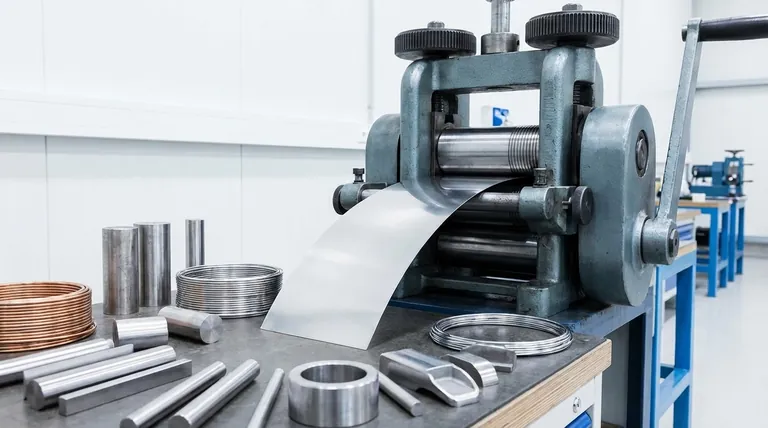
This process reduces the thickness of a metal plate or sheet by passing it through one or more pairs of rollers. It is used to produce sheet metal, strips, and foils with excellent surface finish and increased strength.
Drawing
Drawing pulls metal through a die, reducing its cross-sectional area. This process is fundamental for producing wires, rods, and tubes. The tension force elongates the metal and strain hardens it significantly.
Bending
Bending is a simple process used to shape sheet metal or rods into angles or curves. While it seems straightforward, it induces both tension and compression, causing localized plastic deformation and strain hardening along the bend line.
Cold Extrusion
Extrusion involves pushing a metal billet through a die to create parts with a fixed cross-sectional profile. While many extrusion processes are hot, cold extrusion is used for softer metals like aluminum to produce complex shapes with excellent surface finish and dimensional accuracy.
Squeezing Processes (Forging & Coining)
These processes use compressive force to shape metal within a die.
- Cold Forging produces dimensionally accurate parts like bolts and shafts with good strength.
- Coining is a high-pressure squeezing process that imparts fine details and an excellent surface finish, used for making coins and medallions.
Shearing
Shearing is a process that cuts metal without forming chips. It works by applying extreme localized force that causes the metal to plastically deform to the point of fracture. This is how sheet metal is cut to size.
Understanding the Trade-offs of Cold Working
While powerful, cold working is not a universal solution. Its benefits come with significant engineering trade-offs that must be considered.
Increased Brittleness and Reduced Ductility
The most critical trade-off is that as strength increases, ductility decreases. A strain-hardened metal is less able to bend or stretch without fracturing. It becomes more brittle.
Higher Force and Power Requirements
Deforming metal at room temperature requires immense force. The machinery used for cold working must be far more powerful and robust than that used for hot working, leading to higher equipment and energy costs.
Introduction of Residual Stresses
Cold working locks internal stresses into the material. These residual stresses can sometimes be beneficial, but they can also cause parts to warp over time or lead to premature failure if not properly managed, often through a subsequent stress-relieving heat treatment.
Limited Deformability
You can only deform a metal so much before it becomes too brittle and cracks. For parts requiring extreme shape changes, manufacturers must often perform intermediate annealing—a heat treatment that softens the metal and restores ductility—before continuing with further cold work.
Making the Right Choice for Your Application
Selecting a manufacturing process requires balancing the desired final properties of the part with the realities of production.
- If your primary focus is maximum strength and hardness: Cold working processes like drawing and rolling are ideal for achieving significant strain hardening in uniform cross-sections.
- If your primary focus is high precision and excellent surface finish: Cold processes like coining, drawing, or extrusion provide dimensional accuracy and a clean surface that hot working cannot match.
- If your primary focus is significant shape change or formability: You may need to choose hot working, or plan for intermediate annealing steps between cold working stages to restore ductility and prevent fracture.
Understanding these examples and their underlying principles empowers you to specify a process that delivers the precise balance of mechanical performance, dimensional accuracy, and production efficiency you require.
Summary Table:
| Process | Primary Use | Key Outcome |
|---|---|---|
| Cold Rolling | Producing sheet metal, strips, foils | Increased strength, superior surface finish |
| Drawing | Creating wires, rods, tubes | Significant strain hardening, elongation |
| Bending | Shaping sheet metal/rods | Localized hardening along the bend line |
| Cold Extrusion | Forming complex shapes (e.g., aluminum parts) | Excellent dimensional accuracy, clean surface |
| Cold Forging/Coining | Making bolts, shafts, coins | High precision, fine details, good strength |
| Shearing | Cutting sheet metal to size | Clean cut via plastic deformation and fracture |
Need Precision Metal Parts with Superior Strength?
Cold working processes are essential for manufacturing high-performance components where strength, dimensional accuracy, and a superior surface finish are critical. Choosing the right process requires expert knowledge to balance these benefits with material limitations like reduced ductility.
KINTEK specializes in providing the advanced laboratory equipment and consumables needed to support and analyze these precise metalworking techniques. Whether you are developing new alloys or optimizing production parameters, our solutions help you achieve reliable, repeatable results.
Let our expertise enhance your R&D and quality control. Contact KINTEK today to discuss how our lab equipment can meet your specific metalworking and materials testing challenges.
Visual Guide
