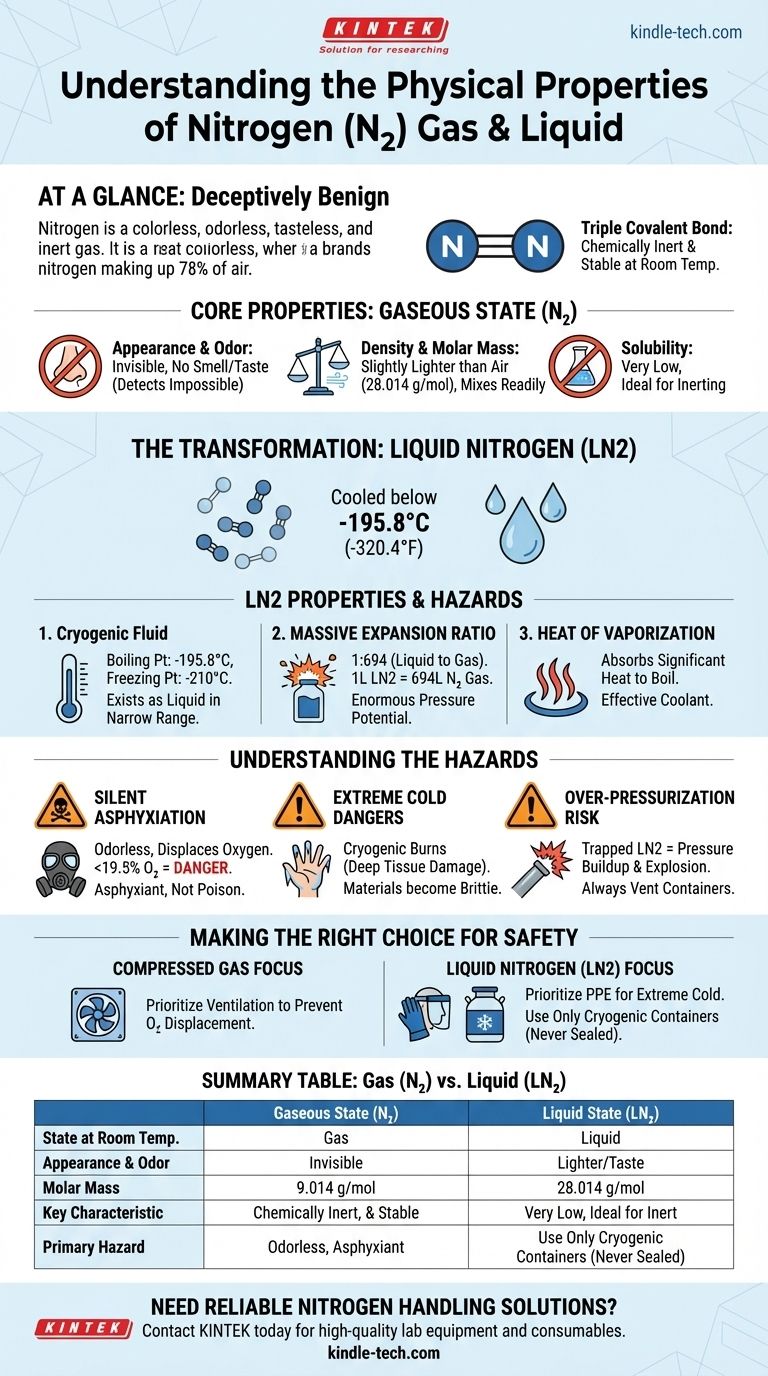
At a glance, nitrogen gas is defined by its apparent lack of properties. It is a colorless, odorless, and tasteless gas that constitutes approximately 78% of the air we breathe. At standard temperature and pressure, it is largely inert and non-reactive, a characteristic that belies its critical role in both industrial applications and safety protocols.
Nitrogen's seemingly benign nature at room temperature is deceptive. Its true significance lies in the extreme properties it exhibits when cooled into a liquid, creating a substance with immense utility and equally significant hazards related to extreme cold, pressure, and oxygen displacement.
Core Properties in its Gaseous State
Under normal atmospheric conditions, nitrogen gas (N₂) is stable and predictable. Understanding these baseline properties is the first step to using it safely and effectively.
Appearance and Odor
Nitrogen gas is completely invisible and has no smell or taste. This makes it impossible for human senses to detect its presence, which is a critical factor in its primary safety hazard: asphyxiation.
Density and Molar Mass
With a molar mass of about 28.014 g/mol, nitrogen is slightly lighter than air (which has an average molar mass of about 29 g/mol). This means in the event of a leak in a poorly ventilated area, it will not rapidly sink or rise, but will mix readily with the air, slowly displacing oxygen.
Solubility
Nitrogen has very low solubility in water and most other common solvents. This property, combined with its inertness, makes it ideal for purging or "blanketing" reactive chemicals to protect them from oxygen and moisture.
Chemical Inertness
The two nitrogen atoms in an N₂ molecule are held together by an exceptionally strong triple covalent bond. A tremendous amount of energy is required to break this bond, which is why nitrogen gas is so unreactive under most conditions.
The Transformation: Liquid Nitrogen (LN2)
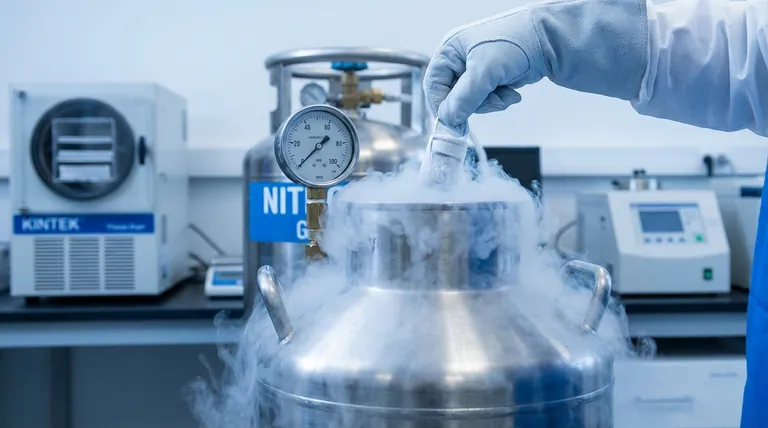
The most dramatic properties of nitrogen are revealed when it is cooled to its liquid state. This cryogenic fluid, known as LN2, is a cornerstone of many scientific and industrial processes.
Boiling and Freezing Points
Nitrogen's boiling point is -195.8°C (-320.4°F). Above this temperature, it exists as a gas unless held under pressure. It freezes into a solid at -210°C (-346°F), meaning it is a liquid over a relatively narrow temperature range.
The Massive Expansion Ratio
The most critical property of liquid nitrogen is its liquid-to-gas expansion ratio of 1:694 at atmospheric pressure. This means that one liter of liquid nitrogen will evaporate to produce 694 liters of nitrogen gas, creating an enormous potential for pressure buildup.
Heat of Vaporization
Liquid nitrogen requires a significant amount of thermal energy to vaporize (boil). This ability to absorb large amounts of heat at a constant, very low temperature is precisely why it is such an effective and widely used coolant.
Understanding the Hazards and Trade-offs
The physical properties of nitrogen are directly linked to its three primary hazards. Misunderstanding these can lead to severe accidents.
The Silent Threat of Asphyxiation
Because nitrogen is odorless and displaces oxygen, it can cause suffocation without warning. In a confined space, a significant nitrogen leak can lower the oxygen level below the 19.5% minimum required for human safety, leading to dizziness, unconsciousness, and death. It is an asphyxiant, not a poison.
Dangers of Extreme Cold
Contact with liquid nitrogen or surfaces cooled by it can cause severe cryogenic burns, which are functionally similar to thermal burns and cause immediate, deep tissue damage. Furthermore, the extreme cold can make many common materials, like carbon steel or plastic, brittle and prone to shattering.
Risk of Over-Pressurization
The high expansion ratio makes trapping liquid nitrogen in a sealed container exceptionally dangerous. As the liquid warms and vaporizes, it can generate immense pressure, causing sealed containers to rupture or explode with catastrophic force. This is why cryogenic containers are always vented or use pressure-relief devices.
Making the Right Choice for Your Application
Understanding these properties allows you to handle nitrogen with the respect it requires. Your safety focus depends entirely on which state of nitrogen you are using.
- If your primary focus is working with compressed nitrogen gas: Your main concern is ventilation to prevent the silent displacement of oxygen and ensure a safe breathing atmosphere.
- If your primary focus is handling liquid nitrogen (LN2): You must prioritize using appropriate personal protective equipment (PPE) for the extreme cold and ensuring all containers are designed for cryogenic use and are never sealed.
By understanding the connection between its physical properties and its potential hazards, you can leverage the power of nitrogen safely and effectively.
Summary Table:
| Property | Gaseous State (N₂) | Liquid State (LN₂) |
|---|---|---|
| State at Room Temp. | Gas | Cryogenic Liquid (below -195.8°C/-320.4°F) |
| Appearance & Odor | Colorless, Odorless, Tasteless | Colorless, boiling liquid |
| Molar Mass | 28.014 g/mol (lighter than air) | - |
| Key Characteristic | Chemically Inert | High Expansion Ratio (1:694) |
| Primary Hazard | Asphyxiation (oxygen displacement) | Cryogenic Burns & Pressure Buildup |
Need Reliable Equipment for Handling Nitrogen Safely?
Whether your laboratory requires specialized gas handling systems, purging equipment, or safe cryogenic containers for liquid nitrogen, KINTEK has the solution. We specialize in high-quality lab equipment and consumables designed for safety and performance.
Contact KINTEK today to discuss how our products can help you manage nitrogen's unique properties effectively and protect your team.
Visual Guide