
In essence, ceramic sintering is a thermal process that transforms a compacted powder of ceramic particles into a dense, solid, and high-strength object. It achieves this by applying intense heat—and often pressure—at temperatures below the material's melting point, causing the individual particles to fuse together on an atomic level and eliminate the empty spaces between them.
The crucial insight is that sintering is not about melting. It's a solid-state process of atomic diffusion, where heat energizes atoms to migrate across the boundaries of individual particles, bonding them into a single, unified mass.
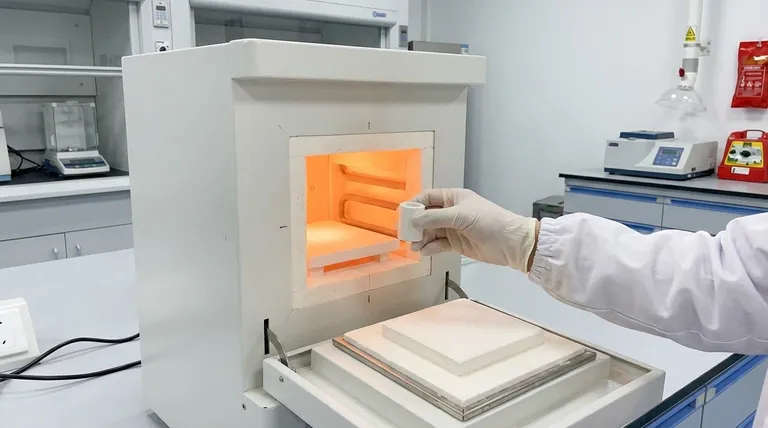
The Core Mechanism: From Powder to Solid
To understand sintering, it's best to visualize it as a series of physical transformations driven by energy. The process converts a fragile, loosely-bound shape into a fully densified and robust component.
The Starting Point: The "Green Body"
Sintering begins with raw ceramic materials ground into a fine powder. This powder is first compacted, often under pressure, into a desired shape known as a "green body" or "green compact." This initial form has some mechanical strength but is highly porous.
The Role of Intense Heat
The green body is then placed in a kiln and heated to an extremely high temperature, often around 1200°C or higher, depending on the material. This temperature is carefully controlled to remain below the ceramic's melting point. The heat provides the thermal energy necessary to activate the atoms within the particles.
Atomic Diffusion at Particle Boundaries
This thermal energy causes the atoms at the surface of each particle to vibrate and become mobile. These energized atoms then migrate, or diffuse, across the boundaries where particles touch. This movement effectively builds "necks" or bridges between adjacent particles, fusing them together.
Eliminating Porosity for Densification
As these necks grow, they pull the centers of the particles closer together. This action systematically shrinks and eliminates the pores, or empty voids, that existed in the green body. The result is a significant increase in the material's overall density. For example, in dental applications, this transforms zirconia from a softer, porous state into an extremely hard and dense final structure.
Understanding the Trade-offs and Limitations
While powerful, the sintering process is a delicate balance. Engineers must manage several variables to achieve the desired outcome, as uncontrolled sintering can lead to suboptimal results.
The Risk of Uncontrolled Grain Growth
If the temperature is too high or the heating time is too long, the individual crystals (or "grains") in the ceramic can grow excessively large. While the material becomes dense, these large grains can sometimes make the final product more brittle.
The Inevitability of Shrinkage
Because sintering works by eliminating empty space, the final sintered part will always be smaller than the initial green body. This shrinkage is substantial and must be precisely calculated and controlled, which presents a significant challenge in manufacturing high-precision components.
Energy and Cost Considerations
The high temperatures required for sintering demand a significant amount of energy, making it a costly process. The specialized kilns and controlled atmospheres required for certain advanced ceramics add further to the operational expense.
How Sintering Achieves Specific Material Properties
Controlling the sintering process allows manufacturers to engineer materials for specific applications by manipulating their final density, strength, and microstructure.
- If your primary focus is maximum strength and density: The goal is to use optimized high temperatures and pressures to eliminate nearly all porosity, creating a fully dense ceramic ideal for structural or wear-resistant applications.
- If your primary focus is optical translucency: Complete densification is critical, as any remaining pores will scatter light and make the material opaque.
- If your primary focus is creating a porous material: You would use a modified, lower-temperature process (partial sintering) to intentionally fuse particles just enough to create strength while leaving a network of pores for products like ceramic filters.
Ultimately, mastering sintering is about precisely controlling the transformation from a simple powder into a high-performance engineered material.
Summary Table:
| Stage | Key Action | Outcome |
|---|---|---|
| 1. Green Body Formation | Compact ceramic powder into a shape | Porous, fragile pre-form |
| 2. Heating & Diffusion | Heat below melting point; atoms migrate | Particles fuse at boundaries |
| 3. Densification | Pores shrink and eliminate | Increased density and strength |
| 4. Final Properties | Control temperature, time, pressure | Tailored strength, translucency, or porosity |
Ready to achieve precise, high-performance ceramic components? KINTEK specializes in advanced lab equipment and consumables for sintering processes, offering the precise temperature control and reliable performance your laboratory needs. Whether you're developing dental zirconia, structural ceramics, or porous filters, our solutions help you master densification and material properties. Contact us today to discuss how we can support your sintering projects!
Visual Guide
