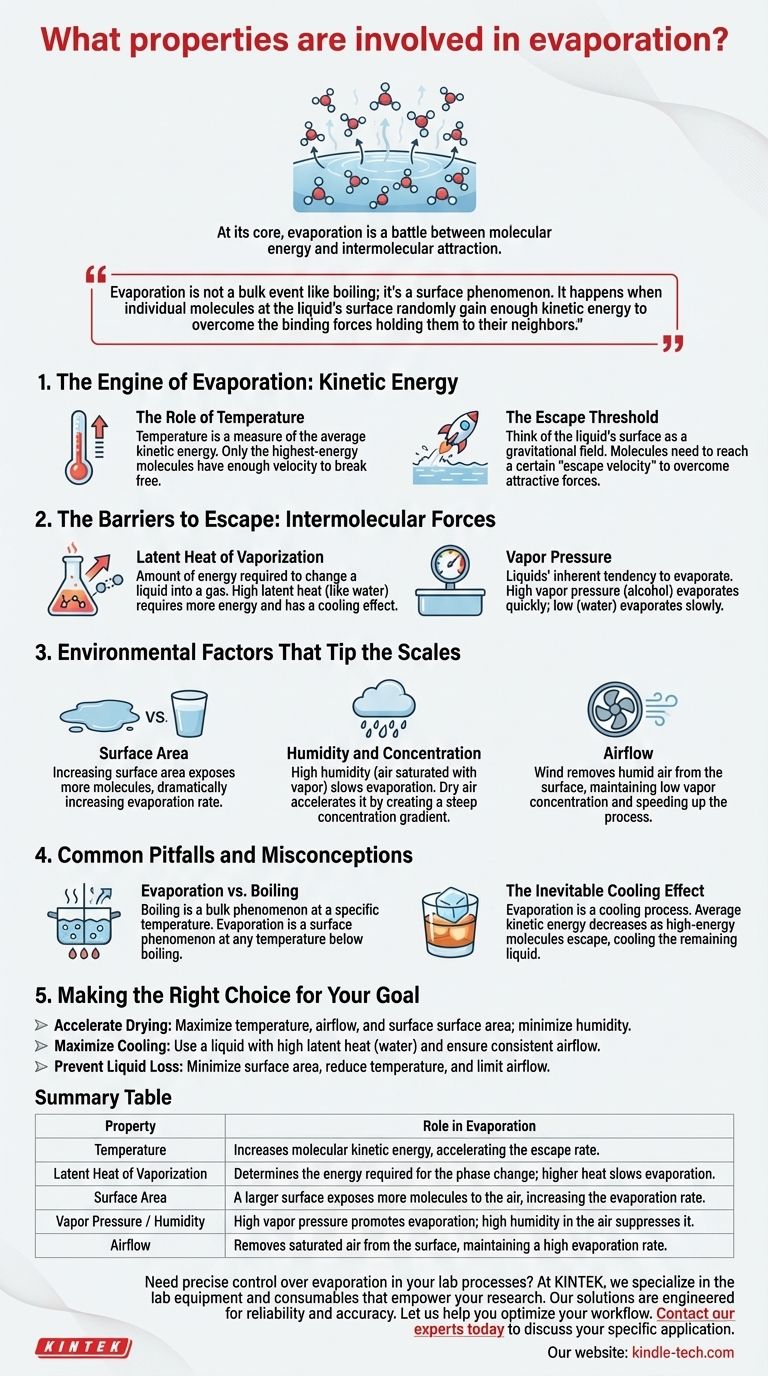
At its core, evaporation is a battle between molecular energy and intermolecular attraction. The process is governed by a handful of key physical properties that determine how easily a liquid's molecules can gain enough energy to break free from the surface and enter a gaseous state. The most critical properties are the liquid's temperature, its latent heat of vaporization, its surface area, and the vapor pressure of the surrounding environment.
Evaporation is not a bulk event like boiling; it's a surface phenomenon. It happens when individual molecules at the liquid's surface randomly gain enough kinetic energy to overcome the binding forces holding them to their neighbors, a process influenced by both the liquid's internal properties and its external environment.
The Engine of Evaporation: Kinetic Energy
Evaporation is driven by the energy of individual molecules. The properties that influence this energy are the primary drivers of the entire process.
The Role of Temperature
Temperature is a measure of the average kinetic energy of the molecules in a substance. However, this is just an average; at any moment, some molecules have much more energy than others.
Only the molecules with the highest energy—the ones at the "fast" end of the spectrum—have enough velocity to break free from the liquid's surface.
The Escape Threshold
Think of the liquid's surface as a gravitational field. A molecule needs to reach a certain "escape velocity" to overcome the attractive forces of its neighbors.
Increasing the temperature raises the average energy, meaning a larger percentage of molecules will possess the required energy to escape at any given moment.
The Barriers to Escape: Intermolecular Forces
While energy is the engine, the inherent properties of the liquid create barriers that molecules must overcome to escape.
Latent Heat of Vaporization
This property is the amount of energy required to change a set amount of liquid into a gas without changing its temperature. It is a direct measure of the strength of the intermolecular forces holding the liquid together.
Water has a high latent heat of vaporization due to strong hydrogen bonds. This is why it takes a lot of energy to evaporate water, and why its evaporation has a significant cooling effect.
Vapor Pressure
Vapor pressure is the pressure exerted by the vapor of a substance in a closed system. More simply, it represents a liquid's inherent tendency to evaporate.
Liquids with weak intermolecular forces, like alcohol, have a high vapor pressure and evaporate quickly. Liquids with strong forces, like mercury or water, have a low vapor pressure and evaporate more slowly.
Environmental Factors That Tip the Scales
The surrounding environment plays a decisive role in determining the net rate of evaporation.
Surface Area
Evaporation can only happen at the surface where the liquid meets the air. Increasing the surface area exposes more molecules to the air, dramatically increasing the rate of evaporation.
A puddle of water with a large surface area will evaporate much faster than the same amount of water in a deep cup.
Humidity and Concentration
The air above the liquid can only hold so much water vapor. Humidity is the concentration of vapor already present.
If the air is already saturated (100% humidity), the rate of molecules returning to the liquid equals the rate of molecules escaping, resulting in zero net evaporation. Dry air accelerates evaporation by creating a steep concentration gradient.
Airflow
Wind or airflow constantly removes the layer of humid air directly above the liquid's surface.
This maintains a low vapor concentration at the interface, ensuring that the net direction of molecular movement is always away from the liquid, which significantly speeds up the process.
Common Pitfalls and Misconceptions
Understanding the nuances of evaporation is key to applying the concept correctly.
Evaporation vs. Boiling
Boiling is a bulk phenomenon that occurs at a specific temperature when the liquid's vapor pressure equals the surrounding atmospheric pressure, forming bubbles within the liquid.
Evaporation is a surface phenomenon that can occur at any temperature below the boiling point.
The Inevitable Cooling Effect
Evaporation is fundamentally a cooling process. Since only the highest-energy molecules escape, the average kinetic energy (and thus, the temperature) of the remaining liquid decreases.
This is the principle behind sweating in animals and evaporative cooling systems. Without a continuous input of external energy, a liquid will cool down as it evaporates.
Making the Right Choice for Your Goal
By manipulating these properties, you can control the rate of evaporation to achieve a specific outcome.
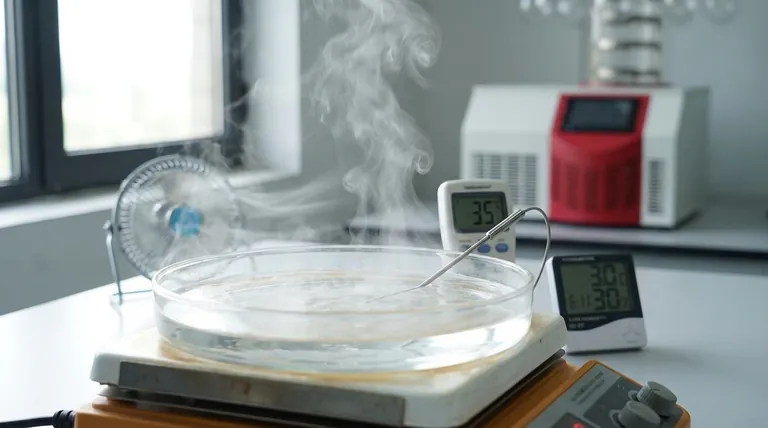
- If your primary focus is to accelerate drying: Maximize temperature, airflow, and surface area while minimizing the ambient humidity.
- If your primary focus is to maximize cooling: Use a liquid with a high latent heat of vaporization (like water) and ensure consistent airflow over its surface to encourage rapid evaporation.
- If your primary focus is to prevent liquid loss: Minimize surface area (by using a narrow container), reduce temperature, and limit airflow (by using a cover).
Understanding these core properties empowers you to predict and control the process of evaporation in any context.
Summary Table:
| Property | Role in Evaporation |
|---|---|
| Temperature | Increases molecular kinetic energy, accelerating the escape rate. |
| Latent Heat of Vaporization | Determines the energy required for the phase change; higher heat slows evaporation. |
| Surface Area | A larger surface exposes more molecules to the air, increasing the evaporation rate. |
| Vapor Pressure / Humidity | High vapor pressure promotes evaporation; high humidity in the air suppresses it. |
| Airflow | Removes saturated air from the surface, maintaining a high evaporation rate. |
Need precise control over evaporation in your lab processes?
At KINTEK, we specialize in the lab equipment and consumables that empower your research. Whether you require efficient drying ovens, precise temperature controllers, or systems designed to manage humidity and airflow, our solutions are engineered for reliability and accuracy.
Let us help you optimize your workflow. Contact our experts today to discuss your specific application and discover the right equipment for your laboratory's needs.
Visual Guide