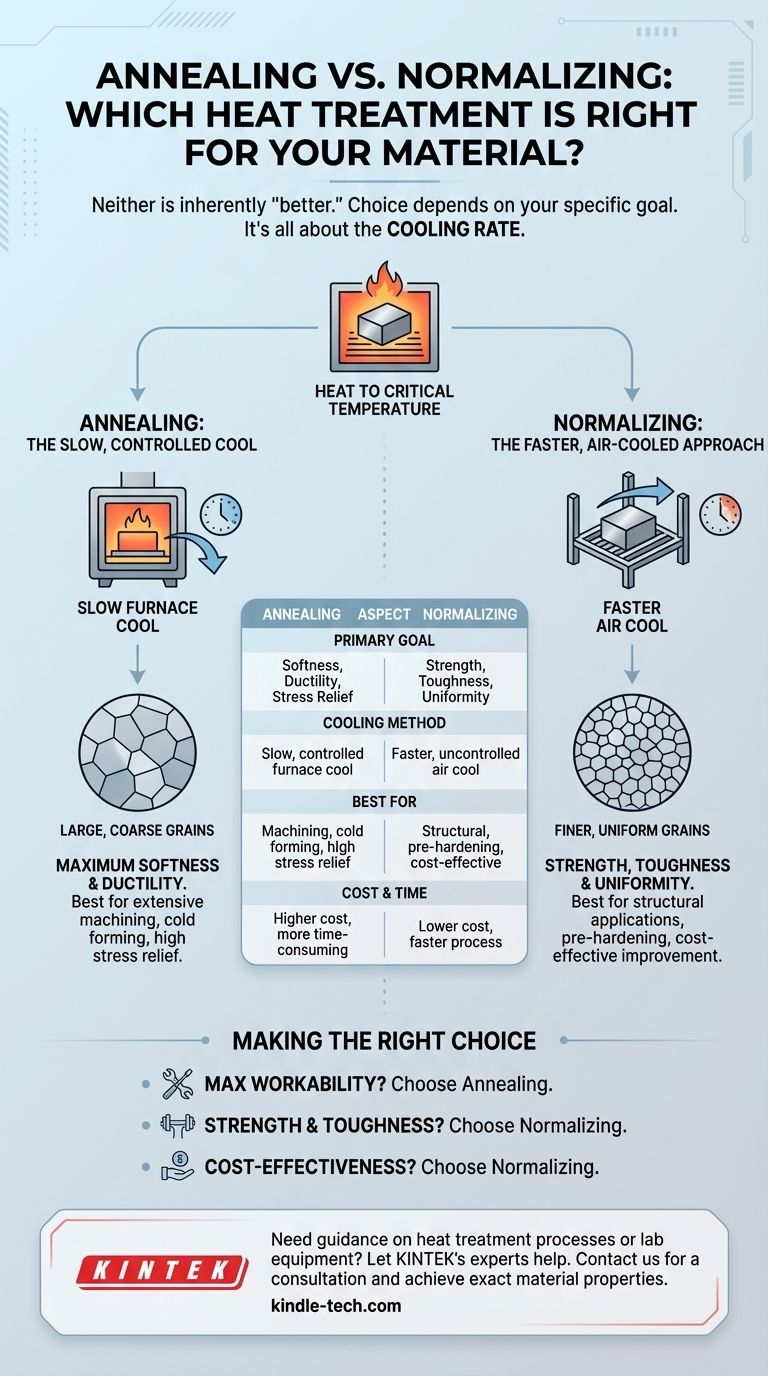
Neither annealing nor normalizing is inherently "better"; they are distinct heat treatment processes designed to achieve different outcomes. Choosing the right one depends entirely on your goal for the material. Annealing is used to maximize softness, ductility, and stress relief, while normalizing is used to create a more uniform grain structure, improving strength and toughness.
The core difference lies in the cooling method. Annealing involves a very slow, controlled cool inside a furnace, while normalizing uses a faster, uncontrolled cool in open air. This single difference in cooling rate dictates the final mechanical properties and cost of the process.
The Fundamental Difference: It's All in the Cooling Rate
Both processes begin by heating a metal, typically steel, to a specific temperature above its critical point, causing a change in its internal crystal structure. The crucial divergence happens during the cooling phase.
Annealing: The Slow, Controlled Cool
In an annealing process, the material is cooled at a very slow and carefully controlled rate, often by leaving it inside the insulated furnace as it cools down over many hours.
This slow cool allows the material's internal grain structure to reform into its most stable, low-energy state. The result is large, coarse grains, which equates to maximum softness.
Normalizing: The Faster, Air-Cooled Approach
In normalizing, the material is removed from the furnace after heating and left to cool in still, room-temperature air.
This cooling rate is significantly faster than furnace cooling but much slower than quenching in oil or water. This intermediate speed creates a finer, more uniform grain structure than annealing, which results in a harder and stronger material.
How Cooling Affects Material Properties
The final microstructure of the steel determines its mechanical properties. The choice between annealing and normalizing is a choice about which properties you need to prioritize.
Annealing's Goal: Maximum Softness and Ductility
The primary purpose of annealing is to make a material as soft and workable as possible.
This process relieves internal stresses from prior work like machining or welding, preventing distortion in later operations. It also restores ductility to materials that have been "work-hardened," allowing for further forming or bending without cracking.
Annealed materials are ideal for extensive machining, as the softness reduces tool wear and improves surface finish.
Normalizing's Goal: Strength and Uniformity
Normalizing is not about achieving maximum softness. Its goal is to refine the grain structure and eliminate inconsistencies within the steel.
This creates a more uniform and predictable material with higher strength and toughness than an annealed part. Normalizing is often used to prepare a material for subsequent hardening treatments or to improve the mechanical properties of forgings and castings.
Understanding the Trade-offs
Choosing between these processes involves balancing material properties, cost, and time.
Cost and Time
Annealing is more expensive and time-consuming. The slow furnace cooling ties up equipment for extended periods and consumes significant energy.
Normalizing is faster and cheaper. Simply removing the part from the furnace and letting it air cool is a much more efficient process, making it the more economical choice when full softness is not required.
Degree of Stress Relief
Annealing provides the most complete stress relief. The extremely slow cooling allows internal stresses to be almost entirely eliminated. This is critical for components that require high dimensional stability.
Normalizing relieves most internal stresses but is not as thorough as a full anneal. For many applications, this level of stress relief is perfectly sufficient.
Final Hardness and Strength
This is the most straightforward trade-off. An annealed part will be softer, more ductile, and weaker. A normalized part will be harder, stronger, and less ductile.
Making the Right Choice for Your Goal
Select the process that aligns directly with the intended function of the component.
- If your primary focus is maximum workability and stress relief: Choose annealing, as it produces the softest, most ductile, and lowest-stress state for extensive machining or cold forming.
- If your primary focus is refining grain structure for strength and toughness: Choose normalizing to create a uniform material with superior mechanical properties for structural applications.
- If your primary focus is cost-effectiveness for a general-purpose improvement: Choose normalizing, as it provides significant benefits over untreated steel at a lower cost and in less time than annealing.
Ultimately, understanding your material's end-use is the key to selecting the correct heat treatment.
Summary Table:
| Aspect | Annealing | Normalizing |
|---|---|---|
| Primary Goal | Maximize softness, ductility, and stress relief | Improve strength, toughness, and grain uniformity |
| Cooling Method | Slow, controlled furnace cool | Faster, uncontrolled air cool |
| Best For | Extensive machining, cold forming, high stress relief | Structural applications, cost-effective improvement, pre-hardening |
| Cost & Time | Higher cost, more time-consuming | Lower cost, faster process |
Still unsure which heat treatment process is right for your specific material and application?
Let KINTEK's experts guide you. We specialize in providing the precise lab equipment and consumables needed for controlled heat treatment processes. Our solutions help you achieve the exact material properties—whether maximum softness or superior strength—that your laboratory or production requires.
Contact our team today for a personalized consultation and ensure your materials perform as intended.
Visual Guide