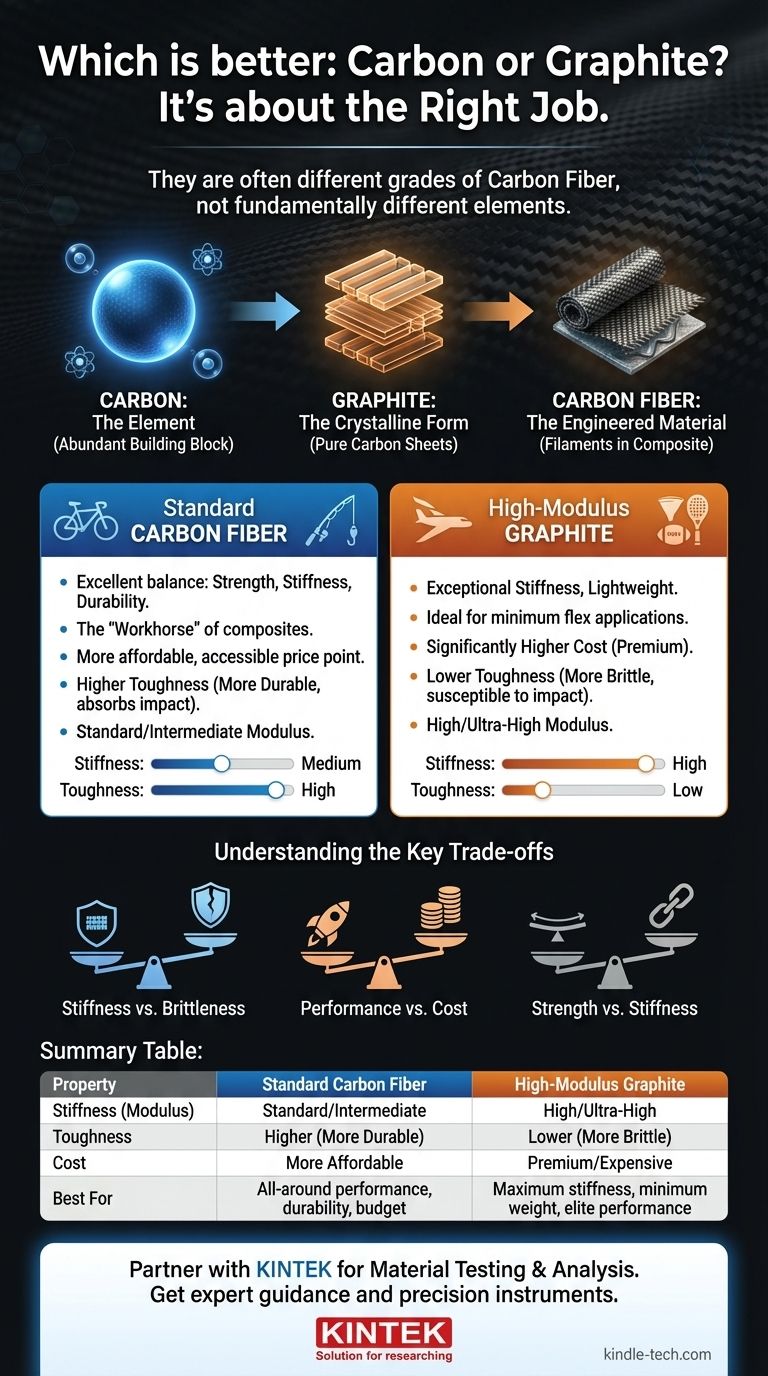
To be precise, the question isn't which is better, but which is right for the job. Graphite is a specific form (an allotrope) of the element carbon. In the context of manufacturing and high-performance products, the terms "carbon" and "graphite" are often used to describe different grades of carbon fiber, where "graphite" typically implies a higher-stiffness, more premium material.
The core issue is one of marketing and material grading, not a choice between two fundamentally different elements. "Graphite" is often used to signify a higher-performance, stiffer, and more expensive grade of carbon fiber, while "carbon" can refer to a more standard, tougher, and cost-effective version.
The Fundamental Relationship: It's All Carbon
Before we can compare, we must clarify the science. Understanding this foundation is key to cutting through marketing jargon.
### Carbon: The Element
Carbon is one of the most abundant elements in the universe. It is the fundamental building block of countless materials, from organic life to industrial diamonds.
### Graphite: The Crystalline Form
Graphite is a naturally occurring crystalline structure of pure carbon atoms arranged in stacked sheets. This sheet-like structure is what gives graphite its characteristic slipperiness and makes it useful in pencils and lubricants.
### Carbon Fiber: The Engineered Material
The material you find in a bicycle frame or fishing rod is actually a carbon fiber composite. It's made from tiny carbon filaments (often processed into a graphite-like structure) that are woven into a fabric and locked in place with a resin, like epoxy.
How "Carbon" and "Graphite" Are Used in Practice
The confusion arises from how manufacturers label these carbon fiber composites. The terms have evolved into a shorthand for different performance characteristics.
### "Carbon" as the Standard
When a product is labeled simply as "carbon" or "carbon fiber," it often refers to a standard or intermediate modulus fiber. This material offers an excellent balance of strength, stiffness, and durability.
It is the workhorse of the composites industry, providing a significant performance jump over materials like aluminum or steel at a more accessible price point than the highest-end fibers.
### "Graphite" as the High-Performance Grade
The term "graphite" is frequently reserved for high-modulus or ultra-high-modulus carbon fibers. Modulus is the technical term for a material's stiffness or rigidity.
These "graphite" fibers are more highly processed to create a more perfect, rigid crystalline structure. This results in a material that is exceptionally stiff and lightweight, ideal for applications where minimum flex is critical.
Understanding the Key Trade-offs
Choosing a material is always about balancing competing properties. There is no single "best" option, only the best option for a specific goal.
### Stiffness vs. Brittleness
Higher stiffness often comes at the cost of reduced toughness. Ultra-high-modulus "graphite" composites can be more brittle than standard "carbon" composites.
This means that while they are incredibly rigid, they may be more susceptible to catastrophic failure from a sharp impact. A standard carbon fiber frame might be more likely to absorb an impact without cracking.
### Performance vs. Cost
The manufacturing process for high-modulus "graphite" fibers is more complex and energy-intensive. This refinement process directly translates to a significantly higher cost.
You are paying a premium for incremental gains in stiffness and reductions in weight.
### Strength vs. Stiffness
It's important to note that strength (resistance to breaking under tension) and stiffness (resistance to bending) are different properties. While often related, the stiffest fiber is not always the strongest.
Many applications require a balance. An aircraft wing, for example, needs immense stiffness but also the strength and toughness to handle extreme stress without failing.
Making the Right Choice for Your Application
Your final decision should be driven entirely by your primary goal, whether that's top-tier performance, durability, or budget.
- If your primary focus is maximum stiffness and minimum weight: Choose the product labeled "high-modulus graphite," as it's engineered for elite performance where every gram and millimeter of flex matters.
- If your primary focus is durability and all-around performance: A standard "carbon fiber" product offers the best balance of strength, toughness, and stiffness for most users.
- If your primary focus is budget: Standard "carbon fiber" provides most of the benefits of composite technology at a much more accessible price point than premium "graphite" versions.
Ultimately, understanding the language of materials empowers you to see past the marketing and select the tool that is perfectly suited to your needs.
Summary Table:
| Property | Standard Carbon Fiber | High-Modulus Graphite |
|---|---|---|
| Stiffness (Modulus) | Standard/Intermediate | High/Ultra-High |
| Toughness | Higher (More Durable) | Lower (More Brittle) |
| Cost | More Affordable | Premium/Expensive |
| Best For | All-around performance, durability, budget | Maximum stiffness, minimum weight, elite performance |
Still unsure which material is right for your specific application?
At KINTEK, we specialize in providing expert guidance and high-quality lab equipment and consumables for material testing and analysis. Whether you're working with standard carbon fiber or high-modulus graphite composites, our team can help you select the right tools to accurately test and validate material properties.
Let us help you make an informed decision:
- Get personalized recommendations based on your specific performance requirements
- Access precision instruments for material stiffness, strength, and durability testing
- Benefit from our technical expertise in composite material analysis
Contact our material science experts today to discuss your project needs and discover how KINTEK's solutions can enhance your research and development process.
Visual Guide