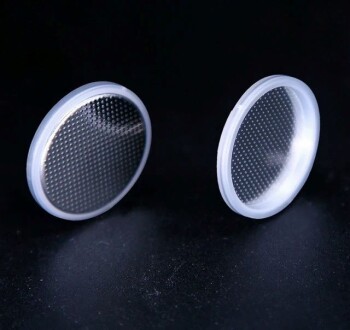
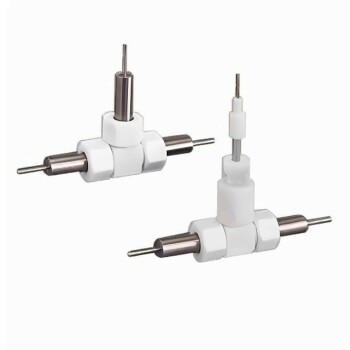
The 2025-type coin cell assembly and testing systems provide the standardized infrastructure necessary to bridge the gap between laboratory synthesis and industrial application. These systems allow researchers to rigorously verify key performance metrics—such as discharge capacity, coulombic efficiency, and cycle life—under controlled, repeatable conditions. By subjecting NCA materials to variable discharge rates ranging from 0.1 C to 10 C, they provide the empirical data required to determine if a material can withstand the high-current demands of the commercial market.
2025-type coin cell systems act as a critical "filter" in battery material development, transforming raw NCA powder into measurable, comparable data. They provide the standardized environment needed to objectively validate whether new synthesis methods, like one-step solid-state processes, meet the high-performance benchmarks required for commercial adoption.
Standardizing the Evaluation of NCA Performance
Precision Assembly for Consistent Data
The 2025-type assembly tools ensure that the physical environment of the battery—such as electrode alignment and pressure—remains constant across all tests. This consistency is vital because it eliminates mechanical variables that could otherwise skew the results of the NCA material being tested.
By utilizing a standardized format, researchers can ensure that any performance gains or failures observed are a direct result of the NCA chemistry rather than inconsistencies in the assembly process.
High-Precision Testing for Industrial Benchmarks
Testing systems capable of high-precision cycles (from 0.1 C to 10 C) allow for a comprehensive "stress test" of the material. Commercial NCA applications, particularly in electric vehicles, require the material to maintain capacity and stability under rapid discharge conditions.
Analyzing the material at these various rates reveals how the NCA will perform in real-world scenarios, which is a prerequisite for any commercial investment or scaling.
Validating One-Step Solid-State Synthesis
Establishing Performance Baselines
NCA materials synthesized via the one-step solid-state method are often evaluated for their cost-effectiveness and simplified production. The 2025 system acts as the primary tool to verify if this simplified synthesis method compromises the material's electrochemical integrity.
Without this standardized testing, it would be impossible to prove that a more efficient manufacturing process can still yield a product that meets industrial standards.
Measuring Capacity and Efficiency
The system provides exact measurements of specific capacity and coulombic efficiency, which are the "currency" of battery performance. High coulombic efficiency in early cycles is a strong indicator of a material's long-term stability and commercial potential.
If an NCA material shows significant capacity loss or low efficiency in a 2025 coin cell, it is unlikely to be viable for large-scale pouch or prismatic cell applications.
Understanding the Trade-offs
Laboratory Scale vs. Industrial Scale
While 2025 coin cells are excellent for material screening, they do not perfectly replicate the thermal dynamics of large-scale battery packs. Results found in a coin cell must eventually be validated in larger formats to account for heat dissipation and mechanical stress at scale.
Limitations of the Coin Cell Format
The small physical size of the 2025 format can sometimes mask issues related to gas evolution or electrolyte distribution that become more prominent in commercial-sized cells. It is a tool for material validation, not a total replacement for full-scale prototype testing.
How to Apply This to Your Project
When utilizing 2025-type systems to evaluate NCA materials, your approach should vary based on your specific development phase.
- If your primary focus is material screening: Utilize the 2025 system to run rapid, high-throughput tests to identify which NCA formulations offer the highest initial capacity and efficiency.
- If your primary focus is synthesis optimization: Use the system to compare NCA produced via one-step solid-state methods against traditional precursors to ensure performance parity.
- If your primary focus is commercial certification: Focus on long-term cycle life and high-rate (10 C) testing within the 2025 format to build a data package that proves the material meets industrial power requirements.
By leveraging these standardized systems, you move from speculative research to data-driven material development ready for the commercial market.
Summary Table:
| Performance Metric | Commercial Significance for NCA | Role of 2025-Type Systems |
|---|---|---|
| Discharge Rate (0.1C - 10C) | Determines suitability for high-power EV applications. | Provides empirical data on capacity retention under stress. |
| Coulombic Efficiency | Indicates long-term stability and electrochemical integrity. | Measures exact efficiency in early cycles to predict lifespan. |
| Synthesis Validation | Proves one-step solid-state methods meet industrial standards. | Acts as a standardized "filter" to compare new vs. traditional methods. |
| Mechanical Consistency | Ensures data is driven by chemistry, not assembly errors. | Standardizes electrode alignment and pressure for repeatable results. |
Accelerate Your Battery Innovation with KINTEK
Transitioning from lab-scale NCA synthesis to commercial-grade performance requires precision you can trust. KINTEK specializes in advanced laboratory equipment, providing the high-precision battery research tools and consumables needed to validate your materials for the industrial market.
Our comprehensive portfolio is designed to support every stage of your R&D workflow, including:
- Battery Research Tools: Specialized coin cell assembly systems, testing units, and high-quality consumables.
- Material Preparation: Precision hydraulic presses (pellet, hot, isostatic) and crushing/milling systems for consistent electrode fabrication.
- Thermal Processing: A wide range of high-temperature furnaces (muffle, tube, vacuum) and CVD/PECVD systems for advanced NCA synthesis.
Whether you are optimizing coulombic efficiency or stress-testing cycle life, KINTEK provides the reliability required to meet rigorous industrial benchmarks.
Ready to validate your material’s commercial potential? Contact KINTEK Today to discover how our specialized tools can streamline your research and move your battery technology from the lab to the production line.
References
- Lifan Wang, Guicheng Liu. One-Step Solid-State Synthesis of Ni-Rich Cathode Materials for Lithium-Ion Batteries. DOI: 10.3390/ma16083079
This article is also based on technical information from Kintek Solution Knowledge Base .
Related Products
- Button Battery Case for Battery Lab Applications
- Customizable Swagelok Type Test Cells for Advanced Battery Research Electrochemical Analysis
People Also Ask
- What is the primary role of standardized coin cell cases in Li/LSTH/Li assembly? Ensure Precise Battery Testing Results
- What is the significance of using a 2032-type coin cell configuration? Isolate Intrinsic Graphene Performance.
- What are the uses of desiccators and specific thermal regulators? Expert Insights for Vapor-Assisted Conversion
- What is the purpose of using a high-pressure hydraulic crimper for CR2032 coin cell assembly? Ensure Superior Sealing
- Why is the use of reaction containers with environmental control capabilities essential in mechanochemistry?