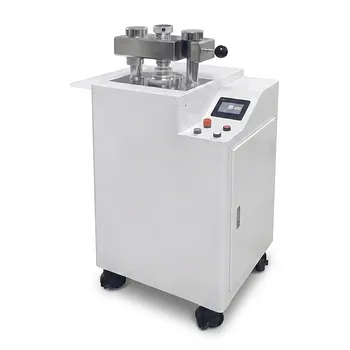
A high-pressure hydraulic crimper is essential for creating a hermetic mechanical seal and ensuring optimal electrical contact within a CR2032 coin cell. By providing constant and high-intensity sealing pressure, the device bonds the battery cap and case against a sealing gasket to prevent electrolyte leakage and atmospheric contamination. This precise physical encapsulation is the fundamental requirement for obtaining stable, reproducible electrochemical data.
The core purpose of the hydraulic crimper is to transform individual battery components into a single, chemically isolated system. It achieves this by simultaneously blocking environmental contaminants and minimizing internal resistance through uniform physical compression.
Hermetic Sealing and Environmental Protection
Preventing Electrolyte Loss
Lithium salt electrolytes are highly volatile and prone to evaporation if the cell is not perfectly sealed. The hydraulic crimper applies the necessary force to deform the sealing gasket, creating a mechanical barrier that prevents the volatilization and leakage of these critical liquids.
Blocking External Contaminants
Lithium and sodium metal anodes are extremely sensitive to moisture and oxygen. A high-pressure seal ensures that the internal chemistry remains stable by blocking atmospheric ingress, which would otherwise lead to hazardous chemical reactions or electrolyte degradation.
Ensuring Chemical Safety
By maintaining a rigorous seal, the crimper protects the chemical safety of the lithium metal anode. This isolation is vital for preventing the "poisoning" of the cell, which can occur if even trace amounts of water vapor enter the casing during long-term cycling.
Optimizing Internal Electrochemical Performance
Reducing Contact Resistance
For a battery to function efficiently, there must be excellent physical contact between the current collectors, electrodes, and separators. The uniform pressure of a hydraulic crimper minimizes interfacial contact resistance, allowing for more accurate measurements of the battery's true capacity.
Structural Consistency and Density
The crimper regulates the density of the overall structure and the physical relationship between internal components like the spring sheets and lithium discs. This physical foundation is necessary to ensure that the battery maintains cycling stability and produces comparable results across different samples.
Eliminating Experimental Variables
In a laboratory setting, consistency is the key to valid research. Using a precision hydraulic press allows researchers to apply the exact same force to every cell, ensuring that variations in test results are due to the materials being studied rather than assembly flaws.
Common Pitfalls to Avoid
The Risk of Over-Pressurization
Applying excessive pressure can lead to the rupture of the sealing gasket or the crushing of internal components. If the separator is punctured due to over-compression, the cell will experience an internal short circuit, rendering the test data useless and potentially creating a safety hazard.
Consequences of Insufficient Pressure
If the pressure is too low, the mechanical seal will be incomplete, leading to "breathing" where air enters the cell. This often manifests as erratic cycling curves or a sudden increase in internal resistance as the electrolyte evaporates or reacts with moisture.
Maintaining Equipment Calibration
Hydraulic systems can drift over time, leading to inconsistent pressure delivery. Failure to regularly calibrate the crimper can result in a "batch effect" where older cells perform differently than newer ones, even when using the same materials.
How to Apply This to Your Assembly Process
Based on your specific laboratory or production goals, consider the following recommendations for utilizing a hydraulic crimper:
- If your primary focus is Data Accuracy and Repeatability: Utilize a crimper with a built-in pressure gauge to ensure every cell in your study is compressed with the exact same tonnage.
- If your primary focus is Long-Term Cycling Stability: Prioritize the integrity of the gasket seal to prevent the slow ingress of moisture over weeks or months of testing.
- If your primary focus is Safety and Leak Prevention: Conduct regular visual inspections of the crimped edges to ensure the casing has deformed uniformly without cracking the protective seal.
A properly executed crimping process is the invisible foundation of successful battery research, ensuring that your results reflect the chemistry of your materials rather than the flaws of your assembly.
Summary Table:
| Key Function | Primary Benefit | Impact on Research |
|---|---|---|
| Hermetic Sealing | Prevents electrolyte loss & moisture ingress | Ensures chemical stability and safety |
| Physical Compression | Minimizes internal contact resistance | Increases accuracy of electrochemical data |
| Uniform Pressure | Maintains structural consistency | Delivers reproducible results across batches |
| Precision Control | Prevents gasket rupture & short circuits | Protects cell integrity and longevity |
Elevate Your Battery Research with KINTEK Precision
Achieving repeatable, high-quality electrochemical data starts with the perfect seal. KINTEK specializes in high-performance laboratory equipment, providing researchers with the precision hydraulic presses and crimpers needed for flawless CR2032 assembly.
Beyond battery research tools and consumables, our comprehensive portfolio includes:
- High-Temperature Furnaces: Muffle, tube, vacuum, and CVD systems.
- Sample Preparation: Crushing, milling, and sieving equipment.
- Specialized Reactors: High-temperature high-pressure reactors and autoclaves.
- Lab Essentials: ULT freezers, electrolytic cells, and high-purity ceramics.
Whether you are scaling up production or conducting fundamental material science, KINTEK delivers the reliability and technical support you need to succeed.
Ready to optimize your assembly process? Contact our experts today for a tailored solution!
References
- Safina‐E‐Tahura Siddiqui, Nirjhor Barua. Microstructured pebble stone like Ni-NiO composite as anode of high-performance lithium-ion batteries. DOI: 10.55670/fpll.fusus.2.1.1
This article is also based on technical information from Kintek Solution Knowledge Base .
Related Products
- Laboratory Hydraulic Press Lab Pellet Press for Button Battery
- Professional Cutting Tools for Carbon Paper Cloth Diaphragm Copper Aluminum Foil and More
- Laboratory Hydraulic Pellet Press for XRF KBR FTIR Lab Applications
- Multifunctional Electrolytic Electrochemical Cell Water Bath Single Layer Double Layer
- Electric button battery sealing machine
People Also Ask
- Why is a high-precision laboratory hydraulic press necessary for radiation-shielding? Ensure Data Accuracy & Density
- Why is a laboratory hydraulic press required during the preparation of Ti3AlC2 precursor pellets?
- How does the laboratory hydraulic press contribute to the preparation of solid targets for laser ablation?
- What is the function of a laboratory hydraulic press in preparing La2FeCrO6? Ensure High-Density Ceramic Pellets
- Why use a lab hydraulic press for 380 MPa Ti-Al alloy compaction? Unlock superior density and structural integrity.