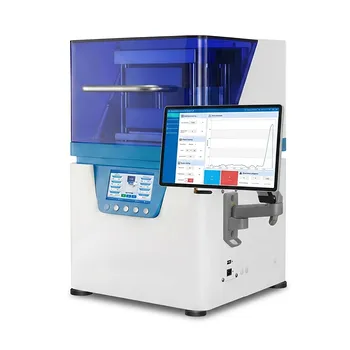
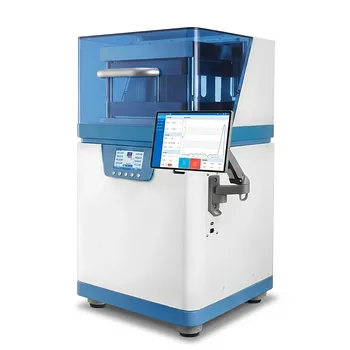
A laboratory hydraulic press is the critical instrument used to transform loose powders into dense, structurally sound solid targets. By applying precise, high-pressure forces—typically ranging from 20 to 30 MPa—the press compacts materials such as coal, metal catalysts, or polymers into pellets. This mechanical consolidation ensures the target possesses the internal strength and uniform density required to withstand high-energy laser pulses without shattering or cracking.
The laboratory hydraulic press facilitates the transition from loose powder to a solid-state target by inducing plastic deformation and particle interlocking. This process is essential for maintaining a constant ablation rate and ensuring signal stability during high-energy laser interactions.
The Role of Compaction in Target Integrity
Achieving Mechanical Strength and Structural Stability
The primary function of the hydraulic press is to provide the mechanical strength necessary for a sample to survive the ablation environment. High-energy lasers exert significant thermal and mechanical stress on the target surface. Without sufficient compaction, the target would likely crumble or shatter upon impact, prematurely ending the analytical process.
Overcoming Inter-particle Repulsion
At the microscopic level, the press forces powder particles into plastic deformation and rearrangement. This physical shift overcomes natural inter-particle repulsion, allowing particles to bond tightly through intermolecular forces. This bonding results in a "green compact" or pellet that can be handled and irradiated without losing its structural form.
Creating Optimal Surface Geometry
Using specialized high-precision molds, the press produces pellets with flat surfaces and specific shapes, such as 13 mm diameter cylinders. A flat, smooth surface is vital for maintaining a consistent distance between the laser source and the target. This geometric precision ensures that the laser energy density remains constant across the entire ablation area.
Impact on Laser Ablation Performance
Ensuring Compositional and Density Uniformity
Precise pressure control by the hydraulic press ensures uniform internal density throughout the pellet. If a target has varying density, the laser will remove material at different rates, leading to inconsistent results. Uniformity is especially critical when using nanosecond or femtosecond lasers to create micro-nanostructured surfaces.
Facilitating Stable Aerosol Output
In applications like mass spectrometry, the laser generates an aerosol from the solid target. A well-pressed pellet ensures a constant ablation rate, which translates to a stable and continuous aerosol output. This stability is the foundation for achieving high signal reproducibility and accurate analytical data.
Eliminating Optical Interference
For characterization techniques like FTIR or XRF, the press eliminates scattering interference in the optical path by ensuring consistent sample density. By removing internal voids and air pockets, the press allows for a clearer interaction between the light source and the substrate. This clarity is essential for the accurate analysis of substrate compositions.
Understanding the Trade-offs and Technical Limitations
Uniaxial vs. Isotropic Pressure
Most laboratory hydraulic presses apply uniaxial pressure, which can occasionally lead to slight density gradients within the pellet. For extremely demanding applications like Pulsed Laser Deposition (PLD), uniaxial molding is often just the first step. To achieve densities as high as 93%, an isostatic press may be required to apply isotropic pressure and eliminate remaining internal voids.
Pressure Sensitivity and Material Deformation
Not all materials respond to pressure in the same way; some may require specific durations, such as 15 minutes of sustained pressure, to achieve full deformation. Applying too much pressure can cause some powders to "cap" or laminate, where the pellet splits into layers upon release. Conversely, insufficient pressure results in a fragile target that may crack under the high-energy impact of the laser pulse.
Applying Compression Techniques to Your Project
Making the Right Choice for Your Goal
To ensure the best results for your specific laser ablation application, consider the following technical recommendations:
- If your primary focus is Pulsed Laser Deposition (PLD): Utilize the hydraulic press for initial uniaxial molding followed by isostatic pressing to maximize density and prevent target cracking.
- If your primary focus is Chemical Analysis (XRF/FTIR): Focus on precise pressure control and high-volume consistency to eliminate scattering interference and ensure accurate substrate characterization.
- If your primary focus is Micro-nanostructuring: Prioritize surface flatness and internal density uniformity to maintain a stable ablation rate with ultra-short pulse lasers.
By mastering the transition from powder to solid through controlled hydraulic pressure, you ensure the physical stability and analytical integrity of your laser ablation targets.
Summary Table:
| Key Feature | Role in Target Preparation | Impact on Laser Ablation |
|---|---|---|
| Mechanical Consolidation | Transforms loose powder into dense pellets (20-30 MPa) | Prevents shattering or cracking under high-energy pulses |
| Uniform Density | Eliminates internal voids and air pockets | Ensures a constant ablation rate and stable signal output |
| Geometric Precision | Produces flat, smooth surfaces with precision molds | Maintains consistent laser energy density across the sample |
| Particle Interlocking | Overcomes inter-particle repulsion via plastic deformation | Provides the structural integrity needed for sample handling |
Elevate Your Sample Preparation with KINTEK
Maximize the accuracy and reproducibility of your laser ablation results with KINTEK’s high-precision laboratory solutions. As experts in material science equipment, KINTEK specializes in a comprehensive range of hydraulic presses (pellet, hot, and isostatic) designed to produce high-density, uniform targets for even the most demanding applications like PLD and XRF.
Our extensive portfolio also features:
- Thermal Processing: Muffle, tube, vacuum, and CVD/PECVD furnaces.
- Sample Prep: Crushing, milling, sieving, and high-temperature high-pressure reactors and autoclaves.
- Advanced Research Tools: Electrolytic cells and electrodes, battery research consumables, and cooling solutions (ULT freezers, freeze dryers).
Don't let poor target integrity compromise your data. Contact our technical team today to find the perfect press or consumable for your laboratory's needs!
References
- Shaochuang Chen, Yan Li. Single-walled carbon nanotubes synthesized by laser ablation from coal for field-effect transistors. DOI: 10.1039/d3mh01053h
This article is also based on technical information from Kintek Solution Knowledge Base .
Related Products
- Laboratory Hydraulic Press Split Electric Lab Pellet Press
- Laboratory Hydraulic Press Lab Pellet Press Machine for Glove Box
- Laboratory Hydraulic Press Lab Pellet Press for Button Battery
- Fully Automatic Heated Hydraulic Lab Press for Materials Sintering and Sample Preparation
- Automatic Laboratory Hydraulic Pellet Press Machine for Lab Use
People Also Ask
- What are the roles of a laboratory hydraulic press and stainless steel molds in the preparation of graphite samples?
- What is the role of a laboratory hydraulic press in electrode prep? Maximize Energy Density & Sealing Precision
- How does a laboratory hydraulic press ensure the quality of alumina-forming alloy green bodies? Optimize CSP Research
- How is a laboratory hydraulic press used to evaluate the mechanical performance of nano-modified concrete? Expert Guide
- Why is a laboratory hydraulic press used for ASSB assembly? Achieving 392 MPa for Optimal Solid-State Battery Density