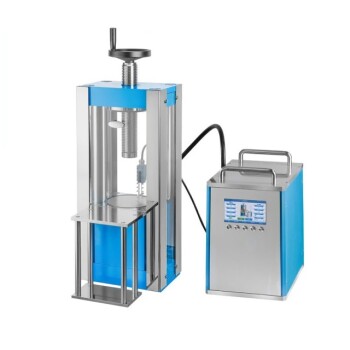
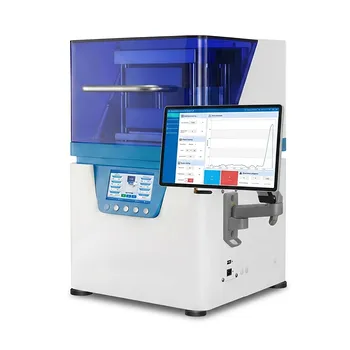
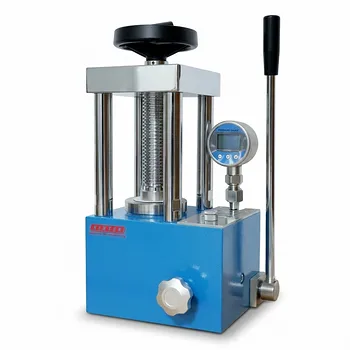
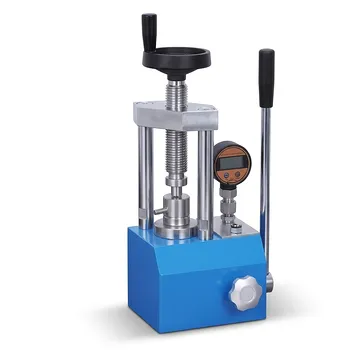
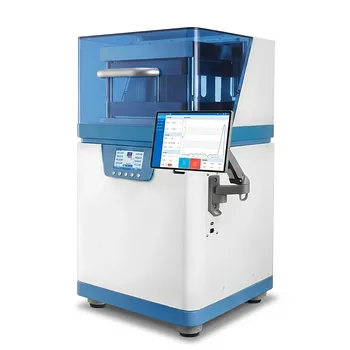
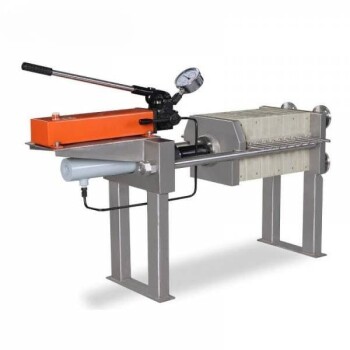
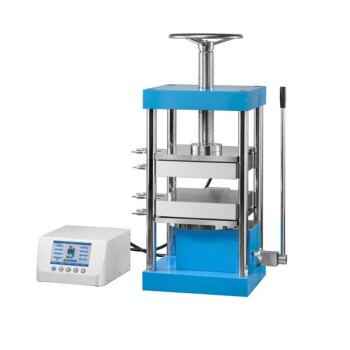
A laboratory hydraulic press is the foundational tool for densifying battery materials and ensuring the mechanical integrity of test cells. It applies stable, linear pressure to compact cathode powders into dense pellets and provides the high-force compression required to hermetically seal button cell casings.
Core Takeaway: The hydraulic press bridges the gap between loose powders and functional electrodes by minimizing interfacial resistance and maximizing volumetric energy density through controlled compaction and precision sealing.
Enhancing Electrode Performance Through Densification
Reducing Ohmic and Contact Resistance
The primary function of the press is to establish robust electronic contact paths between active material particles. By applying high-pressure molding, the press reduces the ohmic resistance within the electrode and ensures the active material layer is firmly bonded to the current collector.
Maximizing Volumetric Energy Density
Compaction is vital for achieving high area loading, which directly translates to a higher volumetric energy density. By eliminating internal porosity, the hydraulic press allows more active material to be packed into a smaller volume, reflecting the performance requirements of commercial-grade batteries.
Ensuring Uniform Current Distribution
When using irregular current collectors like steel mesh, a hydraulic press applies several tons of force to ensure tight mechanical contact. This uniformity prevents current "hot spots" and ensures that experimental data reflects the intrinsic properties of the material rather than artifacts caused by poor contact.
Establishing Critical Solid-State Interfaces
Bridging the Solid-Solid Gap
In solid-state battery research, the press is used for the uniaxial compression molding of mixed cathode and solid electrolyte powders. This process eliminates gaps between powder particles, creating the solid-solid interface necessary for efficient lithium-ion transport.
Constructing Ion Transport Channels
Densifying composite powders (such as sulfur, carbon, and sulfide electrolytes) ensures that the active storage materials are in constant contact with the electrolyte matrix. This creates effective ion transport channels, which are essential for the functionality of pellet-type electrodes.
Precision Assembly of Button Cells
Achieving Hermetic Seals
During the battery packaging phase, the hydraulic press—often equipped with specialized dies—acts as a sealer to ensure the casing is hermetically sealed. This prevents electrolyte leakage and protects internal components from air and moisture ingress, which could otherwise compromise safety and test accuracy.
Optimizing Internal Component Contact
The press applies consistent, monitorable vertical pressure to the entire cell stack, including the cathode, separator, and anode. This ensures the electrolyte fully wets the electrode pores and maintains physical contact between all internal layers, improving the reproducibility of experimental results.
Common Pitfalls to Avoid
Risks of Excessive Compaction Force
While high density is desirable, exceeding the optimal pressure can lead to particle fracturing or the deformation of the current collector. Over-compression may also close off necessary pathways for liquid electrolyte infiltration, paradoxically increasing resistance.
Impact of Non-Uniform Pressure Distribution
If the press platens are not perfectly parallel or the die is misaligned, the resulting electrode will have non-uniform density. This leads to uneven current distribution during cycling, which can cause premature cell failure and skewed data.
How to Apply This to Your Battery Research
Making the Right Choice for Your Goal
- If your primary focus is maximizing energy density: Use the press to achieve the highest possible compaction density without fracturing the active material particles.
- If your primary focus is solid-state battery fabrication: Prioritize uniaxial compression to eliminate voids at the electrolyte-electrode interface for better ion conductivity.
- If your primary focus is experimental reproducibility: Use a press with a digital pressure gauge to ensure identical sealing force is applied to every button cell in your test series.
Mastering the application of hydraulic pressure is essential for transforming raw powders into high-performance, reliable electrochemical devices.
Summary Table:
| Application Phase | Key Function | Impact on Battery Performance |
|---|---|---|
| Electrode Compaction | Densifies cathode powders & improves contact | Higher volumetric energy density & lower ohmic resistance |
| Solid-State Research | Uniaxial compression of composite powders | Creates seamless solid-solid interfaces for ion transport |
| Button Cell Assembly | Hermetic sealing of battery casings | Prevents electrolyte leakage and air/moisture ingress |
| Data Standardization | Uniform pressure application | Eliminates current hot spots and ensures reproducibility |
Elevate Your Battery Research with KINTEK Precision
Achieving consistent, high-performance results in battery R&D requires more than just high pressure—it requires absolute precision. KINTEK specializes in high-quality laboratory equipment designed to meet the rigorous demands of material science. Our comprehensive range of hydraulic presses (pellet, hot, and isostatic) is engineered to provide the stable, linear force necessary for superior electrode densification and hermetic cell sealing.
Beyond presses, KINTEK supports your entire workflow with:
- High-Temperature Furnaces: Muffle, tube, and vacuum systems for material synthesis.
- Processing Tools: Crushing and milling systems, sieving equipment, and high-pressure reactors.
- Battery Specialist Tools: Dedicated button cell dies, battery research consumables, and electrolytic cells.
- Thermal Management: Cooling solutions, including ULT freezers and freeze dryers for sensitive materials.
Ready to minimize resistance and maximize energy density in your test cells? Contact our technical experts today to find the perfect hydraulic press and consumable suite for your laboratory.
References
- Zhepu Shi, Maziar Ashuri. On the Electrochemical Properties of Carbon-Coated NaCrO2 for Na-Ion Batteries. DOI: 10.3390/batteries9090433
This article is also based on technical information from Kintek Solution Knowledge Base .
Related Products
- Laboratory Hydraulic Press Split Electric Lab Pellet Press
- Laboratory Hydraulic Press Lab Pellet Press Machine for Glove Box
- Laboratory Hydraulic Press Lab Pellet Press for Button Battery
- Automatic Laboratory Hydraulic Pellet Press Machine for Lab Use
- Fully Automatic Heated Hydraulic Lab Press for Materials Sintering and Sample Preparation
People Also Ask
- What are the roles of a laboratory hydraulic press and stainless steel molds in the preparation of graphite samples?
- How does a laboratory hydraulic press ensure the quality of alumina-forming alloy green bodies? Optimize CSP Research
- How is a laboratory hydraulic press used to evaluate the mechanical performance of nano-modified concrete? Expert Guide
- Why is a laboratory hydraulic press used for ASSB assembly? Achieving 392 MPa for Optimal Solid-State Battery Density
- How does a laboratory hydraulic press contribute to Fe-Cu-Ni-Sn-VN green bodies? Master High-Density Compaction