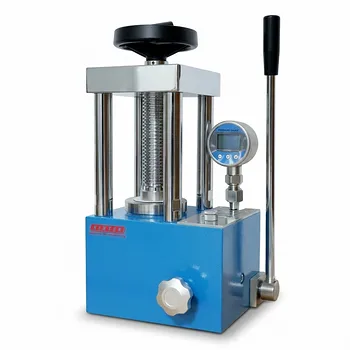
The primary role of a laboratory hydraulic press in the cold sintering pretreatment of BZY20 ceramics is to apply and sustain high mechanical pressure, typically up to 400 MPa. By compressing the moistened powder, the press forces particles into immediate, intimate contact, overcoming the physical gaps that exist in loose powder. When combined with a transient solvent like water, this high-pressure environment facilitates the mass transfer necessary to achieve high green density at significantly lower temperatures than traditional methods.
The hydraulic press acts as a catalyst for low-temperature densification, bridging the gap between simple physical packing and chemical activation. It enables the BZY20 compact to reach a green density of approximately 76% by driving the particle rearrangement and dissolution-precipitation processes simultaneously.
Mechanisms of Action
Forcing Particle Rearrangement
The fundamental function of the hydraulic press is the application of substantial mechanical force. By exerting pressures up to 400 MPa, the equipment overcomes inter-particle friction.
This force rearranges the BZY20 particles, eliminating large voids and creating a tightly packed structure. This physical proximity is a prerequisite for any subsequent chemical bonding to occur.
Activating the Solvent-Assisted Transport
The press does not operate in isolation; it works in tandem with a transient solvent, specifically water. The high pressure drives the solvent into the interfaces between ceramic particles.
This pressurized environment promotes mass transfer, allowing the material to move and fill interstitial spaces more efficiently than dry pressing alone.
Enabling Dissolution-Precipitation
To fully activate the cold sintering mechanism, the hydraulic press is often integrated with a heating device, such as heated platens or tapes.
By maintaining pressure while heating the sample to approximately 180°C, the system triggers a dissolution-precipitation process. This ensures that the BZY20 particles undergo preliminary chemical bonding and microstructural densification, rather than just physical compaction.
Impact on Material Quality
Maximizing Green Density
The most measurable outcome of using a hydraulic press in this context is the dramatic increase in green density.
While standard dry pressing yields porous bodies, the cold sintering pretreatment achieves densities of approximately 76 percent. This high baseline density is critical for reducing shrinkage and defects during the final high-temperature sintering stage.
Enhancing Green Strength
Beyond density, the press ensures the structural integrity of the ceramic compact, often referred to as "green strength."
Precise pressure control allows for the formation of a cohesive shape that can withstand handling. This reduces the risk of cracks or deformation before the final firing of the ceramic.
Operational Considerations and Trade-offs
The Requirement of Integrated Heating
Pressure alone is insufficient to achieve the full benefits of cold sintering pretreatment.
If the laboratory press lacks integrated heating capabilities to reach 180°C, the physicochemical mechanisms of dissolution-precipitation will not activate. Reliance on pressure alone without heat will result in simple compaction, failing to achieve the target 76% density.
Balancing Pressure and Pore Distribution
While high pressure is necessary for density, excessive or uneven pressure can lead to density gradients within the sample.
Precise control via the hydraulic system is required to ensure uniform pore size distribution. Poor control here can lead to warping or inconsistent functional properties in the final BZY20 ceramic.
Optimizing Your Pretreatment Strategy
To maximize the effectiveness of the hydraulic press during BZY20 pretreatment, align your parameters with your specific microstructural goals:
- If your primary focus is maximizing green density: Ensure your press is capable of sustaining 400 MPa and is equipped with heating elements to maintain 180°C during compression.
- If your primary focus is dimensional stability: Prioritize the precision of the hydraulic control system to ensure uniform pressure distribution, which minimizes density gradients and warping.
By strictly controlling both pressure and temperature, the laboratory hydraulic press serves as the critical enabler for creating high-density, defect-free BZY20 ceramic precursors.
Summary Table:
| Feature | BZY20 Pretreatment Requirement | Impact on Final Ceramic |
|---|---|---|
| Applied Pressure | Up to 400 MPa | Drives particle rearrangement & eliminates voids |
| Temperature | ~180°C (with integrated heating) | Activates dissolution-precipitation process |
| Solvent Role | Transient water-based solvent | Facilitates mass transfer & chemical bonding |
| Green Density | Reaches approximately 76% | Reduces shrinkage & defects during final firing |
| Structural Goal | High Green Strength | Ensures dimensional stability & handling integrity |
Elevate Your Materials Research with KINTEK Precision
Achieving a 76% green density in BZY20 ceramics requires more than just force—it requires the perfect synergy of high pressure and thermal control. KINTEK specializes in advanced laboratory hydraulic presses (pellet, hot, and isostatic) and high-temperature furnaces designed to meet the rigorous demands of cold sintering and material science.
Whether you are focusing on battery research, crushing and milling systems, or high-pressure reactors, our comprehensive portfolio provides the reliability and precision your lab deserves. From vacuum furnaces to specialized PTFE and ceramic consumables, we empower researchers to eliminate density gradients and maximize material quality.
Ready to optimize your sintering pretreatment? Contact our experts today to find the ideal equipment solution for your laboratory!
Related Products
- Laboratory Hydraulic Press Split Electric Lab Pellet Press
- Laboratory Hydraulic Press Lab Pellet Press Machine for Glove Box
- Laboratory Hydraulic Press Lab Pellet Press for Button Battery
- Automatic Laboratory Hydraulic Pellet Press Machine for Lab Use
- Automatic Laboratory Hydraulic Press for XRF & KBR Pellet Press
People Also Ask
- What role does a laboratory hydraulic press play in platinum recovery research? Enhancing Sample Precision
- What are the specific applications of a lab hydraulic press in biochar evaluation? Optimize density and data accuracy.
- What are the roles of a laboratory hydraulic press and stainless steel molds in the preparation of graphite samples?
- What is the role of a laboratory hydraulic press in electrode prep? Maximize Energy Density & Sealing Precision
- Why must a laboratory hydraulic press equipped with cylindrical molds be used when preparing BZY green bodies? High Density