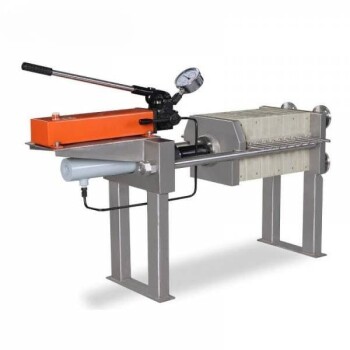
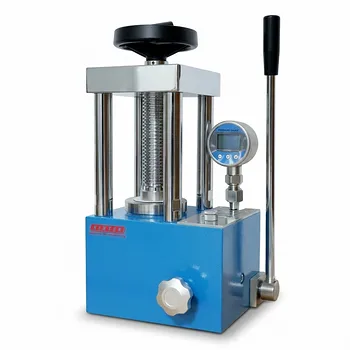
A laboratory hydraulic press serves as the fundamental instrument for densification in the fabrication of sulfide solid-state electrolytes like Li6PS5Cl. Its primary function is to apply precisely controlled, high-intensity uniaxial pressure—typically ranging from 50 to 370 MPa—to transform loose precursor powders into solid, structurally sound pellets.
The role of the hydraulic press extends beyond simple shaping; it is the critical driver of electrochemical performance. By mechanically forcing particles into intimate contact, the press eliminates inter-particle voids to maximize the material's ionic conductivity.
Achieving Critical Density Through Pressure
Applying High-Intensity Uniaxial Force
To create a functional electrolyte, loose powder must be compressed with significant force. A laboratory hydraulic press applies uniaxial pressure, generally between 50 and 370 MPa, to the sulfide powder.
Overcoming Elastic Recovery
Sulfide particles naturally resist compaction due to friction and elastic recovery. The high pressure generated by the press is required to overcome these forces, ensuring the powder particles pack tightly rather than springing back to their original state.
Minimizing Inter-particle Porosity
The primary physical goal of this process is densification. By subjecting the material to high pressure, the press drastically reduces the porosity (empty spaces) between particles, bringing the pellet's relative density closer to its theoretical maximum.
Enhancing Electrochemical Performance
Maximizing Contact Area
For a solid-state battery to function, lithium ions must move effectively through the material. The hydraulic press forces particles together, significantly increasing the contact area between them.
Creating Continuous Ion Pathways
This physical contact establishes continuous channels for ion transport. Without sufficient pressure, gaps between particles would act as barriers, blocking the movement of ions and rendering the electrolyte ineffective.
Improving Ionic Conductivity
The direct result of improved density and particle contact is a significant enhancement in ionic conductivity. By reducing grain boundary resistance (the resistance at the point where particles meet), the press ensures the material can conduct ions efficiently.
Advanced Processing Capabilities
Hot-Pressing for Plastic Deformation
Advanced hydraulic presses can apply heat and pressure simultaneously. This "hot-pressing" promotes plastic deformation and fusion of the sulfide particles, eliminating internal pores that cold-pressing might miss and further enhancing density.
Fabricating Multi-Layer Composites
The press facilitates the creation of tri-layer electrolytes through stepwise pressing. This allows researchers to integrate different functional layers—such as a highly conductive inner layer and chemically stable outer layers—into a single, cohesive unit.
Understanding the Trade-offs
The Challenge of Elastic Recovery
A major pitfall in pellet formation is elastic recovery, where the material expands slightly after pressure is released. If the forming pressure is too low (below the 300-450 MPa range often cited for optimal results), the pellet may retain voids or lack the mechanical strength to suppress metal dendrites.
Balancing Pressure and Integrity
While high pressure is essential, it must be applied uniformly. Inconsistent pressure application can lead to density gradients within the pellet, resulting in weak spots where ionic conductivity is compromised or where physical failure may occur during battery operation.
Making the Right Choice for Your Goal
To maximize the effectiveness of your hydraulic press operations, align your processing parameters with your specific research objectives:
- If your primary focus is maximizing ionic conductivity: Prioritize pressures at the higher end of the spectrum (370+ MPa) and consider hot-pressing to minimize grain boundary resistance.
- If your primary focus is dendrite suppression: Use stepwise pressing to create dense, multi-layered composites that combine high mechanical strength with chemical stability.
- If your primary focus is process efficiency: Ensure your press can maintain consistent uniaxial pressure to overcome elastic recovery without requiring excessive dwell times.
The laboratory hydraulic press is not merely a forming tool, but a precision instrument that dictates the ultimate efficiency and viability of solid-state electrolytes.
Summary Table:
| Feature | Role in Pellet Formation | Impact on Performance |
|---|---|---|
| Pressure Application | 50 - 370+ MPa Uniaxial Force | Overcomes elastic recovery & friction |
| Densification | Minimizes inter-particle porosity | Reaches near-theoretical material density |
| Particle Contact | Maximizes interfacial surface area | Reduces grain boundary resistance |
| Ion Pathways | Creates continuous channels | Significantly boosts ionic conductivity |
| Advanced Options | Hot-pressing & Stepwise pressing | Enables plastic deformation & multi-layers |
Elevate Your Solid-State Battery Research with KINTEK
Precision is paramount when fabricating high-performance electrolytes like Li6PS5Cl. KINTEK specializes in advanced laboratory equipment designed to meet the rigorous demands of material science. Our high-precision hydraulic presses (pellet, hot, isostatic) ensure uniform densification and optimal ionic conductivity for your research.
Beyond pressing, KINTEK offers a comprehensive portfolio including:
- High-Temperature Furnaces: Muffle, vacuum, and CVD systems for precursor synthesis.
- Processing Tools: Crushing, milling, and sieving equipment for powder preparation.
- Battery Research Solutions: High-pressure reactors, autoclaves, and specialized consumables.
Ready to achieve superior pellet density and electrochemical performance? Contact our technical experts today to find the perfect equipment solution for your lab!
Related Products
- Laboratory Hydraulic Press Lab Pellet Press Machine for Glove Box
- Laboratory Hydraulic Press Split Electric Lab Pellet Press
- Laboratory Hydraulic Press Lab Pellet Press for Button Battery
- Automatic Laboratory Hydraulic Press for XRF & KBR Pellet Press
- Automatic Laboratory Hydraulic Pellet Press Machine for Lab Use
People Also Ask
- What is the function of a laboratory hydraulic press in W-Cu composites? Control Porosity and Material Ratio
- What is the role of a laboratory hydraulic press in the initial stages of Li6PS5Cl preparation? Key to Green Pellets
- What role does a laboratory hydraulic press play in triboelectric testing? Achieve Precision Alloy Sample Prep
- How can a laboratory hydraulic press be applied to chitosan for wastewater treatment? Optimize Pores & Strength
- How do a precision laboratory hydraulic press and specialized molds contribute to the fabrication of spherical ceramic samples? Achieving High-Density Material Precision