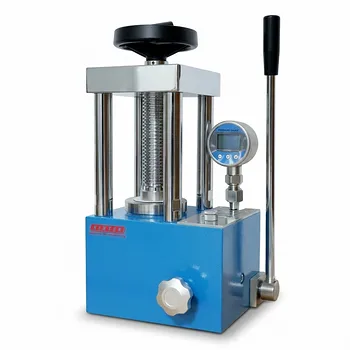
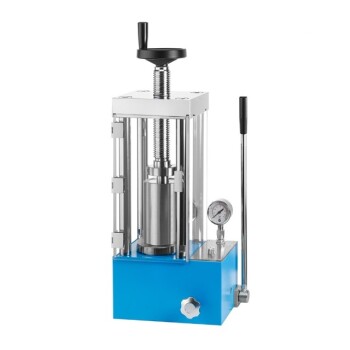
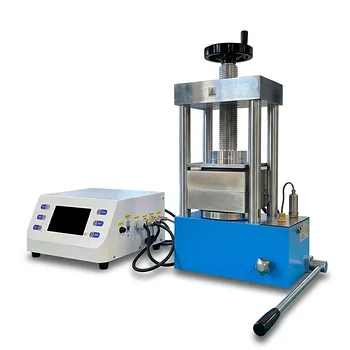
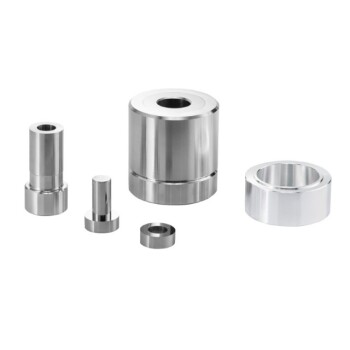
A laboratory manual hydraulic pellet press is the standard tool for converting powder samples into the solid, transparent form required for high-quality FTIR analysis. By applying high pressure to a mixture of your sample and potassium bromide (KBr), the press fuses the powder into a uniform disk. This physical transformation is critical for allowing infrared light to pass through the sample without distortion.
The core advantage of using a manual hydraulic press is the creation of a homogeneous, transparent pellet that minimizes light scattering. This directly improves data quality by producing infrared absorption spectra with stable baselines and sharp, clear characteristic peaks.
The Physics of Sample Preparation
Achieving Optical Transparency
For Fourier transform infrared spectroscopy (FTIR) to work effectively, the infrared light must pass through the sample matrix.
The hydraulic press exerts enough force to compress the abrasive KBr powder and your ground sample into a solid state. This process eliminates air gaps and creates a transparent medium necessary for accurate transmission analysis.
Ensuring Uniformity
Consistency is key to reproducible results. The press applies uniform force across the entire surface of the pellet die.
This ensures the sample is evenly distributed within the KBr matrix (typically at a 1:100 ratio). A uniform pellet prevents areas of high concentration that could block the signal or skew results.
Impact on Spectral Data Quality
Reducing Light Scattering
One of the biggest enemies of FTIR analysis is light scattering, which occurs when the sample surface is rough or the particles are too large.
By compressing the mixture into a smooth, dense pellet, the press significantly reduces light scattering interference. This ensures that the detector measures light absorption by the molecules, not light deflected by physical imperfections.
Stabilizing Baselines
A high-quality physical pellet leads to a high-quality spectral readout.
When the pellet is transparent and smooth, the resulting spectrum exhibits a stable baseline. A flat, stable baseline allows for accurate integration of peak areas, which is essential for quantitative analysis.
Clarifying Characteristic Peaks
The ultimate goal of using the press is resolution.
Because the press ensures proper dilution and transparency, the FTIR instrument can detect distinct chemical signatures. This results in clear characteristic peaks, allowing you to identify specific functional groups within your fiber or powder sample with high precision.
Understanding the Requirements
The Necessity of Dilution
The press is a powerful tool, but it relies on correct sample preparation.
You cannot press the raw sample alone; it must be diluted in a transparent medium like KBr. The press is designed specifically to consolidate this mixture, not to process raw undiluted materials.
Manual Precision
As a manual instrument, the quality of the pellet relies partly on the operator's consistency.
While the hydraulic mechanism provides the force, the user must ensure the die is loaded correctly. Achieving the "high-precision" mentioned requires attention to detail during the loading and pressurization steps to ensure the pellet does not fracture.
Making the Right Choice for Your Goal
To get the most out of your FTIR analysis, consider how the press supports your specific objectives:
- If your primary focus is Spectral Clarity: Use the press to maximize pressure and ensure high transparency, which directly results in sharper peaks and reduced noise.
- If your primary focus is Quantitative Analysis: Focus on the uniformity of the pellet to ensure a stable baseline, which is critical for accurate measurements of peak intensity.
By properly utilizing a hydraulic pellet press, you transform a loose powder into a precise optical element capable of delivering laboratory-grade data.
Summary Table:
| Advantage | Impact on FTIR Analysis | Key Benefit |
|---|---|---|
| Optical Transparency | Eliminates air gaps and light scattering | Maximizes IR light transmission |
| Uniform Force | Ensures even sample distribution in KBr matrix | Consistent, reproducible results |
| Physical Density | Creates a smooth, solid disk surface | Sharp characteristic peaks |
| Stable Baseline | Reduces signal noise and deflection | Accurate quantitative integration |
Elevate Your Laboratory Precision with KINTEK
High-quality spectral data starts with perfect sample preparation. KINTEK specializes in premium laboratory equipment, offering a robust range of manual and automatic hydraulic pellet presses designed specifically for high-precision FTIR and XRF applications.
Whether you are preparing KBr pellets or complex powder samples, our systems provide the uniform force required to achieve maximum transparency and stable baselines. Beyond pressing solutions, we support your entire workflow with our extensive portfolio, including:
- High-Temperature Furnaces (Muffle, Vacuum, CVD/PECVD)
- Crushing & Milling Systems for uniform powder preparation
- Ceramic Crucibles and PTFE Consumables
- High-Pressure Reactors & Autoclaves for advanced material synthesis
Ready to improve your analysis resolution? Contact our technical experts today to find the ideal pellet press and consumables for your research goals.
References
- Kaouther Zaafouri, Moktar Hamdi. Optimization of Hydrothermal and Diluted Acid Pretreatments of Tunisian<i>Luffa cylindrica</i>(L.) Fibers for 2G Bioethanol Production through the Cubic Central Composite Experimental Design CCD: Response Surface Methodology. DOI: 10.1155/2017/9524521
This article is also based on technical information from Kintek Solution Knowledge Base .
Related Products
- Laboratory Manual Hydraulic Pellet Press for Lab Use
- Laboratory Manual Hydraulic Pellet Press for Lab Use
- Automatic Laboratory Hydraulic Press for XRF & KBR Pellet Press
- Automatic Laboratory Hydraulic Pellet Press Machine for Lab Use
- kbr pellet press 2t
People Also Ask
- What is the role of a laboratory hydraulic pellet press and stainless steel molds in the fabrication of RuO2/NbC anodes?
- What is the necessity of using a laboratory hydraulic pellet press in the preparation of biomass fuel pellets? Guide
- What is the significance of applying 200 MPa of pressure with a laboratory hydraulic pellet press for composite ceramics?
- How does a laboratory hydraulic pellet press contribute to SiCw/2024 aluminum composite preforms? Optimize Densification
- Why use laboratory manual hydraulic presses for semiconductor pellets? Optimize Annealing & Crystalline Quality