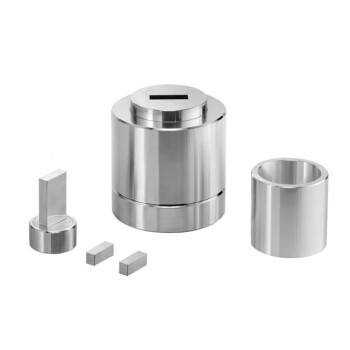
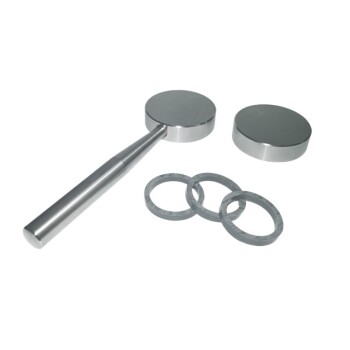
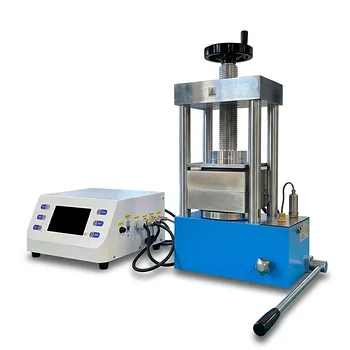
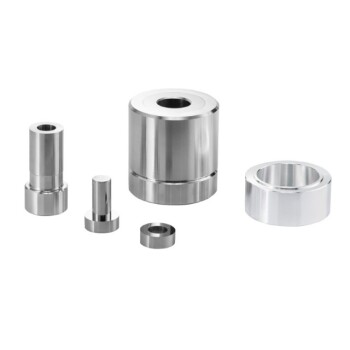
A laboratory hydraulic press is the critical instrument used to transform loose solid electrolyte powders into dense, testable pellets. It applies high pressure—typically ranging from 200 MPa to 600 MPa—to mechanically force particles together, creating a cohesive "green pellet" suitable for electrochemical analysis.
The Core Takeaway The press does not merely shape the sample; it fundamentally alters its microstructure to enable accurate testing. By eliminating internal voids and forcing particles into intimate contact, the hydraulic press minimizes grain boundary resistance, ensuring that subsequent measurements reflect the material's intrinsic ionic conductivity rather than the resistance of air gaps.
The Mechanism of Densification
Overcoming Porosity
Loose electrolyte powders naturally contain significant amounts of air and empty space between particles.
Ideally, ions must travel through a solid pathway. The hydraulic press applies massive force to collapse these voids, increasing the physical density of the pellet to approach the material's theoretical maximum density.
Leveraging Material Elasticity
The effectiveness of this process often depends on the material's mechanical properties.
For sulfide-based electrolytes, which typically possess a low elastic modulus, the high pressure effectively deforms the particles. This allows them to mat together tightly without the need for high-temperature treatment, creating a dense solid network purely through mechanical force.
Ensuring Data Accuracy
Reducing Grain Boundary Resistance
The primary barrier to ion movement in a pellet is often the interface between particles, known as the grain boundary.
If particles barely touch, the resistance is high, leading to artificially low conductivity readings. By compressing the material (often up to 400–490 MPa), the press maximizes the contact area between grains, significantly lowering this resistance.
Facilitating Electrode Contact
Accurate Electrochemical Impedance Spectroscopy (EIS) requires a seamless interface between the electrolyte and the blocking electrodes.
A proper pressing protocol ensures the pellet faces are uniform and dense. This creates an "intimate contact" with the electrodes, preventing interface artifacts from distorting the impedance data.
Enabling Reproducibility
Scientific validity relies on the ability to repeat results.
Using a hydraulic press to create pellets of uniform thickness (e.g., 13 mm diameter discs) ensures that the geometric factors of the test sample remain constant. This standardization allows researchers to compare conductivity data across different batches with confidence.
Understanding the Trade-offs
Pressure Sensitivity
While high pressure is generally beneficial for densification, it must be optimized for the specific material chemistry.
Primary references suggest 200–600 MPa for sulfides, while other contexts mention pressures as low as 10 MPa or specific loads for composites. Applying incorrect pressure can lead to insufficient density (too low) or potentially structural defects in the pellet (too high).
Material Limitations
The hydraulic press is highly effective for soft materials like sulfides, often rendering them test-ready immediately ("cold pressing").
However, for harder ceramic materials like pure oxides (e.g., LLZO), cold pressing alone may not yield sufficient conductivity ($10^{-9}$ S cm$^{-1}$). In these cases, the press is a precursor step to create a "green body" that requires subsequent high-temperature sintering to achieve the desired performance, unless specific composites are used.
Making the Right Choice for Your Goal
To obtain valid ionic conductivity data, you must tailor your pressing protocol to your specific material requirements.
- If your primary focus is measuring intrinsic conductivity: Apply high pressures (200–600 MPa) to eliminate as much porosity as possible and minimize grain boundary resistance.
- If your primary focus is preparing samples for sintering: Use the press to establish a uniform geometric form and sufficient green density to prevent the pellet from collapsing during heating.
- If your primary focus is testing sulfide electrolytes: Leverage their low elastic modulus by using cold pressing as your primary densification method, avoiding heat entirely.
Ultimately, the hydraulic press acts as a bridge between loose powder and reliable data, turning a raw material into a measurable electrochemical component.
Summary Table:
| Feature | Impact on Electrolyte Testing | Primary Benefit |
|---|---|---|
| Porosity Reduction | Eliminates air gaps and internal voids | Increases pellet density toward theoretical maximum |
| Grain Boundaries | Maximizes particle-to-particle contact area | Lowers resistance for accurate conductivity readings |
| Geometric Uniformity | Standardizes pellet thickness and diameter | Ensures reproducible EIS data and constant test factors |
| Electrode Interface | Creates a smooth, uniform pellet surface | Facilitates intimate contact with blocking electrodes |
| Material Adaptation | Adjusts pressure (200-600 MPa) by chemistry | Enables cold-pressing for sulfides or green bodies for oxides |
Elevate Your Battery Research with KINTEK Precision
Achieve the ultimate pellet density and data reproducibility with KINTEK’s advanced laboratory hydraulic presses. Whether you are working with sulfide electrolytes or preparing oxide green bodies, our range of pellet, hot, and isostatic presses is designed to minimize grain boundary resistance and optimize your EIS results.
Beyond pressing, KINTEK offers a comprehensive laboratory ecosystem including high-temperature furnaces, planetary ball mills, and specialized electrolytic cells to support every stage of your material science workflow.
Ready to transform your powders into high-performance test samples? Contact our technical experts today to find the perfect solution for your lab's specific pressure and material requirements.
Related Products
- Automatic Laboratory Hydraulic Press for XRF & KBR Pellet Press
- Automatic Laboratory Hydraulic Pellet Press Machine for Lab Use
- Laboratory Manual Hydraulic Pellet Press for Lab Use
- Laboratory Hydraulic Pellet Press for XRF KBR FTIR Lab Applications
- Laboratory Manual Hydraulic Pellet Press for Lab Use
People Also Ask
- What is the significance of applying 200 MPa of pressure with a laboratory hydraulic pellet press for composite ceramics?
- What is the role of a laboratory hydraulic pellet press and stainless steel molds in the fabrication of RuO2/NbC anodes?
- What is the necessity of using a laboratory hydraulic pellet press in the preparation of biomass fuel pellets? Guide
- How does a laboratory hydraulic pellet press contribute to SiCw/2024 aluminum composite preforms? Optimize Densification
- What role does a laboratory hydraulic pellet press play in fly ash utilization? Enhancing Adsorption and Flow Control