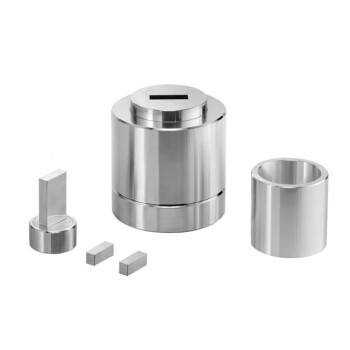
A laboratory hydraulic pellet press serves as the critical foundational step in creating Silicon Carbide whisker (SiCw) reinforced 2024 aluminum matrix composites. It functions by applying high mechanical pressure to convert loose powder mixtures into solid, geometrically defined preforms known as "green" bodies.
The core function of the pellet press is to maximize green density by mechanically eliminating air pockets trapped between powder particles. This compaction process establishes the necessary structural integrity required for successful densification during the subsequent vacuum hot press sintering stage.
The Mechanics of Preform Preparation
Consolidating Loose Powders
The primary input for this process is a loose mixture of 2024 aluminum powder and Silicon Carbide whiskers. The hydraulic press applies substantial mechanical pressure to force these separate particles together, overcoming their natural resistance to flow.
Establishing Structural Integrity
By compressing the material, the press transforms the undefined powder volume into a cohesive unit with a specific shape. This ensures the material holds its form during handling and transfer to the sintering furnace, preventing the segregation of the matrix and reinforcement materials.
Optimizing Material Microstructure
Eliminating Trapped Air
One of the most significant barriers to creating high-quality composites is porosity. The hydraulic press physically forces out air trapped between powder particles through compression. reducing the volume of voids within the material before heat is ever applied.
Increasing Green Density
The removal of air results in a higher green density, which refers to the density of the compacted powder before sintering. A higher green density significantly reduces the amount of shrinkage that occurs during later processing stages.
Facilitating the Sintering Process
Creating Favorable Sintering Conditions
The work done by the hydraulic press is a prerequisite for effective vacuum hot press sintering. By starting with a dense, air-free preform, the sintering process can focus on bonding particles rather than closing large gaps.
Enhancing Final Densification
The initial compaction creates a tightly packed particle arrangement. This proximity promotes efficient diffusion during the hot press phase, leading to a final composite with superior mechanical properties.
Understanding the Process Limitations
The Nature of "Green" Strength
It is important to recognize that the preform created by the press is a green body, not a finished part. While it possesses structural integrity, it relies solely on mechanical interlocking rather than metallurgical bonding.
Dependency on Sintering
The press prepares the potential for high density, but it does not finalize it. The preform remains porous relative to the final product and must undergo vacuum hot press sintering to achieve the actual mechanical strength and stiffness required for 2024 aluminum composites.
Making the Right Choice for Your Goal
To maximize the quality of your SiCw reinforced 2024 aluminum composites, consider how the pressing stage aligns with your objectives:
- If your primary focus is Handling and Shape: Ensure the press applies sufficient pressure to maintain geometric fidelity during transfer to the furnace.
- If your primary focus is Material Performance: Prioritize maximum compression to eliminate air pockets, as high green density directly correlates to better final densification.
The pellet press is not merely a shaping tool; it is a density-enhancing instrument that defines the success of the sintering process.
Summary Table:
| Stage of Preparation | Role of Hydraulic Pellet Press | Impact on Final Composite |
|---|---|---|
| Powder Consolidation | Compresses loose 2024 Al and SiC whiskers | Establishes geometric shape and structural integrity |
| Porosity Control | Eliminates trapped air between particles | Minimizes voids and prevents material segregation |
| Density Optimization | Maximizes initial green density | Reduces shrinkage and promotes efficient sintering |
| Pre-Sintering | Creates mechanical interlocking | Facilitates superior diffusion and mechanical bonding |
Elevate Your Composite Research with KINTEK Precision
Achieving the perfect green density is the first step toward high-performance materials. KINTEK specializes in advanced laboratory equipment designed for the most demanding material science applications. Whether you are developing SiCw-reinforced aluminum composites or exploring novel alloys, our high-precision hydraulic pellet presses (manual, electric, and isostatic) and vacuum hot press sintering systems provide the reliability you need.
Our comprehensive portfolio includes:
- Hydraulic Presses: Pellet, hot, and isostatic presses for superior compaction.
- High-Temperature Furnaces: Muffle, vacuum, and atmosphere furnaces for expert sintering.
- Milling Systems: Efficient crushing and milling for uniform powder preparation.
- Specialized Consumables: High-quality ceramics, crucibles, and PTFE products.
Ready to eliminate porosity and maximize the mechanical strength of your composites? Contact KINTEK today to find the ideal solution for your laboratory!
Related Products
- Laboratory Hydraulic Pellet Press for XRF KBR FTIR Lab Applications
- Automatic Laboratory Hydraulic Pellet Press Machine for Lab Use
- Laboratory Manual Hydraulic Pellet Press for Lab Use
- Automatic Laboratory Hydraulic Press for XRF & KBR Pellet Press
- Laboratory Hydraulic Press Lab Pellet Press for Button Battery
People Also Ask
- What is the role of a laboratory hydraulic pellet press and stainless steel molds in the fabrication of RuO2/NbC anodes?
- What is the necessity of using a laboratory hydraulic pellet press in the preparation of biomass fuel pellets? Guide
- What is the significance of applying 200 MPa of pressure with a laboratory hydraulic pellet press for composite ceramics?
- What function does a laboratory pellet press or rolling mill serve? Enhance Electrode Density and Performance
- What key role does a laboratory pellet press play in FTIR analysis? Master KBr Sample Preparation Excellence