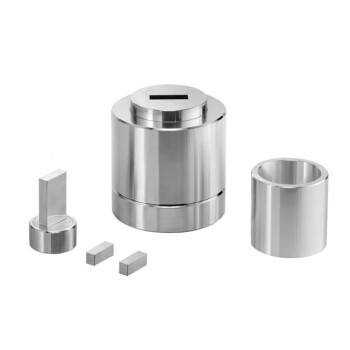
Applying 200 MPa of pressure is the critical threshold for transforming loose, mechanically milled powders into a cohesive, densely packed "green" body. This specific hydraulic pressure eliminates residual air voids between particles and forces them into intimate physical contact, creating the essential foundation for subsequent high-temperature processing.
By establishing high initial density and maximizing particle-to-particle contact, this pressure setting ensures the ceramic maintains its structural integrity during sintering and allows for efficient solid-phase reactions, ultimately preventing structural distortions in the final product.
Achieving Optimal Green Density
Eliminating Residual Air
In the formation of composite ceramics, air trapped between powder particles is a primary source of defects.
Applying 200 MPa of pressure effectively squeezes out this residual air. This prevents the formation of pores that could weaken the material later in the process.
Establishing Particle Contact
Mechanically milled powders require close proximity to interact chemically.
The hydraulic press forces these particles into close physical contact. This mechanical interlocking is necessary to turn a pile of dust into a solid shape that can be handled.
The Impact on High-Temperature Sintering
Ensuring Structural Integrity at 1500°C
The primary reference indicates that these samples undergo sintering at extremely high temperatures, specifically 1500°C.
Without the initial compaction provided by 200 MPa, the sample would likely crumble or crack under this thermal stress. The high-pressure forming ensures the sample retains its shape throughout this rigorous heating cycle.
Facilitating Solid-Phase Reactions
Ceramic formation often relies on solid-phase reactions, where atoms diffuse between particles without fully melting.
High density promotes these reactions by minimizing the distance atoms must travel. The pressure ensures the efficiency of these chemical changes, leading to a more uniform material.
Understanding the Risks of Inadequate Pressure
Preventing Structural Distortions
If the initial packing density is too low or uneven, the ceramic will shrink unpredictably during sintering.
Using 200 MPa helps eliminate structural distortions. It ensures that densification occurs uniformly, preventing warping or deformation in the final composite.
The Consequence of Poor Contact
If particles are not pressed tightly enough, the reaction interface is insufficient.
This leads to incomplete sintering and a final product with inferior mechanical properties. The pressure is the key variable that bridges the gap between raw powder and a solid, reacted ceramic.
Making the Right Choice for Your Goal
To ensure your composite ceramic samples succeed, align your process with these objectives:
- If your primary focus is Structural Stability: Ensure 200 MPa is applied to prevent the sample from disintegrating or warping during the 1500°C sintering phase.
- If your primary focus is Chemical Homogeneity: Use this pressure to maximize particle contact, which is required to drive efficient solid-phase reactions and eliminate porosity.
Correctly applying this pressure acts as the decisive step in converting raw potential into a durable, high-performance ceramic.
Summary Table:
| Key Benefit | Impact on Ceramic Processing | Final Product Outcome |
|---|---|---|
| Eliminating Residual Air | Prevents internal pores and structural voids | Increased mechanical strength and density |
| Maximizing Particle Contact | Facilitates efficient solid-phase reactions | Chemical homogeneity and uniform composition |
| Establishing Green Density | Maintains shape during 1500°C sintering | Prevention of structural distortions and warping |
| Mechanical Interlocking | Transforms loose powder into a cohesive body | Enhanced structural integrity and handleability |
Elevate Your Material Research with KINTEK Precision
High-performance composite ceramics demand the absolute consistency and power provided by KINTEK's professional laboratory hydraulic presses. Whether you are forming pellets for solid-phase reactions or preparing samples for sintering at 1500°C, our high-precision pellet, hot, and isostatic presses ensure you hit the critical 200 MPa threshold every time.
Why choose KINTEK?
- Comprehensive Lab Solutions: From high-temperature furnaces and crushing systems to specialized high-pressure reactors and autoclaves.
- Unmatched Durability: Engineered for rigorous research environments, ensuring uniform densification and preventing structural distortions.
- Expert Support: We specialize in laboratory equipment and consumables, including essential ceramics and crucibles for your most demanding applications.
Don't let inadequate pressure compromise your results. Contact us today to find the perfect hydraulic press for your laboratory!
References
- Daryn B. Borgekov, Dmitriy I. Shlimas. Effect of Phase Composition Variation of Oxy–Nitride Composite Ceramics on Heat Resistance and Preservation of Strength Parameters. DOI: 10.3390/cryst14080744
This article is also based on technical information from Kintek Solution Knowledge Base .
Related Products
- Laboratory Hydraulic Pellet Press for XRF KBR FTIR Lab Applications
- Automatic Laboratory Hydraulic Pellet Press Machine for Lab Use
- Laboratory Manual Hydraulic Pellet Press for Lab Use
- Automatic Laboratory Hydraulic Press for XRF & KBR Pellet Press
- Laboratory Hydraulic Press Lab Pellet Press for Button Battery
People Also Ask
- What is the role of a laboratory hydraulic pellet press and stainless steel molds in the fabrication of RuO2/NbC anodes?
- How does a laboratory hydraulic pellet press contribute to SiCw/2024 aluminum composite preforms? Optimize Densification
- What is the necessity of using a laboratory hydraulic pellet press in the preparation of biomass fuel pellets? Guide
- What function does a laboratory pellet press or rolling mill serve? Enhance Electrode Density and Performance
- What key role does a laboratory pellet press play in FTIR analysis? Master KBr Sample Preparation Excellence