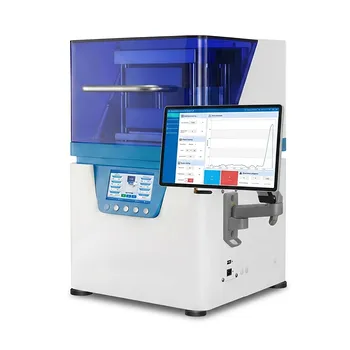
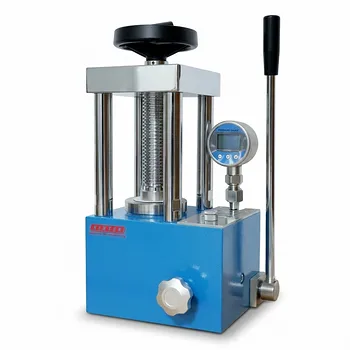
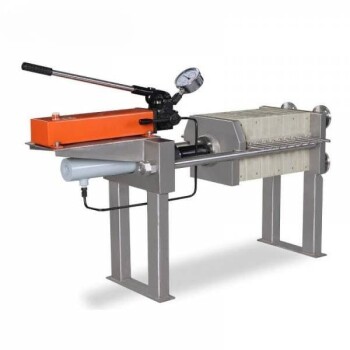
The laboratory hydraulic press is the cornerstone of specimen standardization. In foam glass research, it utilizes uniaxial pressing to transform loose glass powder and foaming agents into dense, geometrically precise "green bodies." This process ensures each sample possesses a consistent initial density and shape, which is the mandatory baseline for comparing volume expansion and thermal performance during subsequent firing.
The primary role of a laboratory hydraulic press is to consolidate powder mixtures into standardized pellets with uniform density and dimensions. This precision allows researchers to isolate material compositions as the primary variable, ensuring that differences in foam expansion or heat transfer are due to the material itself rather than physical inconsistencies in the sample.
The Foundation of Comparative Research
Achieving Geometric Consistency
The hydraulic press uses high-precision molds to apply axial pressure to a set amount of powder. This ensures that every green body produced has the exact same diameter and thickness.
Consistency in shape is critical for studying linear expansion and sintering characteristics. Without standardized dimensions, researchers cannot accurately measure how a material's volume changes when subjected to high temperatures in a furnace.
Ensuring Uniform Initial Density
By applying a constant force—often ranging from 10 MPa to 300 MPa—the press ensures that all samples start with the same internal packing. This consistency is vital for comparative studies of heat transfer efficiency.
Variations in initial density would lead to unpredictable volume expansion rates. A laboratory press eliminates this variable, providing a standardized geometric baseline for every experiment.
Particle-Level Optimization
Facilitating Solid-State Reactions
The high-pressure environment reduces the physical distance between powder particles, enhancing their contact area. This proximity is essential for diffusion-controlled chemical reactions during the firing process.
When particles are tightly packed, the thermal energy in the furnace can more effectively trigger the reactions needed for foaming. This pre-pressing stage creates the necessary physical environment for successful solid-state synthesis.
Eliminating Voids and Macropores
Compaction forces out the air trapped between loose particles, significantly reducing or eliminating internal macropores. This process establishes a homogenized internal structure within the green body.
Removing these voids is fundamental for achieving full densification in specialized glass or ceramic systems. It ensures that the final foam structure is the result of the foaming agent’s reaction, not accidental air pockets.
Structural and Mechanical Benefits
Developing Handling Strength
The pressure applied by the hydraulic press facilitates particle rearrangement and mechanical interlocking. This gives the green body sufficient preliminary mechanical strength to be handled without crumbling.
While the green body is not yet a finished product, it must be robust enough for transport into a tube furnace or onto a sintering tray. The press provides this "green strength" through high-tonnage axial consolidation.
Increasing Particle Coordination
High axial pressure increases the coordination number, or the number of contact points each particle has with its neighbors. This improved packing density is a prerequisite for reaching high relative density in technical glass applications.
A higher coordination number leads to more uniform sintering. This ensures that the material expands or densifies evenly, preventing warping or structural failure during the research phase.
Understanding the Trade-offs and Constraints
Pressure Limits and Material Deformation
While higher pressure generally increases density, exceeding the material's limit can lead to capping or lamination. These are structural defects where the pellet splits into layers due to stored elastic energy.
Researchers must find the "sweet spot" for each specific glass mixture. Too little pressure results in a fragile sample, while too much can cause micro-cracking that ruins the foaming process.
Mold Wear and Contamination
Repeated use of high-tonnage pressure can lead to wear on the tungsten carbide or hardened steel molds. This wear can slightly alter the dimensions of the green body over time.
Additionally, without proper lubrication or cleaning, particles can adhere to the mold walls. This causes surface irregularities that may interfere with the precision of linear expansion measurements.
Making the Right Choice for Your Goal
How to Apply This to Your Research
- If your primary focus is experimental repeatability: Use a digital hydraulic press to ensure the exact same axial load is applied to every 1-gram sample to minimize density deviations.
- If your primary focus is achieving maximum foam density: Focus on increasing the compaction pressure to the highest safe limit of your material to maximize particle contact and coordination.
- If your primary focus is studying expansion kinetics: Ensure your mold dimensions are perfectly calibrated to establish a precise volumetric baseline before the firing stage begins.
The laboratory hydraulic press is not merely a shaper of materials, but the essential tool for ensuring scientific integrity through physical standardization.
Summary Table:
| Key Role | Research Benefit | Critical Parameter |
|---|---|---|
| Geometric Consistency | Enables accurate linear expansion & sintering measurements | Mold Dimensions |
| Density Control | Ensures uniform initial packing for comparative heat transfer | Pressure (10-300 MPa) |
| Particle Proximity | Facilitates solid-state reactions and diffusion during firing | Contact Area |
| Structural Integrity | Develops "green strength" for handling without crumbling | Coordination Number |
| Void Elimination | Removes internal macropores for homogenized structure | Compaction Force |
Standardize Your Research with KINTEK Precision
Consistency is the backbone of material science. KINTEK specializes in high-performance laboratory equipment designed to deliver repeatable results for foam glass, ceramics, and battery research.
Our comprehensive portfolio features:
- Hydraulic Presses: Pellet, hot, and isostatic presses for superior green body consolidation.
- Thermal Solutions: Muffle, tube, vacuum, and atmosphere furnaces for precise sintering and foaming.
- Sample Prep: Crushing and milling systems, sieving equipment, and essential consumables like crucibles and ceramics.
Whether you are a researcher aiming for scientific integrity or a distributor seeking reliable supply and OEM support, KINTEK provides the technical expertise and high-quality tools you need.
Ready to enhance your lab's efficiency? Contact KINTEK today to get a quote!
References
- Sonja Smiljanić, Jakob König. Water-Glass-Assisted Foaming in Foamed Glass Production. DOI: 10.3390/ceramics6030101
This article is also based on technical information from Kintek Solution Knowledge Base .
Related Products
- Laboratory Hydraulic Press Split Electric Lab Pellet Press
- Laboratory Hydraulic Press Lab Pellet Press Machine for Glove Box
- Laboratory Hydraulic Press Lab Pellet Press for Button Battery
- Automatic Laboratory Hydraulic Pellet Press Machine for Lab Use
- Fully Automatic Heated Hydraulic Lab Press for Materials Sintering and Sample Preparation
People Also Ask
- What role does a laboratory hydraulic press play in platinum recovery research? Enhancing Sample Precision
- What are the specific applications of a lab hydraulic press in biochar evaluation? Optimize density and data accuracy.
- What are the roles of a laboratory hydraulic press and stainless steel molds in the preparation of graphite samples?
- What is the role of a laboratory hydraulic press in electrode prep? Maximize Energy Density & Sealing Precision
- Why must a laboratory hydraulic press equipped with cylindrical molds be used when preparing BZY green bodies? High Density