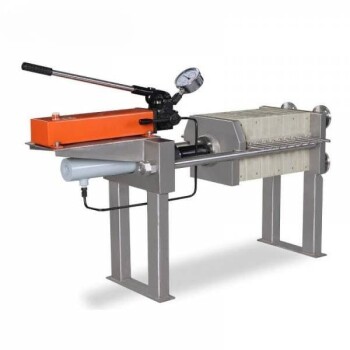
The primary purpose of a laboratory hydraulic press in preparing polyricinoleate thermoset elastomer films is to convert vulcanized bulk material into standardized, high-density samples through the simultaneous application of heat and pressure. This process is critical for eliminating internal structural defects and ensuring the uniform thickness required for valid experimental data.
The press serves as a standardization tool that eliminates air bubbles and compacts polymer chains. Without this densification, the material would lack the structural integrity necessary for reliable mechanical performance evaluations.
The Mechanics of Film Formation
Simultaneous Heat and Pressure application
A laboratory hydraulic press does not simply flatten material; it creates a controlled environment for deformation.
By applying precise temperature alongside high pressure, the press forces the vulcanized bulk polyricinoleate to flow and fill a mold completely.
Elimination of Internal Defects
One of the most critical functions of this process is the removal of microscopic flaws.
The high pressure effectively squeezes out internal air bubbles that are often trapped during the initial bulk preparation.
This results in a void-free structure, which is essential for determining the true properties of the material rather than the properties of its defects.
Densification of Polymer Chains
Beyond removing air, the press alters the microscopic arrangement of the material.
Under pressure, the polymer chains are forced into a tighter, more compact arrangement.
This leads to a film with higher density and greater structural coherence compared to non-pressed samples.
Why Uniformity Determines Data Validity
Ensuring Geometric Consistency
For any scientific measurement, the physical dimensions of the sample must be consistent.
The hydraulic press ensures that the resulting thin film has a uniform thickness across its entire surface area.
This regularity allows researchers to isolate material variables without worry that thickness variations are skewing the results.
Enabling Standardized Testing
The ultimate goal of preparing these films is usually to assess mechanical performance.
Tests such as tensile strength and elongation at break require samples to be homogeneous and defect-free to yield reproducible data.
If the sample contains air bubbles or loose chain arrangements, it will fail prematurely, producing inaccurate performance metrics.
Common Pitfalls to Avoid
The Risk of Inadequate Pressure
While the press is a powerful tool, it relies on the correct parameter settings to be effective.
If the pressure applied is insufficient, air pockets may remain trapped within the elastomer matrix.
This results in a "Swiss cheese" effect that significantly compromises the mechanical strength of the film.
Temperature Control Accuracy
The "thermoset" nature of polyricinoleate requires precise thermal management during pressing.
If the temperature is too low, the material may not deform sufficiently to fill the mold corners.
Conversely, excessive heat could degrade the polymer chains before the film is fully formed.
Making the Right Choice for Your Goal
To ensure your polyricinoleate samples yield valid scientific data, consider the following based on your specific testing needs:
- If your primary focus is Mechanical Testing (Tensile/Elongation): Prioritize high-pressure settings to maximize density and eliminate potential failure points like air bubbles.
- If your primary focus is Comparative Analysis: Ensure identical temperature and pressure protocols are used for every batch to maintain strict geometric uniformity across all samples.
The laboratory hydraulic press is the bridge between raw chemical synthesis and verifiable physical data.
Summary Table:
| Feature | Purpose in Film Preparation | Impact on Research Data |
|---|---|---|
| High Pressure | Eliminates internal air bubbles and voids | Prevents premature failure during tensile testing |
| Controlled Heating | Enables material flow and mold filling | Ensures uniform thickness and geometric consistency |
| Densification | Compacts polymer chains for higher density | Provides reproducible mechanical performance metrics |
| Precision Molds | Standardizes sample dimensions | Isolates material variables from geometric flaws |
Elevate Your Materials Research with KINTEK Precision
Achieving valid experimental data for polyricinoleate thermoset elastomers requires more than just chemistry—it requires the precise application of heat and pressure. KINTEK specializes in high-performance laboratory hydraulic presses (pellet, hot, isostatic) designed to eliminate structural defects and ensure the densification necessary for reliable tensile and elongation testing.
Beyond our industry-leading presses, our comprehensive portfolio includes high-temperature furnaces, crushing and milling systems, and specialized consumables such as PTFE and ceramic crucibles to support every stage of your laboratory workflow.
Ready to eliminate variables and standardize your sample preparation? Contact our technical experts today to find the perfect equipment solution for your research goals.
References
- Ashlyn D. Smith, Rhett C. Smith. Sulfur-Containing Polymers Prepared from Fatty Acid-Derived Monomers: Application of Atom-Economical Thiol-ene/Thiol-yne Click Reactions and Inverse Vulcanization Strategies. DOI: 10.3390/suschem1030015
This article is also based on technical information from Kintek Solution Knowledge Base .
Related Products
- Laboratory Hydraulic Press Split Electric Lab Pellet Press
- Laboratory Hydraulic Press Lab Pellet Press Machine for Glove Box
- Laboratory Hydraulic Press Lab Pellet Press for Button Battery
- Automatic Laboratory Hydraulic Pellet Press Machine for Lab Use
- Automatic Laboratory Hydraulic Press for XRF & KBR Pellet Press
People Also Ask
- What are the roles of a laboratory hydraulic press and stainless steel molds in the preparation of graphite samples?
- What is the role of a laboratory hydraulic press in electrode prep? Maximize Energy Density & Sealing Precision
- How does a laboratory hydraulic press ensure the quality of alumina-forming alloy green bodies? Optimize CSP Research
- How is a laboratory hydraulic press used to evaluate the mechanical performance of nano-modified concrete? Expert Guide
- Why is a laboratory hydraulic press used for ASSB assembly? Achieving 392 MPa for Optimal Solid-State Battery Density