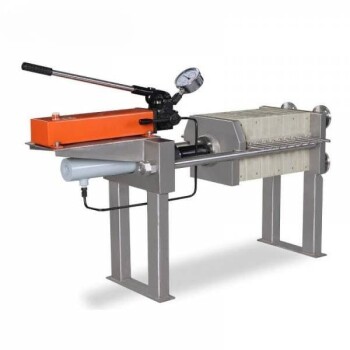
The laboratory hydraulic press acts as the primary quality gatekeeper for alumina-forming alloy research by establishing the fundamental structural integrity of the material before any heat is applied. It ensures quality by applying precise, uniform pressure to alloy powder molds, creating a "green body" with consistent density and minimal internal voids, which is essential for stable performance during the intense thermal cycles of Concentrated Solar Power (CSP) applications.
Core Takeaway The hydraulic press does not merely shape the powder; it mechanically locks particles together to define the material's future microstructure. By maximizing density and particle contact at the green stage, the press prevents catastrophic defects—such as cracking or heterogeneous melting—during the subsequent high-temperature sintering or melting processes required for CSP alloys.
Establishing Microstructural Integrity
The primary function of the hydraulic press is to convert loose powder into a cohesive solid without the use of heat. This physical transformation dictates the quality of the final alloy.
Precise Density Control
A laboratory hydraulic press allows researchers to apply specific, regulated pressure to the mold. This control results in a highly consistent density across the entire geometry of the green body. Uniform density is the single most critical factor in preventing warping or uneven shrinkage later in the process.
Minimizing Microscopic Defects
By compressing the powder, the press forces air out and reduces the space between particles. This minimizes internal voids and microscopic defects. If these voids remain in the green body, they become stress concentration points that lead to failure when the material is subjected to thermal stress.
Enhancing Particle Contact
For alumina-forming alloys, the press reduces gaps to the point of physical contact. This tight contact is necessary to facilitate mass transport and grain bonding. Without this initial mechanical proximity, the diffusion required during sintering would be inefficient or impossible.
The Mechanics of Green Body Formation
Beyond simple compaction, the hydraulic press induces mechanical changes at the particle level that provide the "green strength" necessary for handling.
Deformation of Ductile Components
In alloys containing ductile elements like aluminum or titanium, the high axial pressure causes these particles to deform. This deformation creates mechanical interlocking between the harder and softer particles, binding the mix together physically.
Binder-Free Structural Strength
Because of this mechanical interlocking, the green body achieves sufficient strength to be handled, measured, and moved into furnaces without the need for additional chemical binders. This is crucial for CSP research, as binders can introduce impurities that alter the alloy's high-temperature oxidation resistance.
Geometric Precision
The press utilizes precision molds to ensure the green body maintains a specific geometric shape (often cylindrical or disc-shaped). Maintaining geometric integrity is vital for consistent testing conditions, ensuring that results regarding heat transfer or electrical conductivity are reproducible.
Preparing for High-Temperature Processing
The quality of the green body directly determines the success of the downstream heating processes, such as sintering at temperatures up to 1600°C or vacuum arc melting.
Preventing High-Temperature Cracking
A well-pressed green body resists thermal shock. By minimizing macro defects and internal voids, the press effectively prevents cracking or severe deformation during the ramp-up to high sintering temperatures.
Stabilizing Melting Behavior
For processes involving vacuum arc melting, the press creates a stable electrode or charge morphology. A dense, well-formed pellet ensures continuity of current conduction and concentrates heat distribution, preventing erratic melting that could ruin the alloy composition.
Understanding the Trade-offs
While the laboratory hydraulic press is essential, it is important to recognize the limitations of uniaxial pressing to ensure data accuracy.
Density Gradients
In uniaxial pressing, friction between the powder and the mold walls can create density gradients, where the edges are denser than the center (or vice versa). For extremely tall samples, this non-uniformity can lead to inconsistent properties even if the correct pressure is applied.
Geometric Limitations
The hydraulic press is generally limited to simple shapes, such as discs or cylinders. It cannot produce the complex geometries possible with injection molding. Researchers must account for this by machining the sample after sintering if complex shapes are required for CSP component prototypes.
Making the Right Choice for Your Goal
To maximize the quality of your alumina-forming alloys, tailor your pressing strategy to your specific experimental needs:
- If your primary focus is Vacuum Arc Melting: Prioritize high compaction pressure to ensure maximum electrical continuity and heat concentration within the electrode charge.
- If your primary focus is Solid-State Sintering: Prioritize uniform density distribution to facilitate even grain growth and prevent warping during the long diffusion process at 1600°C.
- If your primary focus is Impurity Control: Leverage the press's ability to create mechanically interlocked bodies to eliminate binders completely, ensuring the chemical purity of your alloy.
The hydraulic press is not just a shaping tool; it is the instrument that defines the potential success of every subsequent thermal experiment.
Summary Table:
| Quality Factor | Role of Hydraulic Press | Impact on CSP Research |
|---|---|---|
| Structural Integrity | Mechanical interlocking of particles | Prevents breakage during furnace handling |
| Density Control | Uniform pressure application | Eliminates warping and uneven shrinkage |
| Void Reduction | Expels trapped air/internal gaps | Prevents cracking under extreme thermal stress |
| Chemical Purity | Binder-free compaction | Ensures high-temperature oxidation resistance |
| Process Stability | Geometric & conductivity precision | Facilitates stable melting and efficient sintering |
Elevate Your Materials Research with KINTEK Precision
Ensure the success of your high-temperature experiments with KINTEK’s premium laboratory hydraulic presses. Whether you are developing alumina-forming alloys for CSP applications or researching advanced ceramics, our pellet, hot, and isostatic presses deliver the uniform density and structural integrity your green bodies require.
Beyond compaction, KINTEK offers a full ecosystem of laboratory solutions, including:
- High-Temperature Furnaces: Muffle, vacuum, and tube furnaces for flawless sintering.
- Crushing & Milling: Precision systems to prepare your alloy powders.
- Essential Consumables: High-quality crucibles, ceramics, and PTFE products.
Ready to minimize defects and maximize research accuracy? Contact KINTEK today to find the perfect equipment for your lab’s specific needs!
References
- Ángel G. Fernández, Luisa F. Cabeza. Anodic Protection Assessment Using Alumina-Forming Alloys in Chloride Molten Salt for CSP Plants. DOI: 10.3390/coatings10020138
This article is also based on technical information from Kintek Solution Knowledge Base .
Related Products
- Laboratory Hydraulic Press Split Electric Lab Pellet Press
- Laboratory Hydraulic Press Lab Pellet Press Machine for Glove Box
- Laboratory Hydraulic Press Lab Pellet Press for Button Battery
- Automatic Laboratory Hydraulic Pellet Press Machine for Lab Use
- Automatic Laboratory Hydraulic Press for XRF & KBR Pellet Press
People Also Ask
- What are the roles of a laboratory hydraulic press and stainless steel molds in the preparation of graphite samples?
- What is the role of a laboratory hydraulic press in electrode prep? Maximize Energy Density & Sealing Precision
- How is a laboratory hydraulic press used to evaluate the mechanical performance of nano-modified concrete? Expert Guide
- Why is a laboratory hydraulic press used for ASSB assembly? Achieving 392 MPa for Optimal Solid-State Battery Density
- How does a laboratory hydraulic press contribute to Fe-Cu-Ni-Sn-VN green bodies? Master High-Density Compaction