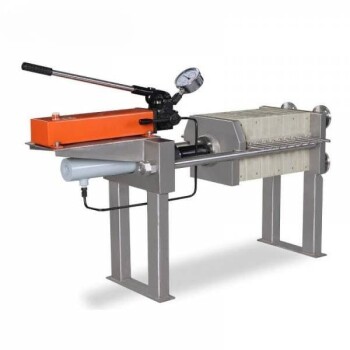
Laboratory hydraulic presses are critical instruments in solid-state battery assembly because they overcome the fundamental inability of solid materials to naturally wet surfaces. By applying extreme pressures, such as 392 MPa, these presses force solid powders to behave like fluids temporarily, merging distinct layers into a single, cohesive unit.
The Core Insight: Unlike liquid electrolytes that naturally fill gaps, solid-state electrolytes require mechanical force to establish connectivity. High-pressure hydraulic pressing induces plastic deformation, eliminating microscopic voids and creating the low-impedance solid-solid interfaces strictly necessary for ion transport.
The Challenge of Solid-Solid Interfaces
The "Wetting" Problem
In traditional batteries, liquid electrolytes flow into porous electrodes, ensuring ions can move freely. Solid-state batteries lack this mechanism; the electrolyte and electrode are rigid powders.
The Barrier of Voids
Without intervention, the gaps (voids) between these powder particles act as insulators. These voids break the path for lithium ions, resulting in extremely high interfacial impedance.
The Necessity of Contact
For an all-solid-state battery (ASSB) to operate, the solid electrolyte must touch the active cathode material physically. Any loss of contact effectively disables that portion of the battery.
Achieving Densification Through Mechanics
Inducing Plastic Deformation
The application of high pressures (e.g., 392 MPa) is not merely about compaction; it is about altering material shape. The pressure forces the powder particles to undergo plastic deformation, permanently changing their shape to fill available space.
Leveraging Material Deformability
This process relies on the deformability of specific solid electrolytes, such as LiBH4 or sulfides. Under high uniaxial pressure, these materials soften and mold themselves around the harder cathode particles.
Creating a Monolithic Structure
The result is cold-pressing densification. The press transforms loose, porous layers into a dense, monolithic block where cathode particles are tightly embedded within the solid electrolyte matrix.
The Impact on Battery Performance
Minimizing Grain Boundary Resistance
By eliminating voids, the press maximizes the contact area between particles. This significantly reduces the resistance encountered by ions as they cross from one particle to another (grain boundaries).
Optimizing Ion Transport
A dense, void-free electrolyte layer creates continuous pathways for ion movement. This is the primary factor that lowers the overall internal resistance of the battery, enabling efficient charging and discharging.
Enhancing Energy Density
Compacting the materials increases the volumetric energy density (Wh/l). By removing air and compressing the structure, more active material is packed into the same physical volume.
Understanding the Trade-offs
Uniaxial vs. Isostatic Pressure
A laboratory hydraulic press typically applies uniaxial pressure (pressure from one direction). While effective for flat, planar test cells, it may produce density gradients in thicker or more complex structures.
The Risk of Incomplete Densification
If the applied pressure is insufficient for the specific materials used, "interface voids" will remain. Even microscopic gaps will lead to poor electrochemical performance and potential battery failure.
Material Limitations
The success of this method depends on the electrolyte's ability to deform. Brittle materials may fracture rather than deform under high pressure, potentially damaging the internal structure of the battery.
Making the Right Choice for Your Goal
To maximize the effectiveness of high-pressure assembly, consider your specific objectives:
- If your primary focus is lowering impedance: Ensure you apply pressure that exceeds the yield strength of your electrolyte to guarantee full plastic deformation and void elimination.
- If your primary focus is material compatibility: Select electrolytes with high deformability (like sulfides or complex hydrides) to ensure they can mold around electrode particles without fracturing.
- If your primary focus is structural integrity: Monitor the pressure duration and intensity to achieve a dense, monolithic structure that minimizes volume changes during operation.
Ultimately, the hydraulic press acts as a mechanical bridge, substituting the fluidity of liquids with force to create the contiguous pathways essential for solid-state energy storage.
Summary Table:
| Feature | Impact on ASSB Performance | Mechanical Mechanism |
|---|---|---|
| Plastic Deformation | Fills microscopic gaps & voids | High uniaxial pressure (392+ MPa) |
| Interface Contact | Lowers interfacial impedance | Solid electrolyte molding around cathode |
| Cold Densification | Creates a monolithic structure | Compaction of rigid powder layers |
| Ion Path Optimization | Minimizes grain boundary resistance | Continuous pathways for ion transport |
| Volumetric Density | Increases Wh/l capacity | Removal of air and compression of materials |
Elevate Your Battery Research with KINTEK Precision
Don't let interfacial impedance hinder your solid-state breakthroughs. KINTEK specializes in advanced laboratory equipment designed for the rigorous demands of ASSB development. From high-performance hydraulic presses (pellet, hot, and isostatic) capable of achieving critical densification pressures to our specialized battery research tools and consumables, we provide the mechanical precision needed to transform loose powders into high-density energy storage solutions.
Our expertise extends to high-temperature high-pressure reactors, crushing and milling systems, and a full range of ceramic and PTFE consumables to support your entire workflow.
Ready to achieve superior cell performance? Contact KINTEK today to find the perfect press for your lab!
Related Products
- Laboratory Hydraulic Press Split Electric Lab Pellet Press
- Laboratory Hydraulic Press Lab Pellet Press Machine for Glove Box
- Laboratory Hydraulic Press Lab Pellet Press for Button Battery
- Automatic Laboratory Hydraulic Pellet Press Machine for Lab Use
- Automatic Laboratory Hydraulic Press for XRF & KBR Pellet Press
People Also Ask
- What are the roles of a laboratory hydraulic press and stainless steel molds in the preparation of graphite samples?
- What is the role of a laboratory hydraulic press in electrode prep? Maximize Energy Density & Sealing Precision
- How does a laboratory hydraulic press ensure the quality of alumina-forming alloy green bodies? Optimize CSP Research
- How is a laboratory hydraulic press used to evaluate the mechanical performance of nano-modified concrete? Expert Guide
- How does a laboratory hydraulic press contribute to Fe-Cu-Ni-Sn-VN green bodies? Master High-Density Compaction