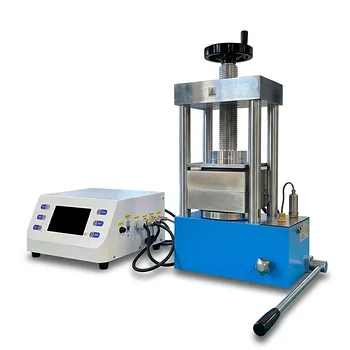
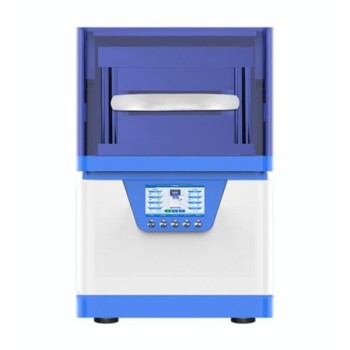
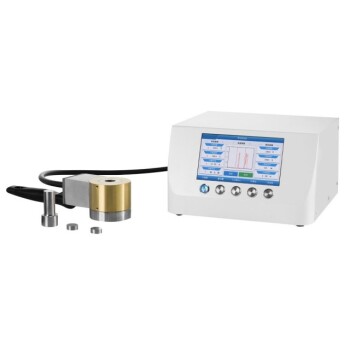
A heated hydraulic press acts as a dual-control environment, applying simultaneous temperature and pressure to the materials to alter their physical state. This specific combination exploits the thermoplastic behavior of Polyethylene Oxide (PEO) polymers, allowing them to be manipulated far more effectively than mechanical pressure alone would allow.
By softening the polymer while applying force, the hot press enables the formation of ultra-thin films and drives the material into microscopic ceramic pores. This process is the foundational step for establishing tight contact and significantly reducing interfacial resistance in solid-state batteries.
Mechanisms of Interface Formation
Leveraging Thermoplastic Properties
The primary technical condition provided is the precise application of heat to utilize the thermoplastic properties of PEO.
This softens the polymer, transitioning it from a rigid state to a malleable one. This thermal softening is a prerequisite for effective shaping and bonding within the battery stack.
Creating Ultra-Thin Films
Once the PEO is softened, the hydraulic aspect of the press applies uniform pressure.
This force flattens the malleable polymer into extremely thin films. Minimizing film thickness is generally desirable in battery design to reduce the path length for ion transport.
Optimizing Contact with Ceramics (LATP)
Solid-state electrolytes, such as Lithium Aluminum Titanium Phosphate (LATP), typically feature rough surfaces with microscopic pores.
The hot press forces the softened PEO to penetrate these microscopic pores. Without the combination of heat (to soften) and pressure (to push), the polymer would merely sit on top of the surface irregularities.
Integration with the Anode
Beyond the ceramic interface, this process ensures tight contact with the lithium metal anode.
The result is a unified assembly where gaps are eliminated. This seamless integration is the direct cause of reduced interfacial resistance, which is critical for efficient battery operation.
Critical Process Variables
The Necessity of Controlled Parameters
While the hot press enables high-quality interfaces, the reference highlights the need for controlled temperature and pressure.
The process relies on a balance: enough heat to soften the PEO without degrading it, and enough pressure to fill pores without crushing the ceramic components. Deviating from these controlled conditions would fail to achieve the necessary contact or film thickness.
Making the Right Choice for Your Goal
To achieve the best results in solid-state battery fabrication, you must adjust the press parameters to match your specific interface requirements.
- If your primary focus is minimizing resistance: Prioritize temperature control to ensure the PEO is sufficiently soft to fully penetrate the microscopic pores of the LATP pellets.
- If your primary focus is cell energy density: Focus on the hydraulic pressure application to compress the PEO into the thinnest possible film, reducing inactive volume.
The hot press is not merely a shaping tool; it is the essential mechanism for bridging the physical gap between polymer and ceramic electrolytes.
Summary Table:
| Technical Condition | Mechanism of Action | Impact on Battery Performance |
|---|---|---|
| Controlled Heating | Softens PEO polymers using thermoplastic properties | Enables malleability and deep pore penetration |
| Uniform Pressure | Flattens softened polymer into ultra-thin films | Reduces ion transport path and increases energy density |
| Pore Penetration | Drives PEO into microscopic LATP ceramic pores | Eliminates air gaps and maximizes contact area |
| Interfacial Bonding | Integrates polymer with lithium metal anode | Significantly lowers interfacial resistance |
Elevate Your Battery Research with KINTEK Precision
Achieving the perfect solid-state interface requires absolute control over thermal and mechanical variables. KINTEK specializes in high-performance laboratory equipment, offering advanced heated hydraulic presses (pellet, hot, and isostatic) designed specifically for the rigorous demands of battery material synthesis.
Whether you are working with PEO polymers, LATP ceramics, or complex solid-state assemblies, our solutions—ranging from vacuum furnaces and high-pressure reactors to crushing systems and specialized crucibles—ensure your research is backed by precision and durability.
Ready to minimize interfacial resistance and maximize your lab's efficiency? Contact KINTEK today to find the perfect hot press solution!
Related Products
- 24T 30T 60T Heated Hydraulic Press Machine with Heated Plates for Laboratory Hot Press
- Heated Hydraulic Press Machine with Integrated Manual Heated Plates for Lab Use
- Automatic Heated Hydraulic Press Machine with Heated Plates for Laboratory Hot Press 25T 30T 50T
- Heated Hydraulic Press Machine with Heated Plates for Vacuum Box Laboratory Hot Press
- Automatic High Temperature Heated Hydraulic Press Machine with Heated Plates for Lab
People Also Ask
- What role does a heated hydraulic press play in Cold Sintering (CSP)? Enhancing LATP-Halide Densification
- Why is the heating function of a laboratory hydraulic press essential for MEA assembly in DEFC? Optimize Cell Bonding
- How is a heated hydraulic press used for Li-LLZO batteries? Optimize Interfacial Bonding with Thermal-Pressure
- What is the core function of a laboratory heated hydraulic press in CSP? Revolutionize Low-Temp Ceramic Sintering
- What are heated hydraulic presses used for? Molding Composites, Vulcanizing Rubber, and More