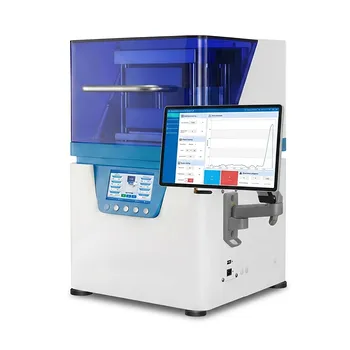
High-pressure compaction is the critical first step in transforming loose metallic powders into a structural precursor. A laboratory hydraulic press applying 380 MPa forces softer metallic particles, such as aluminum (Al) and tin (Sn), to undergo significant plastic deformation. This process flattens the particles, creates mechanical interlocking, and eliminates internal voids to ensure the green compact is stable enough for subsequent vacuum arc melting or sintering.
Core Takeaway: The use of 380 MPa pressure is essential to overcome the natural resistance of metallic powders, inducing the plastic deformation and mechanical interlocking required to create a dense, void-free green body that can withstand the rigors of high-temperature alloying.
The Mechanics of Particle Consolidation
Inducing Plastic Deformation in Soft Metals
At room temperature, metallic powders like aluminum are relatively soft compared to titanium. The application of 380 MPa provides the necessary force to exceed the yield strength of these softer particles.
This causes the originally spherical or irregular powders to flatten and spread. This deformation is the primary mechanism for filling the empty spaces (interstices) between the harder titanium particles.
Establishing Mechanical Interlocking
As particles deform under axial pressure, they physically wrap around and "hook" into one another. This creates a mechanical interlocking network that gives the green compact its initial structural integrity.
Without this interlocking, the "green body" would remain a pile of loose dust. The press transforms this dust into a solid, handleable geometric shape that retains its form without the need for chemical binders.
Minimizing Internal Porosity
High pressure is the most effective tool for eliminating air pockets and internal voids. By forcing particles into the closest possible proximity, the hydraulic press maximizes the relative density of the compact.
Reducing these voids is critical because air trapped inside can cause expansion, cracking, or contamination during the melting stage. A dense precursor ensures the final alloy ingot reaches near-theoretical density, often exceeding 99%.
Impact on Downstream Processing
Facilitating Intimate Atomic Contact
For successful vacuum arc melting or sintering, the different metallic elements must be in intimate physical contact. The 380 MPa of pressure increases the surface area where titanium and aluminum touch.
This high contact area is the "engine" for solid-state diffusion. It allows atoms to move across particle boundaries more efficiently when heat is eventually applied, leading to a more homogenous final alloy.
Enhancing Structural Stability for Handling
Green compacts must be moved from the press to the furnace or melting crucible without breaking. The high-pressure compaction increases the splitting tensile strength of the body.
This strength prevents "fragmentation," a common failure where the compact crumbles under its own weight or during transport. High pressure ensures the compact can withstand the thermal shocks of the initial heating phases.
Understanding the Trade-offs
The Risk of Particle "Spring-back"
While high pressure is beneficial, every material has an elastic limit. When the press releases, particles may attempt to return to their original shape, a phenomenon known as elastic recovery or spring-back.
If the pressure is applied too rapidly or released too quickly, internal stresses can cause "lamination" or horizontal cracks. This requires precise control over the decompression rate of the hydraulic system.
Pressure Limits and Tooling Wear
Increasing pressure beyond the necessary 380 MPa can lead to diminishing returns. Extremely high pressures significantly increase the wear and tear on expensive steel molds and dies.
Furthermore, over-pressing can lead to "over-compaction," where the density is so high that gases cannot escape during the early stages of heating. This can lead to internal pressure buildup and explosive failure of the compact.
Making the Right Choice for Your Project
Recommendations for Effective Compaction
- If your primary focus is maximizing final ingot density: Ensure the press achieves at least 380 MPa to eliminate the voids that cause porosity in the final melt.
- If your primary focus is preventing compact breakage: Prioritize the mechanical interlocking of softer additives (like Al) to create a more robust internal "skeleton."
- If your primary focus is reducing sintering time: Use higher pressures to increase particle contact area, which accelerates the atomic diffusion process.
By precisely controlling the hydraulic force during the green state, you lay the physical foundation for a high-performance, high-density titanium-aluminum alloy.
Summary Table:
| Mechanism | Process Effect | Benefit for Final Alloy |
|---|---|---|
| Plastic Deformation | Flattens soft Al/Sn particles | Fills internal voids and pores |
| Mechanical Interlocking | Hooks particles together | Enhances green strength for handling |
| Maximized Contact | Increases atomic proximity | Accelerates solid-state diffusion |
| Void Removal | Eliminates trapped air | Prevents cracking and gas expansion |
Elevate Your Material Research with KINTEK Precision
Achieving near-theoretical density in titanium-aluminum alloys requires more than just force—it requires precision. KINTEK specializes in high-performance laboratory hydraulic presses, including pellet, hot, and isostatic models designed to deliver consistent pressure for critical powder metallurgy applications.
Beyond compaction, we provide a complete ecosystem for your laboratory, including:
- Sample Preparation: Crushing and milling systems and sieving equipment.
- Thermal Processing: High-temperature muffle, vacuum, and sintering furnaces.
- Specialized Tools: High-pressure reactors, autoclaves, and essential ceramic crucibles.
Whether you are a researcher or a high-volume lab, KINTEK offers the reliability and technical support you need to optimize your fabrication workflow. Contact our experts today to find the perfect equipment for your high-pressure compaction needs!
References
- John Ellard, A.S. Bolokang. Effects of Sn on the densification and microstructure of a Ti-48Al-2Nb-0.7Mn-0.3Si-1Sn alloy fabricated from cold-pressed powders through vacuum melting. DOI: 10.1051/matecconf/202338803009
This article is also based on technical information from Kintek Solution Knowledge Base .
Related Products
- Laboratory Hydraulic Press Split Electric Lab Pellet Press
- Laboratory Hydraulic Press Lab Pellet Press Machine for Glove Box
- Laboratory Hydraulic Press Lab Pellet Press for Button Battery
- Automatic Laboratory Hydraulic Pellet Press Machine for Lab Use
- Fully Automatic Heated Hydraulic Lab Press for Materials Sintering and Sample Preparation
People Also Ask
- What are the roles of a laboratory hydraulic press and stainless steel molds in the preparation of graphite samples?
- What is the role of a laboratory hydraulic press in electrode prep? Maximize Energy Density & Sealing Precision
- How does a laboratory hydraulic press ensure the quality of alumina-forming alloy green bodies? Optimize CSP Research
- How is a laboratory hydraulic press used to evaluate the mechanical performance of nano-modified concrete? Expert Guide
- Why is a laboratory hydraulic press used for ASSB assembly? Achieving 392 MPa for Optimal Solid-State Battery Density