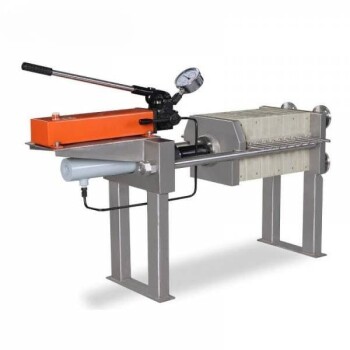
Precision is the bedrock of reliable radiation data. A high-precision laboratory hydraulic press is essential because it delivers constant, repeatable pressure control during sample fabrication. This ensures that every composite sample maintains identical thickness and material density, preventing minor physical deviations from skewing shielding performance evaluations.
In radiation testing, material density is directly correlated to shielding efficiency. A high-precision press eliminates physical inconsistencies, providing a scientifically valid baseline for comparing the neutron or gamma-ray absorption rates of different materials.
The Critical Link Between Density and Shielding
The Dangers of Inconsistency
In the context of radiation shielding, material density is a primary variable. If test samples vary in thickness or density, the resulting data on radiation absorption becomes unreliable.
Even minor deviations in how the material is compacted can lead to false conclusions about a material's shielding capability. The hydraulic press mitigates this by applying exact force parameters.
Ensuring Scientific Repeatability
For research to be valid, it must be reproducible. A high-precision press ensures that every batch of composite material is processed under identical conditions.
This repeatability isolates the material composition as the single variable. It allows researchers to confidently attribute differences in performance to the chemistry of the composite, rather than flaws in the manufacturing process.
Mechanisms of Structural Integrity
Eliminating Internal Voids
Loose powders used in composites naturally contain trapped air and internal pores. These voids create "weak spots" where radiation can pass through more easily.
High-pressure application significantly increases the contact area between particles. This effectively eliminates internal pores and creates a cohesive, high-density structure essential for maximum shielding performance.
Stabilizing the Material State
Applying precise pressure allows for the formation of a stable "green body" (the compacted unfired material). This process forces out trapped air before any heating or curing takes place.
By removing air early, the press reduces shrinkage and deformation during subsequent phases, such as sintering. This ensures the final sample retains the exact geometric dimensions required for the test apparatus.
Understanding the Trade-offs
Process Time vs. Throughput
Achieving high-precision density often requires longer hold times under pressure to allow air to fully escape and particles to rearrange.
This focus on quality can slow down the production rate of samples. While acceptable for a laboratory setting, this trade-off between precision and speed must be calculated when moving toward mass production.
Calibration Sensitivity
High-precision hydraulic presses are sensitive instruments. To maintain the repeatability required for radiation testing, they require regular calibration.
Neglecting maintenance can result in "drift," where the displayed pressure differs from the actual force applied, quietly reintroducing the density variations you are trying to avoid.
Making the Right Choice for Your Goal
To ensure your radiation shielding study produces publishable, accurate data, consider your specific testing requirements.
- If your primary focus is Comparative Analysis: Prioritize a press with advanced pressure control systems to ensure identical density across different material batches.
- If your primary focus is Material Densification: Prioritize a press capable of higher pressure limits to ensure the complete elimination of internal pores and maximum particle contact.
Precision in sample preparation is not just a procedural step; it is the prerequisite for accurate scientific discovery.
Summary Table:
| Feature | Impact on Shielding Samples | Benefit for Researchers |
|---|---|---|
| Pressure Control | Ensures uniform material density | Eliminates density as an experimental variable |
| Void Elimination | Removes internal pores/trapped air | Prevents radiation leakage through 'weak spots' |
| Repeatability | Identical thickness across batches | Guarantees scientific reproducibility of data |
| Structural Stability | Minimizes shrinkage and deformation | Maintains exact geometric dimensions for testing |
Elevate Your Material Research with KINTEK Precision
Don't let sample inconsistencies compromise your radiation shielding data. KINTEK specializes in high-performance laboratory equipment designed for the rigorous demands of material science. Our comprehensive range of hydraulic presses (pellet, hot, isostatic) provides the exact pressure control and repeatability needed to create high-density, void-free composite samples.
Beyond sample preparation, KINTEK offers a full suite of laboratory solutions, including high-temperature furnaces, crushing and milling systems, and advanced battery research tools. Partner with us to ensure your scientific discoveries are built on a foundation of precision and reliability.
Ready to optimize your lab's performance? Contact KINTEK experts today to find the perfect solution for your research!
References
- Alyona I. Wozniak, Anton Yegorov. Modern Approaches to Polymer Materials Protecting from Ionizing Radiation. DOI: 10.13005/ojc/330502
This article is also based on technical information from Kintek Solution Knowledge Base .
Related Products
- Laboratory Hydraulic Press Split Electric Lab Pellet Press
- Laboratory Hydraulic Press Lab Pellet Press Machine for Glove Box
- Laboratory Hydraulic Press Lab Pellet Press for Button Battery
- Automatic Laboratory Hydraulic Pellet Press Machine for Lab Use
- Automatic Laboratory Hydraulic Press for XRF & KBR Pellet Press
People Also Ask
- What are the roles of a laboratory hydraulic press and stainless steel molds in the preparation of graphite samples?
- What is the role of a laboratory hydraulic press in electrode prep? Maximize Energy Density & Sealing Precision
- How does a laboratory hydraulic press ensure the quality of alumina-forming alloy green bodies? Optimize CSP Research
- How is a laboratory hydraulic press used to evaluate the mechanical performance of nano-modified concrete? Expert Guide
- Why is a laboratory hydraulic press used for ASSB assembly? Achieving 392 MPa for Optimal Solid-State Battery Density