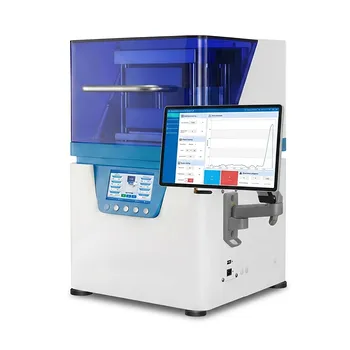
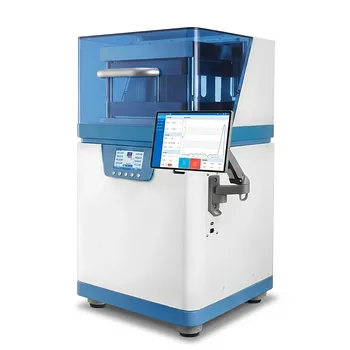
The laboratory hydraulic press serves as the critical bridge between raw chemical powder and a measurable solid-state ceramic. It applies precise, high-magnitude vertical pressure to $La_2FeCrO_6$ powder within precision molds to induce particle rearrangement and plastic deformation. This process creates a "green body" with minimized internal voids, which is essential for achieving the dense microstructure required for accurate dielectric and transport (resistivity) measurements after sintering.
Core Takeaway: The hydraulic press is used to consolidate $La_2FeCrO_6$ powder into a high-density green pellet, ensuring that subsequent electrical measurements reflect the material's intrinsic properties rather than artifacts caused by air pockets or poor grain contact.
Transforming Powder into a Dense Green Body
Particle Rearrangement and Plastic Deformation
The primary role of the press is to apply uniaxial force that overcomes the friction between $La_2FeCrO_6$ particles. As pressure increases, loose powder particles slide and rotate into a more compact arrangement, followed by plastic deformation at the contact points.
Elimination of Internal Voids and Micro-pores
By applying specific pressures—often ranging from several megapascals (MPa) to multiple tons—the press expels trapped air and reduces internal porosity. This reduction in voids is a prerequisite for the sintering phase, where high temperatures merge the particles into a solid, polycrystalline ceramic.
Establishing Mechanical Integrity
The hydraulic press provides the "green strength" necessary for the sample to be handled and moved into a furnace without crumbling. This initial bonding ensures the sample maintains a standardized shape, such as a pellet or a ring, which is vital for consistent data collection.
Ensuring Accuracy in Dielectric and Transport Measurements
Minimizing Dielectric Inconsistencies
Dielectric measurements are highly sensitive to the presence of air, which has a much lower dielectric constant than $La_2FeCrO_6$. By using a hydraulic press to ensure a uniform, dense sample, researchers prevent "dilution" of the dielectric signal, leading to a more accurate calculation of the material's permittivity.
Optimizing Electrical Transport Paths
For transport measurements like resistivity, electrons must flow across grain boundaries throughout the sample. The high-pressure molding process improves the initial contact between powder particles, which facilitates better grain growth and tighter bonding during sintering.
Dimensional Uniformity for Instrumentation
Precise molds used with the hydraulic press ensure that every $La_2FeCrO_6$ sample has a consistent diameter and thickness. This geometric precision is required for Vector Network Analyzers and other measurement tools that rely on exact physical dimensions to calculate material constants.
Understanding the Trade-offs and Pitfalls
The Risk of Density Gradients
While uniaxial pressing is effective, it can lead to "density gradients," where the pressure is higher near the plunger than in the center of the pellet. If these gradients are too severe, the sample may warp or develop internal cracks during the high-temperature sintering process.
Pressure-Induced Delamination
Applying excessive pressure can lead to "capping" or delamination, where the ceramic pellet splits into horizontal layers upon being ejected from the mold. This occurs when the stored elastic energy in the compressed powder exceeds the strength of the particle bonds.
Impact of Over-Compaction
Over-compacting the $La_2FeCrO_6$ powder can sometimes hinder the escape of gases during the early stages of sintering. This can result in bloating or internal structural defects that compromise the reliability of the electrical characterization.
How to Apply This to Your Project
Recommendations for Sample Preparation
To achieve the best results for $La_2FeCrO_6$ characterization, tailor your pressing strategy to your specific measurement goals:
- If your primary focus is Dielectric Constant Accuracy: Use a high-precision mold and ensure the pressure is held constant for a specific "dwell time" to maximize density and eliminate air gaps.
- If your primary focus is Transport/Resistivity Measurements: Focus on achieving a uniform density across the pellet to ensure consistent grain-to-grain contact throughout the material.
- If your primary focus is High-Frequency Analysis: Ensure the hydraulic press is paired with precision-machined molds to produce specimens with exact standardized dimensions (e.g., 7.0 mm outer diameter).
Properly controlled hydraulic pressing is the foundation of reliable data in ceramic science, transforming a simple powder into a high-performance electronic specimen.
Summary Table:
| Preparation Phase | Action of Hydraulic Press | Impact on Measurement Accuracy |
|---|---|---|
| Consolidation | Transforms loose powder into a dense "green body" | Ensures mechanical integrity and standardized geometry for testing. |
| Void Reduction | Expels trapped air and eliminates micro-pores | Prevents signal dilution; ensures dielectric constants reflect intrinsic properties. |
| Particle Contact | Induces particle rearrangement and plastic deformation | Optimizes electrical transport paths and improves sintering outcomes. |
| Geometric Shaping | Uses precision molds for uniform diameter/thickness | Vital for calculating material constants using instruments like VNAs. |
Elevate Your Material Research with KINTEK Precision
Achieving reliable dielectric and transport measurements starts with the perfect pellet. KINTEK specializes in high-performance laboratory equipment designed to transform your $La_2FeCrO_6$ research from powder to precision-engineered ceramic.
Our extensive portfolio features manual, automatic, and isostatic hydraulic presses specifically engineered for pellet preparation, ensuring uniform density and minimizing internal defects. To support your entire workflow, we also provide:
- High-Temperature Furnaces: Muffle and vacuum furnaces for optimal sintering of your green bodies.
- Crushing & Milling Systems: Achieve the ideal particle size distribution before pressing.
- Precision Molds & Consumables: High-quality dies and ceramic crucibles for consistent results.
Don't let air pockets or density gradients compromise your data. Partner with KINTEK for the reliability and expertise your laboratory deserves. Contact our technical team today to find the perfect pressing solution for your project!
References
- Kang Yi, Xinhua Zhu. Microstructural Characterization and Magnetic, Dielectric, and Transport Properties of Hydrothermal La2FeCrO6 Double Perovskites. DOI: 10.3390/nano13243132
This article is also based on technical information from Kintek Solution Knowledge Base .
Related Products
- Laboratory Hydraulic Press Split Electric Lab Pellet Press
- Laboratory Hydraulic Press Lab Pellet Press Machine for Glove Box
- Laboratory Hydraulic Press Lab Pellet Press for Button Battery
- Automatic Laboratory Hydraulic Pellet Press Machine for Lab Use
- Fully Automatic Heated Hydraulic Lab Press for Materials Sintering and Sample Preparation
People Also Ask
- What are the roles of a laboratory hydraulic press and stainless steel molds in the preparation of graphite samples?
- What is the role of a laboratory hydraulic press in electrode prep? Maximize Energy Density & Sealing Precision
- How does a laboratory hydraulic press ensure the quality of alumina-forming alloy green bodies? Optimize CSP Research
- How is a laboratory hydraulic press used to evaluate the mechanical performance of nano-modified concrete? Expert Guide
- Why is a laboratory hydraulic press used for ASSB assembly? Achieving 392 MPa for Optimal Solid-State Battery Density