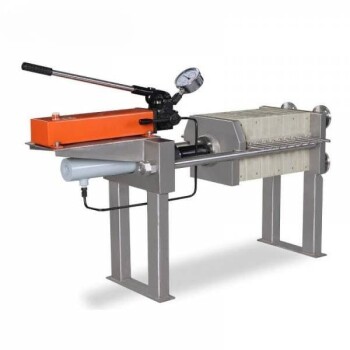
The use of a laboratory hydraulic press is a critical pre-processing step to ensure the physical and aerodynamic stability of the catalyst bed. By compressing fine powders into dense pellets, researchers can then crush and sieve them into specific particle sizes (such as 60-80 mesh) to eliminate pressure drops and prevent gas "channeling." This process ensures that reactant gases like methane and oxygen maintain uniform contact with the catalyst surface, providing the necessary foundation for accurate, reproducible experimental data.
Core Takeaway: Pelletizing catalyst powder transforms loose material into mechanically stable granules, which is essential for controlling gas flow resistance and ensuring uniform reactant distribution within a fixed-bed reactor.
Optimizing Fluid Dynamics in the Reactor
Eliminating Excessive Pressure Drops
Fine catalyst powders create significant resistance to gas flow, leading to high back pressure within the reactor system. A hydraulic press compacts these powders into "green bodies" that can be processed into larger, uniform particles. This structural change allows gases to flow through the catalyst bed with minimal resistance, protecting the system from pressure-induced fluctuations.
Preventing Gas Channeling and Bypassing
In a bed of loose powder, reactant gases often create "channels" or paths of least resistance, bypassing the majority of the catalyst's active sites. By using sieved pellets of a consistent size, you ensure a homogenous bed density. This forces the methane and oxygen to distribute evenly, maximizing contact with the active catalyst surface.
Protecting Downstream Analytical Systems
Loose, fine powders are easily carried away by high-velocity gas flows during Oxidative Coupling of Methane (OCM) experiments. These particles can migrate into downstream equipment, such as gas chromatographs or mass spectrometers, causing clogs or signal interference. Pelletization ensures the catalyst remains stationary and secure within the reaction zone.
Enhancing Material and Data Integrity
Facilitating Atomic Diffusion
High-pressure compaction significantly reduces the distance between individual particles, increasing their contact area. This is particularly beneficial during the subsequent calcination phase, as it promotes atomic diffusion. Enhanced diffusion can lead to higher phase purity in the final catalyst and may allow reactions to complete at lower temperatures.
Ensuring Accurate Kinetic Data
To obtain reliable kinetic measurements, the reaction must occur under controlled mass and heat transfer conditions. Pelletizing and sieving to a specific range (e.g., 250–425 μm) helps eliminate external mass transfer limitations. This ensures that the observed reaction rates reflect the true chemical activity of the catalyst rather than physical diffusion bottlenecks.
Improving Surface Characterization
For post-reaction analysis using techniques like XRD or XPS, a hydraulic press is used to create flat, dense discs. A uniform surface height is essential for these analytical methods to maximize signal intensity and ensure accuracy. This provides a clearer picture of how the catalyst surface changed during the OCM process.
Understanding the Trade-offs
The Risk of Pore Collapse
Applying excessive pressure (typically exceeding 40 MPa) can lead to the mechanical collapse of the catalyst’s internal pore structure. This reduction in surface area can negatively impact the catalyst's performance, masking its true potential. It is vital to find the "sweet spot" where mechanical strength is achieved without sacrificing porosity.
Internal Mass Transfer Limitations
While larger pellets improve gas flow, they can introduce internal diffusion resistances where reactants cannot reach the center of the particle. This is why pellets are typically crushed and sieved back down to a specific mesh size rather than used as large, whole discs. The goal is to balance aerodynamic flow with internal accessibility.
How to Apply This to Your Project
Making the Right Choice for Your Goal
- If your primary focus is obtaining precise kinetic data: Use the hydraulic press to create pellets, then sieve them to a narrow 60-80 mesh range to ensure uniform gas-solid contact.
- If your primary focus is simulating industrial scale-up: Use the press to achieve specific pellet densities that mimic the pressure drop environment of a commercial fixed-bed reactor.
- If your primary focus is material characterization (XRD/XPS): Use high, uniform static pressure to create flat, reflective discs that ensure consistent sample surface height.
- If your primary focus is preventing reactor clogs: Ensure the "green body" strength is sufficient to withstand high-temperature gas flows without crumbling into fines.
Properly pelletizing your catalyst ensures that the physical environment of your reactor supports, rather than hinders, the discovery of chemical insights.
Summary Table:
| Key Objective | Benefit of Pelletization | Impact on Research |
|---|---|---|
| Fluid Dynamics | Eliminates pressure drops and gas channeling | Ensures uniform reactant contact and bed stability. |
| Data Integrity | Minimizes external mass transfer limitations | Provides accurate, reproducible kinetic measurements. |
| Equipment Safety | Secures catalyst within the reaction zone | Protects downstream GC/MS systems from powder clogs. |
| Material Analysis | Creates flat, dense discs for XRD/XPS | Maximizes signal intensity for surface characterization. |
| Structural Control | Promotes atomic diffusion during calcination | Enhances phase purity and lowers reaction temperatures. |
Elevate Your Catalyst Research with KINTEK Precision
Achieving consistent, high-quality pellets is the first step toward breakthrough research in oxidative coupling of methane. KINTEK specializes in high-performance laboratory equipment designed to meet the rigorous demands of material science.
From our precision manual and automatic hydraulic presses (pellet, hot, and isostatic) to our specialized high-temperature high-pressure reactors and autoclaves, we provide the tools you need for total control over your experimental environment. Our portfolio also includes crushing and milling systems, sieving equipment to reach the perfect mesh size, and muffle or tube furnaces for optimal catalyst calcination.
Ready to eliminate gas channeling and secure your reactor's performance? Contact our technical experts today to find the ideal pelletizing and processing solution for your laboratory.
References
- Kun Zhao, Fanxing Li. Lithium carbonate-promoted mixed rare earth oxides as a generalized strategy for oxidative coupling of methane with exceptional yields. DOI: 10.1038/s41467-023-43682-5
This article is also based on technical information from Kintek Solution Knowledge Base .
Related Products
- Laboratory Hydraulic Press Split Electric Lab Pellet Press
- Laboratory Hydraulic Press Lab Pellet Press Machine for Glove Box
- Laboratory Hydraulic Press Lab Pellet Press for Button Battery
- Automatic Laboratory Hydraulic Pellet Press Machine for Lab Use
- Automatic Laboratory Hydraulic Press for XRF & KBR Pellet Press
People Also Ask
- What are the roles of a laboratory hydraulic press and stainless steel molds in the preparation of graphite samples?
- What is the role of a laboratory hydraulic press in electrode prep? Maximize Energy Density & Sealing Precision
- How does a laboratory hydraulic press ensure the quality of alumina-forming alloy green bodies? Optimize CSP Research
- How is a laboratory hydraulic press used to evaluate the mechanical performance of nano-modified concrete? Expert Guide
- Why is a laboratory hydraulic press used for ASSB assembly? Achieving 392 MPa for Optimal Solid-State Battery Density