While it sounds like a complex scientific instrument, the centrifuge is a surprisingly common tool used to produce many of the products you encounter every day. From the dairy in your refrigerator to the spin cycle on your washing machine, the principle of centrifugation is constantly at work, quietly separating materials in the world around us.
The core function of any centrifuge is to use high-speed rotation to separate substances based on their density. This single, powerful principle of physics is harnessed in countless industrial, commercial, and household applications.
The Core Principle: Separation by Density
A centrifuge is essentially a machine that spins a container at very high speeds. This rapid rotation creates a powerful outward force known as centrifugal force.
How It Works
Imagine spinning a bucket of water around your head; the water stays in the bucket because of this outward force. A centrifuge does the same thing, but with a mixture of different substances inside a container.
The Role of Density
Heavier, denser components in the mixture are thrown outward against the wall of the container with more force than the lighter, less dense components. This causes the mixture to rapidly separate into distinct layers, with the densest material at the bottom (farthest from the center) and the least dense at the top.
From the Factory to Your Home: Common Applications
This simple principle of separating materials by density is incredibly versatile, making the centrifuge an unsung hero in many industries.
In Food and Beverage Production
Many foods and drinks rely on centrifugation for their quality and consistency.
The most classic example is in the dairy industry. When milk is spun in a large industrial centrifuge, the dense water-based milk is separated from the less-dense fat globules. This process is how we get both cream (the fat) and skim milk (the remainder). This cream is then used to make butter and other high-fat dairy products.
Other food applications include:
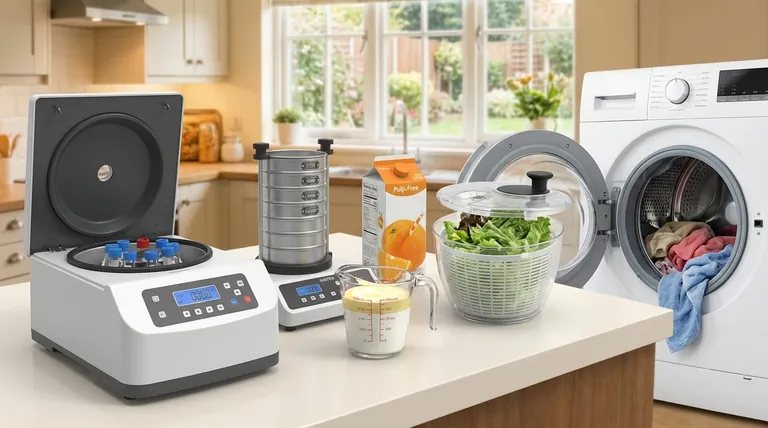
- Juice Production: Removing pulp from fruit juice to create a "pulp-free" product.
- Oil Manufacturing: Separating extracted oil from leftover plant solids, such as in the production of olive oil or vegetable oil.
- Winemaking: Clarifying wine by removing yeast cells and other sediment after fermentation, a process called racking.
In Your Home
The most accessible example of a centrifuge is the spin cycle of your washing machine. As the drum spins at high speed, it forces liquid water out through the small holes, leaving the much heavier clothes behind.
A salad spinner is another perfect example. It uses the same principle to fling water droplets off of lettuce leaves, drying them for your meal.
In Environmental and Waste Management
Centrifuges play a critical role in keeping our environment clean. In wastewater treatment plants, massive decanter centrifuges spin sludge at high speeds.
This separates the solid waste from the liquid water. The resulting "dewatered" solids are much more compact and easier to transport and dispose of, while the clarified water can move on to the next stage of purification.
Understanding the Trade-offs
While powerful, centrifugation is not always the perfect solution for separation. It has specific limitations and costs that are important to understand.
Energy Consumption
Spinning a heavy drum at thousands of rotations per minute requires a significant amount of energy. Industrial-scale centrifuges are major power consumers, which contributes to their operational cost.
Not a Perfect Separation
Centrifugation works best when there is a significant density difference between the components. If two substances in a mixture have very similar densities, a centrifuge will struggle to separate them cleanly. In these cases, other methods like filtration or chemical extraction are needed.
Mechanical Stress and Safety
The immense forces generated inside a centrifuge put incredible stress on its mechanical parts. This necessitates high-precision engineering, robust materials, and regular maintenance to prevent catastrophic failure, which can be extremely dangerous.
Making the Right Choice for Your Goal
By understanding the core principle, you can now see centrifugation happening all around you.
- If your primary focus is understanding basic physics: Observe your washing machine's spin cycle; it's a perfect demonstration of centrifugal force separating a liquid (water) from a solid (clothes).
- If your primary focus is appreciating food science: Recognize that the distinct properties of cream, butter, and skim milk are all made possible by separating fat from milk in a centrifuge.
- If your primary focus is connecting to public health: Acknowledge its role in everything from preparing blood samples for medical tests to ensuring the efficiency of your local water treatment facility.
Ultimately, centrifugation is a fundamental physical process harnessed by human ingenuity to separate, refine, and purify the materials that build our world.
Summary Table:
| Application | Example | What It Separates |
|---|---|---|
| Food & Beverage | Dairy Production, Juice Clarification | Fat from milk, Pulp from juice |
| Household | Washing Machine, Salad Spinner | Water from clothes, Water from lettuce |
| Environmental | Wastewater Treatment | Solid waste from water |
Need Reliable Separation for Your Lab?
Centrifuges are fundamental to countless processes, from sample preparation to quality control. KINTEK specializes in high-quality lab equipment and consumables, including centrifuges, to ensure your laboratory operates with precision and efficiency.
Contact us today to find the perfect centrifuge solution for your specific application and enhance your lab's productivity.
Visual Guide

Related Products
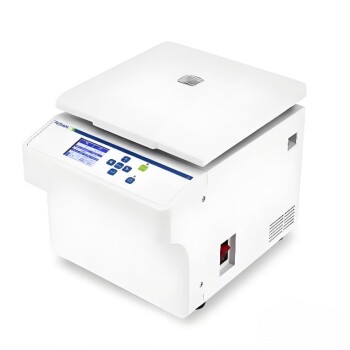
- High-Speed Desktop Centrifuge for Blood Sample Processing
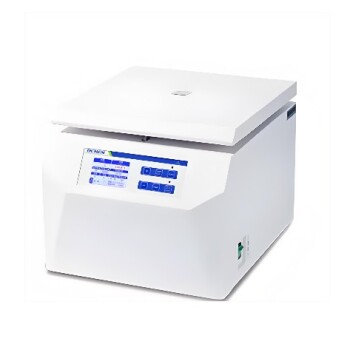
- Benchtop High Speed Small Lab Centrifuge for Serum Separation and Low Temperature Dehydration
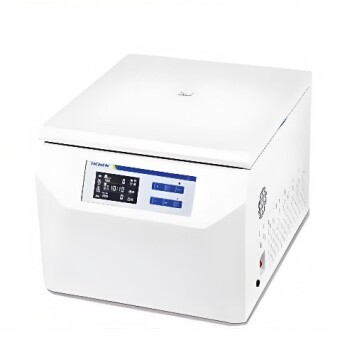
- Laboratory Benchtop High Speed Small Centrifuge for Low Temp Serum Separation Dehydration Research
- Circulating Water Vacuum Pump for Laboratory and Industrial Use
People Also Ask
- What are the advantages and disadvantages of a centrifuge? Weighing Speed Against Cost and Risk
- What are the types of centrifuges and their applications? Find the Right Tool for Your Separation Needs
- How does a centrifuge separate particles? Master the Science of High-Speed Separation
- What does the centrifuge do to the solution? Separate Components with High-Speed Centrifugal Force
- How is a benchtop laboratory centrifuge used in the desorption and regeneration of composite adsorbent beads?