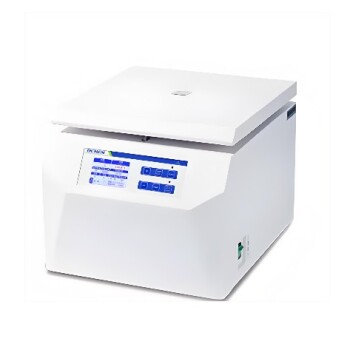
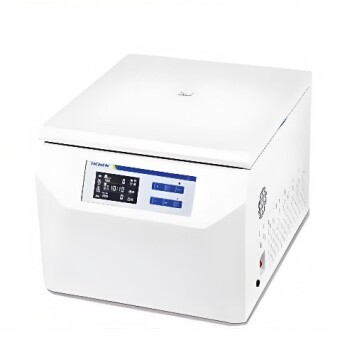
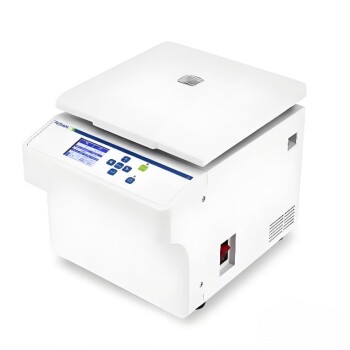
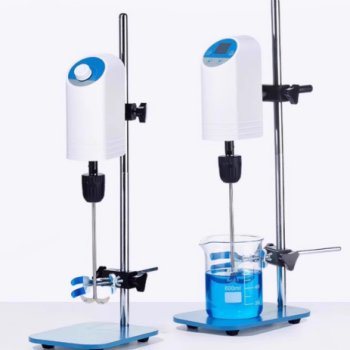
The benchtop laboratory centrifuge serves as the primary mechanism for efficient solid-liquid separation during the regeneration of composite adsorbent beads. It utilizes high-speed centrifugal force to rapidly isolate solid beads from desorption liquids, such as hydrochloric acid and ethanol mixtures, ensuring the recovery of the material for subsequent use.
Core Insight: In the context of cyclic regeneration, the centrifuge is not merely a separator but a restoration tool. It ensures the total removal of both captured pollutants and harsh desorption chemicals, thereby "resetting" the adsorbent's active sites for high-performance reuse.
The Mechanics of Desorption and Recovery
Rapid Solid-Liquid Separation
In desorption experiments, gravity filtration is often too slow or inefficient for recovering fine composite beads.
A benchtop centrifuge applies significant G-force to settle the solid beads at the bottom of the tube almost instantly.
This allows you to decant the supernatant (the liquid containing the desorbed pollutants) without losing any of the valuable adsorbent material.
Handling Desorption Reagents
The regeneration process typically involves harsh solvents, such as a mixture of hydrochloric acid and ethanol.
The centrifuge facilitates the safe handling of these chemicals by keeping the reaction contained within a sealed rotor environment.
This containment minimizes operator exposure to corrosive vapors while the separation occurs.
Ensuring Cycle Efficiency
Deep Cleaning and Pollutant Removal
To restore the beads to their original efficiency, every trace of the pollutant must be removed from the porous structure.
Centrifugation drives the washing process, forcing the washing solvent into and out of the bead matrix more effectively than static soaking.
This ensures that residual pollutants are completely flushed out, preventing cross-contamination in future experimental cycles.
Preparing for the Next Cycle
The ultimate goal of cyclic regeneration is to produce clean, high-performance material ready for immediate reuse.
By thoroughly spinning down the wash water or solvent, the centrifuge minimizes the moisture content left on the beads.
This prepares the material for the final drying stage (often in a laboratory oven at 80 °C), ensuring no excess chemicals interfere with subsequent porosity analysis.
Operational Considerations and Trade-offs
Mechanical Stress on Composites
While high speeds ensure rapid separation, excessive centrifugal force can physically crush fragile composite beads.
If the structural integrity of the bead is compromised, the surface area available for adsorption in the next cycle will decrease.
Chemical Compatibility of Equipment
Because desorption often requires acids like hydrochloric acid, standard centrifuge rotors may be susceptible to corrosion.
You must ensure that your centrifuge buckets and tubes are chemically resistant to the specific desorption solvents being used.
Optimizing Your Regeneration Protocol
To maximize the lifespan and efficiency of your composite adsorbent beads, consider these specific adjustments:
- If your primary focus is Speed and Throughput: Utilize higher RPM settings to minimize the time required for the solid-liquid separation phases between multiple wash cycles.
- If your primary focus is Material Integrity: Reduce the G-force to the minimum required to pellet the beads to prevent crushing the porous structure of sensitive biological composites.
Success in cyclic regeneration relies on balancing the force required for cleaning against the gentleness needed to preserve your adsorbent.
Summary Table:
| Process Phase | Function of Centrifuge | Key Benefit |
|---|---|---|
| Desorption | Rapidly isolates beads from HCl/Ethanol mixtures | Minimizes material loss during chemical handling |
| Washing | Forces solvent through porous bead matrix | Removes residual pollutants & "resets" active sites |
| Recovery | Minimizes moisture content before drying | Shortens drying time and prevents cross-contamination |
| Cycle Prep | Prepares beads for subsequent porosity analysis | Ensures consistency in long-term performance testing |
Maximize Your Material Recovery with KINTEK
Efficient cyclic regeneration requires the perfect balance of centrifugal force and material integrity. KINTEK specializes in high-performance laboratory equipment designed to withstand the rigors of chemical desorption and mechanical stress. Our comprehensive portfolio includes:
- Precision Centrifuges: Optimized for rapid solid-liquid separation.
- High-Temperature Ovens: Perfect for the final 80°C drying stage of your adsorbent beads.
- Crucibles & Ceramics: Chemically resistant consumables for harsh reagent handling.
- Advanced Crushing & Milling: For post-regeneration analysis and sample preparation.
Whether you are working with sensitive biological composites or robust industrial adsorbents, KINTEK provides the tools to ensure your research is both accurate and repeatable. Contact us today to find the ideal centrifugal and thermal solution for your laboratory!
References
- Jie Qi, Fang Guo. Biopolymer Meets Nanoclay: Rational Fabrication of Superb Adsorption Beads from Green Precursors for Efficient Capture of Pb(II) and Dyes. DOI: 10.3390/nano14090766
This article is also based on technical information from Kintek Solution Knowledge Base .
Related Products
- Benchtop High Speed Small Lab Centrifuge for Serum Separation and Low Temperature Dehydration
- Laboratory Benchtop High Speed Small Centrifuge for Low Temp Serum Separation Dehydration Research
- High-Speed Desktop Centrifuge for Blood Sample Processing
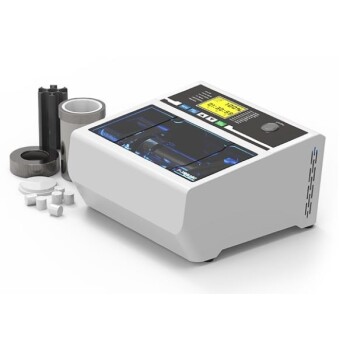
- Laboratory Micro Horizontal Jar Mill for Precision Sample Preparation in Research and Analysis
- Laboratory High Pressure Horizontal Autoclave Steam Sterilizer for Lab Use
People Also Ask
- What is the primary function of a laboratory centrifuge? Master PAAMP-b-PVK Block Copolymer Purification
- What role does a Laboratory Centrifuge play in the production of succinic acid? Critical Solid-Liquid Separation Guide
- What are the advantages and disadvantages of a centrifuge? Weighing Speed Against Cost and Risk
- How does a centrifuge work and for what purpose? Unlock the Power of Rapid Sample Separation
- What does the centrifuge do to the solution? Separate Components with High-Speed Centrifugal Force