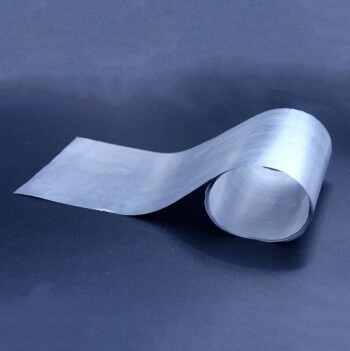
Aluminum foil is selected as the current collector for Fluorinated Helical Carbon Nanotube (F-HCNT) electrodes because it balances high electrical conductivity with exceptional chemical stability at high operating potentials. It provides a reliable conductive pathway while forming a protective oxide layer that prevents the collector from dissolving into the electrolyte. This combination ensures that the F-HCNT material can perform efficiently without the risk of structural failure or current loss.
The primary reason for choosing aluminum is its ability to form a dense passivation film at high voltages, which shields the collector from chemical corrosion. This allows for stable electron transfer and maintains the mechanical integrity of the electrode throughout its lifecycle.
The Electrochemical Advantage of Aluminum
Superior Corrosion Resistance through Passivation
At high electrochemical potentials, aluminum naturally forms a dense passivation film on its surface. This thin oxide layer acts as a barrier, preventing the organic electrolyte from reacting with the metal underneath. Without this film, the current collector would suffer from severe chemical corrosion, leading to battery failure.
Wide Electrochemical Window
Aluminum possesses a wide electrochemical window, making it ideal for the high-potential environments typically associated with fluorinated carbon materials. It remains stable in ranges where other metals, such as copper, would oxidize and dissolve. This stability is critical for ensuring the long-term cycling performance of F-HCNT electrodes.
Efficient Electron Transport
Despite the presence of a passivation layer, aluminum maintains excellent electrical conductivity. This ensures that electrons generated during the electrochemical reaction move swiftly from the F-HCNT active material to the external circuit. High conductivity is essential for minimizing internal resistance and maximizing the power output of the cell.
Physical and Economic Considerations
Mechanical Flexibility and Support
Aluminum foil offers the mechanical flexibility required to support the coating of F-HCNT slurries. It can withstand the physical stresses of electrode fabrication, such as rolling and winding, without cracking. This flexibility ensures that the active material remains in constant contact with the collector.
Material Cost and Scalability
Compared to precious metals or specialized alloys, aluminum is relatively low cost and widely available. Its established supply chain and ease of processing make it the standard choice for scaling up F-HCNT technology from the lab to industrial production. Using a cost-effective collector is vital for the economic viability of the final energy storage device.
Understanding the Trade-offs
Limitations at Low Potentials
While aluminum is excellent for positive electrodes, it cannot be used at very low potentials (near 0V vs. Li/Li+). At low voltages, aluminum can alloy with lithium, which causes the foil to pulverize and lose its structural integrity. This is why copper is typically used for negative electrodes while aluminum is reserved for the cathode side.
Challenges with Mechanical Adhesion
Standard aluminum foil is smooth, which can sometimes lead to delamination of the active material if the coating is too thick. While aluminum mesh can improve adhesion through its porous structure, it is often more expensive and harder to process than flat foil. Engineers must balance the need for surface grip with the requirements of the manufacturing process.
Making the Right Choice for Your Goal
When integrating F-HCNT electrodes into a system, the choice of current collector should align with your specific performance targets and environmental conditions.
- If your primary focus is High-Voltage Stability: Use high-purity aluminum foil to ensure a uniform passivation layer that prevents electrolyte corrosion.
- If your primary focus is High Energy Density: Opt for the thinnest possible aluminum foil to reduce the "dead weight" of the collector and increase the proportion of active F-HCNT material.
- If your primary focus is Mechanical Durability: Consider using chemically etched or carbon-coated aluminum foil to increase surface roughness and improve the bond between the collector and the carbon nanotubes.
Selecting aluminum foil provides the essential foundation of stability and conductivity required to harness the full electrochemical potential of F-HCNT electrodes.
Summary Table:
| Key Feature | Benefit for F-HCNT Electrodes | Impact on Battery Performance |
|---|---|---|
| Passivation Film | Prevents electrolyte corrosion at high voltages | Extends cycle life and structural integrity |
| High Conductivity | Facilitates swift electron transport | Minimizes internal resistance and boosts power |
| Wide Electro-Window | Remains stable in high-potential environments | Enables high-voltage fluorinated carbon use |
| Mechanical Flexibility | Supports F-HCNT slurry coating and winding | Prevents cracking during electrode fabrication |
| Cost-Efficiency | Lowers material costs for scalable production | Enhances economic viability of energy storage |
Elevate Your Battery Research with KINTEK Precision
Advancing F-HCNT technology requires high-purity materials and reliable equipment. KINTEK specializes in premium laboratory solutions, providing the essential tools for next-generation energy storage. From battery research tools and consumables like specialized foils and electrodes to high-temperature furnaces and high-pressure reactors, we empower researchers to achieve stable, high-performance results.
Whether you need precision hydraulic presses for pellet preparation or ULT freezers for material stability, our comprehensive portfolio is designed to meet the rigorous demands of industrial and academic labs.
Ready to optimize your electrode performance? Contact KINTEK today for expert guidance and high-quality lab equipment tailored to your research goals!
References
- Gaobang Chen, Xian Jian. Helical fluorinated carbon nanotubes/iron(iii) fluoride hybrid with multilevel transportation channels and rich active sites for lithium/fluorinated carbon primary battery. DOI: 10.1515/ntrev-2023-0108
This article is also based on technical information from Kintek Solution Knowledge Base .
Related Products
- Aluminum Foil Current Collector for Lithium Battery
- Copper Nickel Foam Metal Sheet
- Professional Cutting Tools for Carbon Paper Cloth Diaphragm Copper Aluminum Foil and More
People Also Ask
- How is aluminum foil utilized as a consumable during the assembly of cold sintering molds? Optimize Tooling Longevity
- How to tell if a lithium-ion battery is bad? Spot the critical signs of failure before it's too late.
- How to check if a lithium battery is good? Safely Test Voltage, Capacity & Internal Resistance
- Is there a way to test lithium batteries? Understand Voltage vs. True Health
- What is the significance of using a 2032-type coin cell configuration? Isolate Intrinsic Graphene Performance.