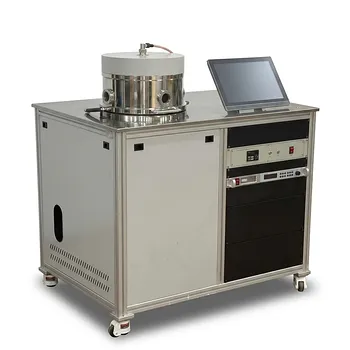
Deposition rate measures the speed at which a thin film grows on a substrate during the fabrication process. It is quantified as thickness accumulated over time, utilizing units such as Angstroms per second (Å/s), nanometers per minute (nm/min), or micrometers per hour (μm/hour). Rates vary significantly based on the technique, ranging from a few tens of Å/min to upwards of 10,000 Å/min.
The ideal deposition rate is not simply "as fast as possible"; it must be commensurate with the application. While high speeds increase throughput, they frequently compromise critical film characteristics like uniformity and density.
Matching Rate to Application
Precision for Thin Films
When the target application requires a very thin film, slower deposition rates are preferred.
Operating at a reduced speed allows for granular control over the process. This ensures the final product meets precise thickness specifications without overshooting.
Efficiency for Thick Films
Conversely, applications requiring thick films generally demand faster deposition rates.
This is primarily driven by process efficiency. Growing a thick layer at a slow rate would make the fabrication process prohibitively long and inefficient.
Understanding the Trade-offs
The Cost of Increased Speed
Achieving a faster deposition rate is not a passive adjustment; it requires more aggressive system inputs.
To accelerate growth, operators must typically increase power, raise process temperatures, or ramp up gas flows. These adjustments introduce new variables into the vacuum environment.
Impact on Film Quality
The most critical trade-off is the potential degradation of film properties.
When the deposition process is rushed via high energy or flow, the resulting film often suffers. Common negative outcomes include poor uniformity, increased internal stress, and reduced film density.
Making the Right Choice for Your Goal
Selecting the optimal deposition rate requires balancing the need for throughput against the physical requirements of the material.
- If your primary focus is precise thickness control: Prioritize slower deposition rates to maximize density and ensure uniformity across the substrate.
- If your primary focus is production efficiency for thick films: Utilize higher deposition rates, but carefully monitor stress levels and temperature inputs to prevent quality degradation.
Ultimately, the correct rate is the one that achieves the necessary film structure while remaining economically viable for the application.
Summary Table:
| Deposition Rate | Best For | Advantages | Potential Trade-offs |
|---|---|---|---|
| Slower Rates | Thin films, precision layers | High density, superior uniformity, precise thickness control | Lower throughput, longer process times |
| Faster Rates | Thick films, high-volume production | High process efficiency, increased throughput | Increased internal stress, lower density, reduced uniformity |
Elevate Your Thin Film Precision with KINTEK
Finding the perfect balance between deposition speed and film integrity is critical for advanced research and manufacturing. At KINTEK, we specialize in providing high-performance laboratory equipment designed to give you total control over your fabrication process.
Whether you require sophisticated CVD and PECVD systems for high-precision growth or rugged high-temperature furnaces and vacuum systems for material processing, KINTEK offers the tools you need to achieve optimal results. From battery research tools to crucibles and ceramic consumables, we support your entire workflow with quality and reliability.
Ready to optimize your deposition process? Contact our technical experts today to find the right equipment for your specific application and ensure your thin films meet the highest standards of excellence.
Related Products
- RF PECVD System Radio Frequency Plasma-Enhanced Chemical Vapor Deposition RF PECVD
- Inclined Rotary Plasma Enhanced Chemical Vapor Deposition PECVD Equipment Tube Furnace Machine
People Also Ask
- What is plasma enhanced chemical vapour deposition PECVD used for? Enable Low-Temp Thin Films for Electronics & Solar
- What is an example of PECVD? RF-PECVD for High-Quality Thin Film Deposition
- What is the role of RF-PECVD in VFG preparation? Mastering Vertical Growth and Surface Functionality
- What is plasma enhanced chemical Vapour deposition process used for fabrication of? A Guide to Low-Temperature Thin Films
- What is plasma CVD? Unlock Low-Temperature Thin Film Deposition for Sensitive Materials