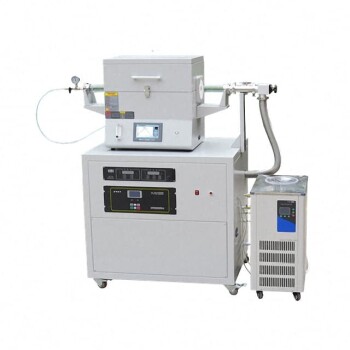
The high-temperature tube furnace functions as the primary reactor vessel, creating a sealed, controlled environment essential for the Chemical Vapor Deposition (CVD) synthesis of Fe-C@C nanoparticles. It manages both the thermal profile and the precise introduction of reactive gases to drive distinct chemical transformations.
The furnace enables a dual-stage process: first reducing iron oxide precursors at higher temperatures, then maintaining a specific lower thermal range to catalyze the cracking of acetylene, resulting in a complete carbon coating around an iron-carbon core.
Precise Atmospheric Control
Regulation of Precursor Gases
The furnace acts as a sealed chamber that allows for the rigorous control of the reaction atmosphere.
It manages the flow of specific gases—including hydrogen, argon, and acetylene—which are critical for different phases of the synthesis.
Creating a Sealed Environment
By isolating the reaction from the ambient environment, the furnace prevents oxidation and ensures that only intended chemical reactions occur.
This sealed nature is vital for maintaining the purity required for nanomaterial synthesis.
The Two-Stage Thermal Process
Stage 1: Reduction of Precursors
The first role of the furnace is to facilitate the reduction of iron oxide (Fe2O3).
The system elevates the temperature to 600 °C in a hydrogen-rich atmosphere.
This thermal energy, combined with the reducing gas, converts the oxide precursor into metallic iron nanoparticles.
Stage 2: Catalytic Carbon Growth
Once reduction is complete, the furnace adjusts to a specific lower temperature range between 300 and 450 °C.
At these temperatures, the newly formed iron nanoparticles act as catalysts.
They facilitate the "cracking" (decomposition) of acetylene gas, causing carbon to deposit and grow a complete coating around the iron-carbon cores.
Understanding Process Sensitivities
Temperature Precision is Critical
The effectiveness of the synthesis relies heavily on the furnace's ability to hold distinct temperature plateaus.
If the temperature deviates from the 300–450 °C range during the second stage, the catalytic behavior of the iron may change, potentially leading to incomplete coatings or amorphous carbon buildup.
The Necessity of Sequential Processing
This process cannot occur in a single thermal step; the furnace must be capable of dynamic temperature adjustments.
The reduction phase requires higher energy (600 °C) than the coating phase.
Attempting to run both processes at a single temperature would likely result in either unreduced precursors or uncontrolled carbon deposition.
Making the Right Choice for Your Goal
To optimize the synthesis of Fe-C@C nanoparticles, you must focus on the distinct phases of the furnace operation.
- If your primary focus is Core Purity: Prioritize the stability of the 600 °C phase and hydrogen flow to ensure complete reduction of Fe2O3 before carbon introduction.
- If your primary focus is Coating Uniformity: Tightly regulate the temperature between 300 and 450 °C during acetylene flow to maximize the catalytic efficiency of the iron cores.
Success in this CVD process depends entirely on synchronizing gas flow with the furnace's thermal transitions.
Summary Table:
| Synthesis Phase | Temperature | Atmosphere | Primary Function |
|---|---|---|---|
| Precursor Reduction | 600 °C | Hydrogen (H2) | Converts Fe2O3 into metallic iron nanoparticles |
| Carbon Coating | 300 - 450 °C | Acetylene (C2H2) | Catalytic cracking of gas to form carbon shells |
| Atmosphere Control | Variable | Argon/Reactive Gas | Prevents oxidation and maintains material purity |
Elevate Your Nanomaterial Synthesis with KINTEK
Precise thermal transitions and atmospheric integrity are the foundations of successful Fe-C@C nanoparticle production. KINTEK specializes in advanced laboratory equipment designed for rigorous research environments. We provide a comprehensive range of high-temperature tube furnaces, CVD systems, and PECVD solutions specifically engineered for uniform heating and sophisticated gas management.
Whether you are focusing on core purity or uniform carbon coatings, our high-performance furnace systems and specialized consumables—including crucibles, ceramics, and gas flow controllers—ensure repeatable results for battery research, chemical engineering, and material science.
Ready to optimize your CVD process? Contact KINTEK today to discover how our expert heating and crushing solutions can streamline your laboratory workflow.
References
- Lixin Zhao, Chunyong Liang. Synthesis and Characterization of Flower-like Carbon-encapsulated Fe-C Nanoparticles for Application as Adsorbing Material. DOI: 10.3390/ma12050829
This article is also based on technical information from Kintek Solution Knowledge Base .
Related Products
- 1400℃ Laboratory High Temperature Tube Furnace with Alumina Tube
- 1700℃ Laboratory High Temperature Tube Furnace with Alumina Tube
- Split Chamber CVD Tube Furnace with Vacuum Station Chemical Vapor Deposition System Equipment Machine
- Multi Heating Zones CVD Tube Furnace Machine Chemical Vapor Deposition Chamber System Equipment
- High Temperature Alumina (Al2O3) Furnace Tube for Engineering Advanced Fine Ceramics
People Also Ask
- What roles does a high-temperature tube furnace play in the synthesis of N/O co-doped carbon? Master Precise Doping
- What functions does a laboratory high-temperature tube furnace perform? Master Catalyst Synthesis & Carbonization
- How does a laboratory tube furnace facilitate methane catalyst evaluation & regeneration? Optimize Thermal Performance
- Why is a high-temperature tube furnace core to carbon black recovery? Master Precision Pyrolysis & Material Regeneration
- What is the primary role of a high-temperature tube furnace in the production of magnetic carbon xerogels? Key Insights