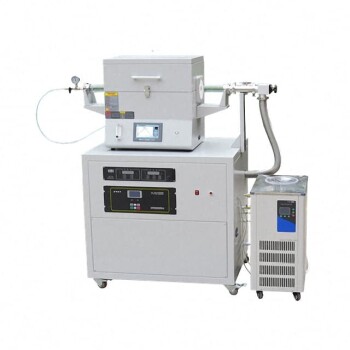
The technical value of a quartz tube reaction chamber lies in its ability to create a hermetically sealed, chemically controlled environment within a high-temperature thermal field. By functioning as a physical barrier, it isolates the test specimen from external oxygen while enabling the precise introduction of reducing gas mixtures, ensuring that static corrosion data reflects specific chemical potentials rather than uncontrolled atmospheric oxidation.
Core Takeaway The quartz tube acts as an independent atmosphere space that decouples the thermal environment from the chemical environment. It allows for the simulation of extreme industrial conditions by preventing abnormal oxidation of liquid metals and enabling the precise regulation of oxygen partial pressure.
Achieving Precise Atmospheric Control
Establishing a Reducing Environment
The primary function of the quartz tube is to facilitate the introduction of specific reducing gas mixtures, such as argon-hydrogen blends.
This capability allows you to create a controllable chemical potential around the sample. By adjusting the gas ratios, you can simulate exact reduction conditions required for the experiment.
Regulating Oxygen Partial Pressure
Beyond simply adding gases, the quartz liner enables the precise regulation of oxygen partial pressure at the melt surface.
This is often achieved through vacuuming prior to gas introduction or by strictly controlling carrier gases like high-purity argon. This control is critical for studying how varying oxygen concentrations directly impact material corrosion resistance.
Ensuring Data Integrity via Isolation
Acting as a Physical Barrier
The quartz tube serves as a robust physical barrier that provides excellent airtightness.
In static corrosion testing—particularly with liquid metals or fillers—preventing external contaminants is paramount. The tube physically blocks ambient air from entering the reaction zone.
Preventing Abnormal Oxidation
Without this barrier, external oxygen ingress would lead to abnormal oxidation of the liquid metal or test sample.
Uncontrolled oxidation alters the surface chemistry of the melt, invalidating corrosion rate data. The quartz tube maintains the high-reduction conditions necessary to keep the experiment valid.
Operational and Thermal Benefits
Stable Thermal Field
When paired with an electric heating furnace, the quartz tube liner benefits from a highly stable thermal field.
Vertical tube furnace designs, in particular, offer excellent temperature uniformity along the tube's length. This ensures that the corrosion reaction proceeds at a consistent rate across the entire sample surface.
Simulation of Extreme Conditions
The combination of high-temperature resistance and atmospheric control allows for the simulation of extreme working conditions.
This makes the setup ideal for evaluating fillers or materials destined for harsh industrial environments where both heat and specific chemical attacks are present.
Understanding the Trade-offs
Physical Fragility
While quartz offers excellent thermal shock resistance, it remains mechanically brittle.
Care must be taken during sample loading and unloading to avoid chipping or cracking the tube, which would immediately compromise the airtight seal and ruin the experiment.
Volume and Geometry Constraints
Tube furnaces generally offer a limited working volume compared to box furnaces.
While supplementary references note that vertical designs simplify batch processing, the geometry of the quartz tube restricts the size and shape of the samples you can test effectively.
Making the Right Choice for Your Goal
To maximize the value of this setup, align your operational procedures with your specific experimental needs:
- If your primary focus is Simulating Industrial Reduction: Prioritize the precise control of argon-hydrogen gas ratios to match the chemical potential of the target environment.
- If your primary focus is Material Screening: Leverage the batch processing capabilities of vertical tube furnaces to ensure consistent temperature uniformity across multiple samples.
Ultimately, the quartz tube is not just a container; it is the critical control element that transforms a standard furnace into a precision instrument for simulating specific corrosion mechanisms.
Summary Table:
| Feature | Technical Benefit | Impact on Testing |
|---|---|---|
| Airtight Isolation | Blocks external oxygen ingress | Prevents abnormal oxidation of samples |
| Atmosphere Control | Enables reducing gas introduction (Ar-H2) | Simulates specific industrial chemical potentials |
| Oxygen Regulation | Precise partial pressure adjustment | Allows study of oxygen-dependent corrosion |
| Thermal Stability | Uniform heating in a tube furnace | Ensures consistent reaction rates across samples |
| High Resistance | Withstands extreme thermal fields | Facilitates simulation of harsh environments |
Elevate Your Materials Research with KINTEK Precision
Unlock the full potential of your static corrosion studies with KINTEK’s industry-leading thermal solutions. Whether you require high-temperature tube furnaces, vacuum systems, or specialized quartz and ceramic consumables, our equipment is engineered to provide the hermetic sealing and precise atmospheric control your data demands.
From battery research tools and high-pressure reactors to our comprehensive range of crushing, milling, and pellet presses, KINTEK empowers laboratories to simulate extreme industrial conditions with confidence.
Ready to optimize your experimental integrity? Contact KINTEK today to discuss your laboratory needs!
References
- Franziska Müller‐Trefzer, Klarissa Niedermeier. Screening of Filler Material for a Packed‐Bed Thermocline Energy Storage Test Facility with Lead–Bismuth Eutectic as the Heat Transfer Fluid. DOI: 10.1002/ente.202300781
This article is also based on technical information from Kintek Solution Knowledge Base .
Related Products
- 1200℃ Split Tube Furnace with Quartz Tube Laboratory Tubular Furnace
- Laboratory Rapid Thermal Processing (RTP) Quartz Tube Furnace
- Customer Made Versatile CVD Tube Furnace Chemical Vapor Deposition Chamber System Equipment
- Split Chamber CVD Tube Furnace with Vacuum Station Chemical Vapor Deposition System Equipment Machine
- Multi Heating Zones CVD Tube Furnace Machine Chemical Vapor Deposition Chamber System Equipment
People Also Ask
- What functions does a laboratory high-temperature tube furnace perform? Master Catalyst Synthesis & Carbonization
- What roles does a high-temperature tube furnace play in the synthesis of N/O co-doped carbon? Master Precise Doping
- How does a high-temperature tube furnace influence 253MA steel? Master Microstructure & High-Temp Creep Resistance
- Why is a high-temperature tube furnace required for the production of biochar from tobacco straw? Expert Pyrolysis Guide
- What are the primary applications of muffle and tube furnaces in photocatalysts? Optimize Metal Loading & Support Synthesis