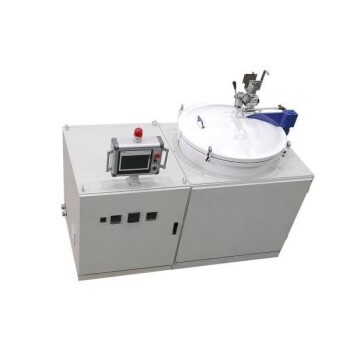
A quartz tube vacuum furnace serves as the critical reaction vessel for converting amorphous precursor powders into high-performance crystalline electrolytes. By maintaining a precisely controlled temperature of approximately 550°C under vacuum, it drives atomic rearrangement while strictly isolating the sensitive sulfide materials from moisture and oxygen.
The Core Insight The furnace is not simply a heat source; it is an isolation chamber essential for chemical stability. Its primary function is to facilitate the annealing of mechanically damaged powders into a defect-free Ag-doped Li-argyrodite phase while simultaneously preventing the catastrophic oxidation and sulfur loss that occurs in open-air environments.
Driving the Phase Transformation
From Amorphous to Crystalline
The primary role of the furnace is to provide the thermal energy required to transform precursor powders. These powders typically enter the furnace in an amorphous (disordered) state following high-energy mechanical milling.
Atomic Rearrangement
At controlled temperatures, typically around 550°C, the furnace enables atomic rearrangement. This thermal activation allows the disordered atoms to align into the specific crystal lattice structure of Ag-doped Li-argyrodite, which is necessary for ionic conductivity.
Eliminating Lattice Defects
The ball-milling process used to mix precursors creates significant mechanical stress and defects within the material. The steady heat of the furnace heals these lattice defects, resulting in a highly crystalline structure with optimized ionic transport pathways.
The Critical Role of the Environment
Preventing Hydrolysis and Oxidation
Sulfide-based electrolytes like Li-argyrodite are extremely sensitive to air and moisture. Even trace amounts of humidity can cause the material to decompose or hydrolyze. The vacuum environment within the quartz tube is the only barrier preventing the material from degrading into useless byproducts during heating.
Preserving Stoichiometry
Beyond preventing oxidation, the sealed environment is vital for maintaining the chemical balance of the electrolyte. The quartz tube encapsulation inhibits the loss of volatile sulfur components that might otherwise escape at high temperatures.
Ensuring Phase Purity
By retaining volatile components and excluding external contaminants, the furnace ensures the final product maintains the correct stoichiometric ratio. This precise chemical balance is required to achieve the high phase purity associated with superior conductivity.
Understanding the Trade-offs
Batch Process Limitations
The use of sealed quartz tubes typically limits the synthesis to a batch process. Unlike continuous flow furnaces, the output is constrained by the volume of the quartz ampoules and the time required to seal, heat, and cool them under vacuum.
Seal Integrity Risks
The success of the crystallization process is entirely dependent on the integrity of the vacuum seal. Any micro-cracks in the quartz or failures in the sealing mechanism will lead to immediate oxidation, rendering the entire batch unusable.
Making the Right Choice for Your Goal
To maximize the quality of your Ag-doped Li-argyrodite electrolytes, align your furnace operation with your specific objectives:
- If your primary focus is ionic conductivity: Prioritize precise temperature control around 550°C to ensure complete crystallization and the elimination of lattice defects that impede ion flow.
- If your primary focus is phase purity: Focus on the integrity of the quartz encapsulation to prevent sulfur volatilization and ensure the strict exclusion of moisture.
Ultimately, the quartz tube vacuum furnace acts as a stabilizer, allowing high-energy thermodynamics to reorganize the material without the interference of environmental chemistry.
Summary Table:
| Feature | Role in Crystallization Process |
|---|---|
| Thermal Activation | Provides ~550°C heat to transform amorphous precursors into crystalline structures. |
| Vacuum Environment | Prevents hydrolysis and oxidation of sensitive sulfide materials from moisture/air. |
| Stoichiometry Control | Sealed quartz tube inhibits the loss of volatile sulfur components during heating. |
| Defect Healing | Anneals mechanical stress from ball-milling to optimize ionic transport pathways. |
Elevate Your Battery Research with KINTEK Precision
High-performance electrolytes require uncompromising environmental control. KINTEK specializes in advanced laboratory solutions designed for sensitive material synthesis. Whether you are developing next-generation Ag-doped Li-argyrodite electrolytes or exploring solid-state chemistry, our high-temperature tube furnaces, vacuum systems, and crushing/milling equipment provide the stability and precision your research demands.
Our value to your lab:
- Superior Thermal Accuracy: Achieve the exact temperatures needed for perfect phase transformation.
- Robust Isolation: Protect your sulfide-based materials from moisture and oxygen contamination.
- Comprehensive Range: From ball mills for precursor preparation to high-temperature furnaces for final annealing.
Ready to optimize your crystallization process and maximize ionic conductivity? Contact KINTEK today for a customized equipment consultation!
Related Products
- 1200℃ Split Tube Furnace with Quartz Tube Laboratory Tubular Furnace
- Laboratory Rapid Thermal Processing (RTP) Quartz Tube Furnace
- Vacuum Sealed Continuous Working Rotary Tube Furnace Rotating Tube Furnace
- Laboratory High Pressure Vacuum Tube Furnace
- Laboratory Vacuum Tilt Rotary Tube Furnace Rotating Tube Furnace
People Also Ask
- What functions does a laboratory high-temperature tube furnace perform? Master Catalyst Synthesis & Carbonization
- What roles does a high-temperature tube furnace play in the synthesis of N/O co-doped carbon? Master Precise Doping
- Why is a high-temperature tube furnace required for the production of biochar from tobacco straw? Expert Pyrolysis Guide
- How does a high-temperature tube furnace influence 253MA steel? Master Microstructure & High-Temp Creep Resistance
- What are the primary applications of muffle and tube furnaces in photocatalysts? Optimize Metal Loading & Support Synthesis