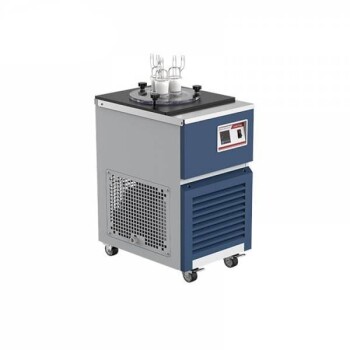
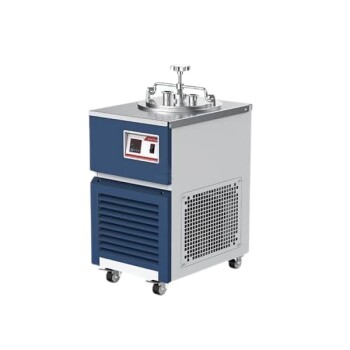
The online cold trap pre-concentrator (CTPC) serves as a high-precision enrichment tool that captures and concentrates trace volatile organic products for gas analysis. By utilizing cryogenic temperatures to physically adsorb low-concentration substances from the battery headspace, the CTPC significantly amplifies the sensitivity of detection instruments. This process allows researchers to identify and monitor the subtle chemical signatures of battery degradation that would otherwise remain invisible to standard analytical methods.
Core Takeaway: The CTPC overcomes the detection limits of conventional gas analysis by cryogenically trapping trace degradation products and rapidly releasing them into an analyzer, providing a clear, real-time window into the complex side reactions of lithium-oxygen batteries.
The Mechanism of Trace Product Enrichment
Cryogenic Adsorption and Condensation
The CTPC operates by creating an extreme temperature gradient, often reaching -50°C through liquid nitrogen cooling. As the headspace gases from the lithium-oxygen reaction chamber pass through the trap, volatile organic products are physically adsorbed and condensed onto the cold surfaces.
Rapid Thermal Desorption
Once the target molecules are captured, the system undergoes rapid heating to release the concentrated sample. This "flash" release sends a dense pulse of the degradation products into the analytical instrument, such as a mass spectrometer, ensuring a high signal-to-noise ratio.
Real-Time Monitoring Capabilities
Because the CTPC is integrated online, it can sample the battery's atmosphere continuously during charge and discharge cycles. This allows for the immediate correlation of electrochemical events with the specific chemical species produced during electrolyte or electrode degradation.
Enhancing Analytical Precision in Lithium-Oxygen Research
Overcoming Detection Limits
Lithium-oxygen batteries often produce degradation products in concentrations far below the parts-per-million (ppm) threshold of standard sensors. The CTPC acts as a "chemical magnifying glass," concentrating these trace amounts until they reach detectable levels for accurate quantification.
Identifying Side Reaction Pathways
Degradation in Li-O2 systems is often driven by the formation of reactive oxygen species that attack the solvent or binder. By capturing diverse volatile organics, the CTPC helps researchers map the specific pathways that lead to capacity fade and cell failure.
Improving Data Temporal Resolution
While traditional batch sampling might miss transient intermediate species, the CTPC's ability to cycle through capture and release phases provides temporal data. This helps in understanding exactly when during a cycle the most damaging side reactions occur.
Understanding Technical Constraints and Trade-offs
System Complexity and Cooling Requirements
Implementing a CTPC requires a consistent supply of liquid nitrogen and precise thermal management hardware. This adds significant complexity to the experimental setup and increases the cost of the analytical infrastructure compared to direct sampling.
Potential for Selective Trapping
While effective, the trap's efficiency is highly dependent on the boiling points and polarity of the degradation products. Some highly volatile species might bypass the trap if the temperature is not sufficiently low, potentially leading to an incomplete picture of the gas composition.
Risk of Sample Transformation
The transition from extreme cold to rapid heat must be carefully controlled to prevent thermal decomposition of the captured products. If the heating phase is too aggressive, the very molecules being studied could break down into smaller fragments before they reach the analyzer.
How to Apply This to Your Research
Effective use of a CTPC depends on aligning the tool's capabilities with your specific analytical goals.
- If your primary focus is detecting ultra-trace organics: Utilize the lowest possible trapping temperatures to ensure that even the most volatile degradation species are successfully condensed.
- If your primary focus is real-time kinetic studies: Shorten the collection intervals and optimize the heating ramp rate to increase the frequency of data points throughout the battery cycle.
- If your primary focus is identifying unknown side products: Pair the CTPC with high-resolution mass spectrometry to leverage the concentrated sample for definitive molecular identification.
By effectively concentrating trace volatiles, the CTPC transforms gas analysis from a simple observation tool into a definitive diagnostic for lithium-oxygen battery longevity.
Summary Table:
| Feature | Function | Research Benefit |
|---|---|---|
| Cryogenic Adsorption | Captures volatiles at -50°C | Detects ultra-trace (ppm) degradation products |
| Thermal Desorption | Rapidly releases concentrated samples | Maximizes signal-to-noise ratio for analyzers |
| Online Integration | Continuous headspace sampling | Enables real-time monitoring of side reactions |
| Kinetic Resolution | Cycles capture/release phases | Tracks exactly when degradation occurs in a cycle |
Elevate Your Battery Research Precision with KINTEK
Identifying subtle chemical signatures in lithium-oxygen batteries requires more than standard tools—it demands high-performance analytical infrastructure. KINTEK specializes in premium laboratory equipment designed for the most rigorous research environments. From advanced battery research tools and consumables to high-precision cooling solutions (ULT freezers, cold traps, and freeze dryers), we provide the hardware necessary to capture and analyze trace degradation products with absolute accuracy.
Whether you are mapping side reaction pathways or optimizing electrolyte stability, our team offers the technical expertise and reliable supply—including high-temperature reactors, electrolytic cells, and specialized ceramics—to drive your breakthroughs forward.
Ready to enhance your lab's analytical capabilities?
Contact a KINTEK Specialist Today to find the perfect solution for your battery research needs.
References
- Yanan Gao, Kohei Uosaki. Real time monitoring of generation and decomposition of degradation products in lithium oxygen batteries during discharge/charge cycles by an online cold trap pre-concentrator-gas chromatography/mass spectroscopy system. DOI: 10.1039/d2ra07670e
This article is also based on technical information from Kintek Solution Knowledge Base .
Related Products
People Also Ask
- Why are precision Condensers and Cold Traps necessary at the collection end of a pyrolysis system? Maximize Yield & Purity
- Why is it necessary to configure efficient cold traps in membrane distillation? Ensure Flux Stability & Data Accuracy
- What is the purpose of connecting a cold trap at the reactor outlet? Protect Equipment and Analyze Liquid Products
- What is the role of glass condensation components in arsenic collection? Optimize Niccolite Roasting & Kinetics
- What is the function of a cold trap in bio-ethanol and methane reforming experiments? Optimize Purity & Protect Systems