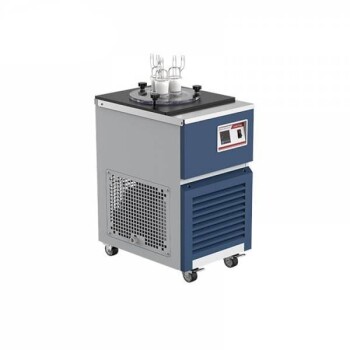
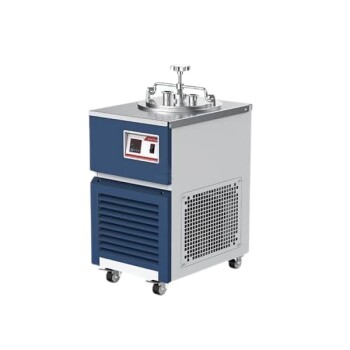
Condensers and Cold Traps are essential for the phase-change cooling and fractional separation of volatile vapors generated during pyrolysis. These components work in a staged sequence to liquefy heavy hydrocarbons and capture light condensable substances, transforming complex gases into stable, usable products. Without this precision cooling, valuable liquid fuels are lost as vapors, and the remaining non-condensable gases remain contaminated with impurities.
The Central Takeaway: Precision collection systems provide the necessary thermal gradients to separate pyrolysis products into distinct phases—liquid oils, light volatiles, and pure gases—ensuring both high recovery yields and the chemical purity required for advanced material synthesis.
Staged Fractionation of Hydrocarbon Vapors
The Role of the Precision Condenser
The condenser serves as the first line of recovery by utilizing a circulating cooling medium to rapidly lower vapor temperatures. This process quenches hot hydrocarbon vapors, causing heavy components and oxygenated compounds to liquefy into what is commonly known as pyrolysis oil or bio-oil.
The Precision of the Cold Trap
Positioned after the condenser, the cold trap uses extremely low temperatures (often dry ice or ice-water baths) to catch what the condenser misses. It captures light condensable substances and volatile organic compounds (VOCs), such as alcohols and acetic acid, which require sub-zero environments to transition into a liquid state.
Carbon Number Distribution
By controlling temperatures across these multiple stages, the system effectively separates products based on their boiling points and carbon numbers. This allows operators to isolate heavy synthetic waxes and tars from light olefins and permanent gases, maximizing the commercial and functional value of each fraction.
Ensuring Analytical Integrity and Gas Purity
Improving Precursor Gas Quality
For applications involving the synthesis of carbon nanostructures, gas purity is a non-negotiable requirement. Staged collection removes condensable "impurities" from the stream, leaving behind high-purity non-condensable gases like hydrogen, methane, and carbon monoxide that are ideal for downstream synthesis.
Accurate Mass Balance Calculations
In a laboratory setting, capturing every gram of output is critical for reconstructing thermal decomposition pathways. Cold traps prevent the loss of light components, ensuring that the final data reflect an accurate mass balance and yield analysis when using instruments like GC-MS or NMR.
Protection of Downstream Equipment
Volatile vapors can be corrosive or prone to gumming up sensitive analytical sensors and pumps. By "scrubbing" these vapors through condensation, the system protects high-end downstream equipment from contamination and mechanical failure.
Understanding the Trade-offs and Limitations
Temperature Sensitivity vs. System Blockage
Maintaining an ultra-low temperature is vital for recovery, but it introduces the risk of thermal shock or freezing. If the temperature is too low in the primary condenser, high-boiling-point tars may solidify instantly, leading to system blockages and dangerous pressure build-ups.
Maintenance and Fouling
The internal surfaces of condensers are prone to fouling, where heavy tars and carbon soot create an insulating layer. This reduces heat exchange efficiency over time, requiring frequent solvent cleaning to maintain consistent condensation rates.
Energy and Consumable Costs
Operating high-precision cold traps often requires a continuous supply of refrigerants or liquid nitrogen. For industrial-scale operations, the energy cost of cooling must be carefully balanced against the market value of the recovered light oils and chemical precursors.
How to Apply This to Your Project
Making the Right Choice for Your Goal
To optimize your pyrolysis collection end, align your cooling strategy with your primary output objective:
- If your primary focus is bio-oil yield: Prioritize a high-efficiency multi-stage condenser with precise temperature control to maximize the recovery of heavy and medium hydrocarbon fractions.
- If your primary focus is carbon nanotube synthesis: Focus on the cold trap's efficiency to ensure all condensable vapors are stripped, providing a bone-dry, high-purity gas stream for the reactor.
- If your primary focus is plastic waste recycling: Utilize a series of graduated cooling zones to separate synthetic waxes from lighter pyrolysis oils, allowing for immediate product grading.
- If your primary focus is chemical kinetic research: Implement a dual cold-trap setup with liquid nitrogen to ensure 100% capture of volatiles for rigorous mass balance and GC-MS analysis.
Effective volatile management through precision cooling is the difference between a contaminated waste stream and a high-value chemical resource.
Summary Table:
| Component | Primary Function | Cooling Medium | Target Output |
|---|---|---|---|
| Precision Condenser | Quenches hot vapors to liquefy heavy hydrocarbons | Circulating cooling fluid | Pyrolysis oil, bio-oil, heavy tars |
| Cold Trap | Captures light volatiles and VOCs via sub-zero temperatures | Dry ice, ice-water, or LN2 | Light oils, alcohols, acetic acid |
| Post-Trap Stage | Isolates high-purity non-condensable gases | N/A (Residual gas) | Hydrogen, Methane, Carbon Monoxide |
Elevate Your Pyrolysis Research with KINTEK Precision
Precision is the backbone of successful thermal decomposition. At KINTEK, we understand that the difference between a contaminated waste stream and a high-value chemical resource lies in your collection efficiency.
We offer a comprehensive suite of laboratory equipment designed to optimize your recovery rates and protect your analytical integrity, including:
- Advanced Cooling Solutions: High-performance cold traps, ULT freezers, and recirculating chillers.
- Reaction Systems: High-temperature reactors, CVD/PECVD systems, and specialized furnaces.
- Consumables & Analysis: High-purity ceramics, crucibles, and hydraulic presses for material preparation.
Whether you are focusing on bio-oil fractionation, plastic waste recycling, or carbon nanostructure synthesis, our experts are ready to help you configure the perfect staged collection system.
Maximize your yields and ensure equipment longevity—Contact KINTEK today for a tailored solution.
References
- Katerine Ordoñez Agredo, Edgar Mosquera. Pirólisis del tereftalato de polietileno y poliestireno para la síntesis de nanoestructuras de carbono: una revisión bibliométrica. DOI: 10.18273/revuin.v22n2-2023003
This article is also based on technical information from Kintek Solution Knowledge Base .
Related Products
- Vacuum Cold Trap Chiller Indirect Cold Trap Chiller
- Vacuum Cold Trap Direct Cold Trap Chiller
- Vacuum Cold Mounting Machine for Sample Preparation
People Also Ask
- Why is it necessary to configure efficient cold traps in membrane distillation? Ensure Flux Stability & Data Accuracy
- What is the purpose of connecting a cold trap at the reactor outlet? Protect Equipment and Analyze Liquid Products
- What is the role of glass condensation components in arsenic collection? Optimize Niccolite Roasting & Kinetics
- What is the function of a cold trap in bio-ethanol and methane reforming experiments? Optimize Purity & Protect Systems
- Why is a cold trap system containing isopropanol required for pyrolysis gas? Capture Elusive Volatiles Effectively