Processing pyrolysis gas requires absolute precision. A cold trap system utilizing isopropanol is required to capture light tars and fine aerosols that usually fail to condense at standard room temperatures. By functioning as a solvent within a refrigerated environment, isopropanol effectively dissolves and "fixes" these volatile substances, preventing them from remaining in the gas stream.
Pyrolysis gas contains complex volatiles that can bypass standard condensers. Using isopropanol in a cold trap solves this by chemically capturing these elusive aerosols, ensuring downstream equipment receives clean gas while preserving liquid products for accurate analysis.
The Challenge of Complex Volatiles
Overcoming Temperature Limitations
Pyrolysis generates a complex mixture of gases and vapors. Many light tars and fine aerosols possess physical properties that allow them to remain suspended or gaseous at room temperature.
Standard condensation methods often fail to capture these compounds. Without a specialized trap, these volatiles pass through the collection system as if they were permanent gases.
The Role of Isopropanol as a Solvent
Temperature reduction alone is often insufficient for complete capture. Isopropanol is introduced into the cold trap to act as a chemical capture agent.
It functions as a solvent, physically dissolving the volatile substances as they enter the trap. This "fixes" the compounds into a liquid state, preventing them from re-vaporizing or slipping through the system.
Protecting Downstream Infrastructure
Ensuring "Dry and Clean" Syngas
The primary operational goal of the cold trap is the protection of sensitive instrumentation. The non-condensable syngas must flow through flow meters and gas analyzers.
If tars or aerosols remain in the stream, they will deposit on sensors and clog metering channels. The isopropanol trap acts as a final scrubber, ensuring the gas entering these devices is dry and free of contaminants.
Preventing Equipment Fouling
Long-term exposure to sticky tars can ruin expensive analytical equipment. By stripping these heavy hydrocarbons out early, the system extends the lifespan of the entire analysis train.
Facilitating Data Accuracy
Enabling Quantitative Analysis
Beyond protection, the trap serves a critical analytical purpose. To calculate an accurate mass balance, you must account for every product generated during pyrolysis.
By capturing volatiles in isopropanol, you retain them in a measurable medium. Researchers can subsequently analyze the isopropanol-product mixture to determine the exact quantity and composition of the condensed products.
Understanding the Trade-offs
Solvent Saturation Risks
While isopropanol is effective, it has a finite capacity for dissolving tars. If the concentration of volatiles exceeds the solvent's saturation point, "breakthrough" can occur, allowing contaminants to pass into the analyzers.
Analytical Complexity
Using a solvent adds a step to the post-run analysis. When analyzing the liquid products, the presence of isopropanol must be accounted for mathematically to isolate the true yield of the pyrolysis oil.
Making the Right Choice for Your Goal
To maximize the effectiveness of your pyrolysis setup, consider your primary objective:
- If your primary focus is Equipment Protection: Prioritize maintaining the cold trap at a consistently low temperature to maximize the solvent's scrubbing efficiency.
- If your primary focus is Mass Balance Accuracy: Ensure the entire volume of isopropanol is recovered and analyzed post-run to account for all trapped volatiles.
A properly managed cold trap is the difference between erratic sensor data and a verifiable, closed mass balance.
Summary Table:
| Feature | Purpose of Isopropanol in Cold Trap |
|---|---|
| Function | Acts as a solvent to dissolve and "fix" fine aerosols and light tars. |
| Temperature | Works within refrigerated environments to capture sub-room temp volatiles. |
| Equipment Protection | Prevents tar deposition on flow meters and sensitive gas analyzers. |
| Analytical Value | Enables accurate mass balance by retaining liquid products for analysis. |
| Primary Benefit | Ensures "dry and clean" syngas for downstream instrumentation. |
Elevate Your Pyrolysis Research with KINTEK Precision
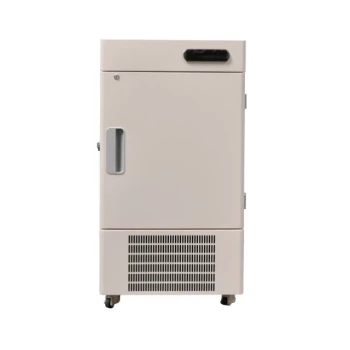
Don't let complex volatiles compromise your data or damage your instrumentation. KINTEK specializes in advanced laboratory solutions designed for the most demanding thermal processes. From high-performance cold traps and cooling solutions (ULT freezers, freeze dryers) to sophisticated high-temperature furnaces and reactors, we provide the tools necessary for verifiable, closed mass balance results.
Whether you are refining syngas purity or conducting detailed quantitative analysis, our comprehensive range of laboratory equipment and consumables—including PTFE products, ceramics, and high-pressure reactors—is engineered to meet your exact specifications.
Ready to optimize your pyrolysis setup? Contact our technical experts today to discover how KINTEK can enhance your lab's efficiency and accuracy.
References
- J. Chojnacki, Václav Peer. Batch Pyrolysis and Co-Pyrolysis of Beet Pulp and Wheat Straw. DOI: 10.3390/ma15031230
This article is also based on technical information from Kintek Solution Knowledge Base .
Related Products
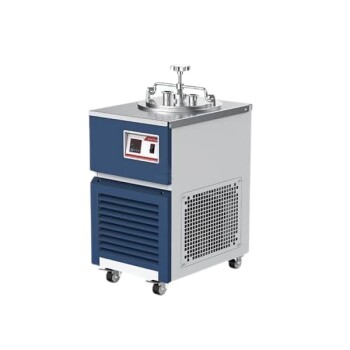
- Vacuum Cold Trap Direct Cold Trap Chiller
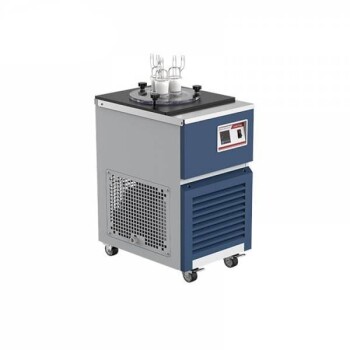
- Vacuum Cold Trap Chiller Indirect Cold Trap Chiller
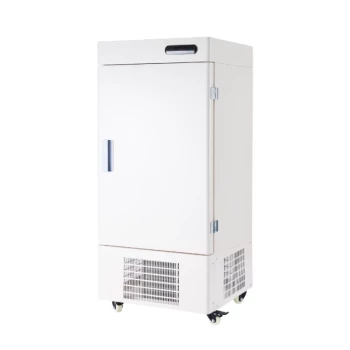
- 608L Essential Laboratory Ultra Low Temperature Freezer For Critical Sample Preservation
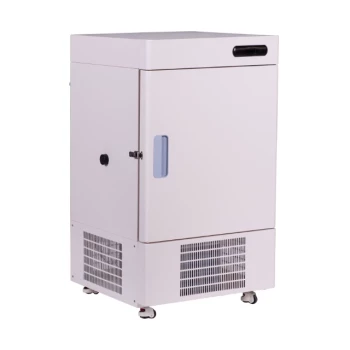
- 158L Precision Vertical Ultra Low Freezer for Laboratory Applications
- 108L Vertical Ultra Low Temperature ULT Freezer
People Also Ask
- What is the role of glass condensation components in arsenic collection? Optimize Niccolite Roasting & Kinetics
- Why is it necessary to configure efficient cold traps in membrane distillation? Ensure Flux Stability & Data Accuracy
- What is the purpose of connecting a cold trap at the reactor outlet? Protect Equipment and Analyze Liquid Products
- What is the primary purpose of a cold trap at a reactor outlet? Protect Analyzers & Ensure Data Integrity
- What is the function of a cold trap in bio-ethanol and methane reforming experiments? Optimize Purity & Protect Systems