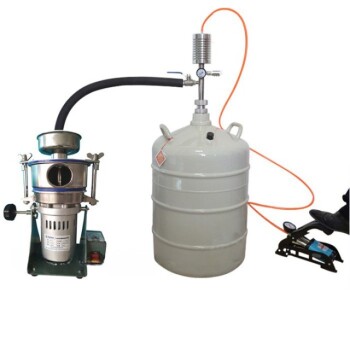
The installation of a liquid nitrogen cold trap is a critical step for preserving chemical integrity. It serves to rapidly condense and capture unstable intermediate products and unreacted monomers from the reactor exhaust that would otherwise be lost. By freezing these volatile components immediately, you ensure they remain available for qualitative and quantitative analysis.
The core function of the cold trap is to convert a dynamic, volatile gas stream into a stable liquid or solid sample. This preservation is the only way to accurately map the complex chemical reaction pathways occurring within the plasma.
The Critical Role of Sample Preservation
Capturing Unstable Intermediates
Plasma reactions often generate fleeting, unstable chemical species. If these species remain in a gaseous state, they may degrade or react further before reaching the analyzer.
The extreme cold of liquid nitrogen halts these secondary reactions immediately. This "freezes" the chemical state of the exhaust, capturing a true snapshot of the reaction process for analysis via Gas Chromatography-Mass Spectrometry (GC-MS).
Retaining Volatile By-products
Many significant by-products in plasma processing are highly volatile. Without a cold trap, these components would simply pass through the system undetected.
By condensing these gases into a liquid or solid phase, the trap effectively concentrates the sample. This allows for high-precision detection of trace elements that define the efficiency of the plasma process.
Operational Stability and Instrument Protection
Eliminating Moisture Interference
Beyond chemical analysis, the cold trap serves a vital protective function by removing water vapor. Moisture is a common contaminant that can severely degrade the performance of analytical columns.
Condensing water out of the product gas stream ensures that moisture does not enter the online gas chromatograph. This preserves column efficiency and ensures the longevity of your analytical equipment.
Stabilizing System Pressure
Accumulated liquid water in gas lines can cause unpredictable pressure fluctuations. These fluctuations introduce noise and errors into sensitive gas analysis data.
By trapping condensables at a single point, the cold trap ensures a smooth, consistent gas flow to the instruments. This mechanical stability is a prerequisite for reproducible data.
Understanding the Trade-offs
The Challenge of Selectivity
While liquid nitrogen is excellent at trapping targets, it is non-selective. It condenses almost everything, including atmospheric moisture and carrier gases with higher boiling points.
This can lead to a sample that requires further purification before analysis. You must account for the presence of frozen water or other background gases when interpreting your GC-MS results.
potential for Physical Blockages
The rapid accumulation of frozen material can create physical obstructions. If the concentration of condensables is high, the trap can clog, blocking the reactor outlet.
Regular monitoring of the pressure drop across the trap is essential. A blocked trap can pressurize the reactor upstream, potentially altering the plasma conditions you are trying to study.
Making the Right Choice for Your Goal
To maximize the utility of your cold trap, align its usage with your specific analytical objectives:
- If your primary focus is elucidating reaction mechanisms: Prioritize the immediate retrieval and cold-storage of the trapped sample to prevent the degradation of unstable monomers.
- If your primary focus is instrument longevity: Ensure the trap is sized correctly to handle the expected water volume without restricting flow to the gas chromatograph.
Ultimately, the cold trap bridges the gap between the chaotic environment of the reactor and the precision required by the laboratory.
Summary Table:
| Feature | Primary Function | Impact on Analysis |
|---|---|---|
| Sample Capture | Rapidly condenses unstable intermediates and monomers | Prevents degradation; enables accurate reaction mapping |
| Moisture Removal | Extracts water vapor from the exhaust stream | Protects GC columns and prevents signal interference |
| Pressure Stability | Prevents liquid accumulation in gas lines | Reduces data noise and ensures reproducible results |
| Sample Concentration | Converts volatile gases into liquids/solids | Enhances detection limits for trace by-products |
Elevate Your Plasma Research with KINTEK Precision
Optimize your analytical accuracy and protect your sensitive equipment with KINTEK’s advanced laboratory solutions. Whether you are analyzing complex plasma exhaust or managing high-pressure reactions, our expertise ensures your data remains pure and your systems run efficiently.
Our comprehensive portfolio includes:
- Cooling Solutions: High-performance cold traps, ULT freezers, and freeze dryers.
- High-Temperature & Pressure Systems: High-pressure reactors, autoclaves, and a wide range of specialized furnaces (CVD, PECVD, vacuum).
- Sample Preparation: Crushing systems, milling tools, and hydraulic presses (pellet, isostatic).
- Essential Consumables: High-purity ceramics, crucibles, and PTFE products.
Don't let unstable intermediates or moisture interference compromise your results. Contact KINTEK today to find the perfect equipment for your laboratory and experience the difference that professional-grade tools bring to your research.
References
- Fiorenza Fanelli, Francesco Fracassi. Ar/HMDSO/O<sub>2</sub> Fed Atmospheric Pressure DBDs: Thin Film Deposition and GC‐MS Investigation of By‐Products. DOI: 10.1002/ppap.200900159
This article is also based on technical information from Kintek Solution Knowledge Base .
Related Products
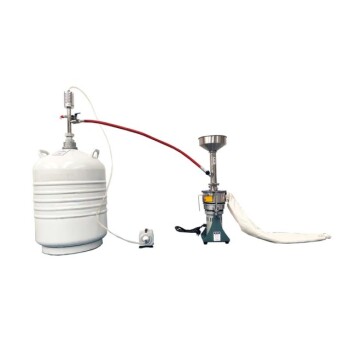
- Liquid Nitrogen Cryogenic Grinder Mill Cryomill Airflow Ultrafine Pulverizer
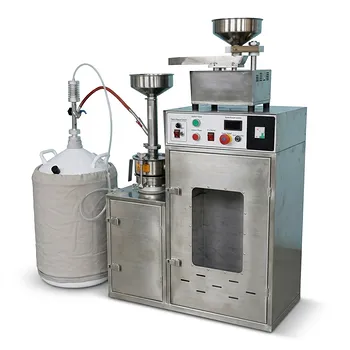
- Liquid Nitrogen Cryogenic Grinder Mill Cryomill with Screw Feeder
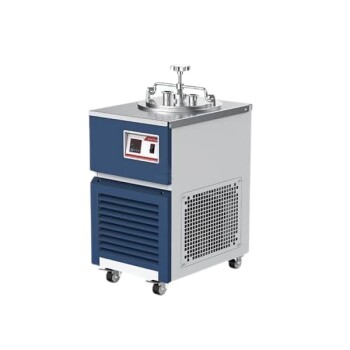
- Vacuum Cold Trap Direct Cold Trap Chiller
- lab cryogenic grinding use liquid-nitrogen for pulverizing plastic raw materials and heat sensitive materials
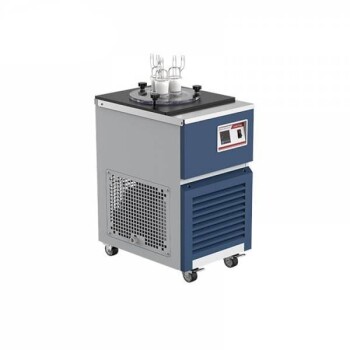
- Vacuum Cold Trap Chiller Indirect Cold Trap Chiller
People Also Ask
- What is cryogenic grinding of crumb rubber? Achieve Fine, High-Quality Rubber Powder
- What are the advantages of using a cryogenic grinder? Achieve Nanoscale Precision for All-Solid-State Battery Cathodes
- What is the role of a cryogenic grinder in PET recycling? Transform Waste into High-Reactive Micron Powders
- Why is a cryogenic grinder required for cured alkyd resin HRMAS NMR? Ensure Structural Integrity & Sample Precision
- What is the temperature of cryogenic grinding? Achieve Superior Particle Size & Preserve Heat-Sensitive Materials