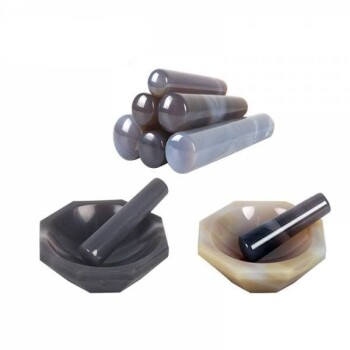
A high-hardness agate mortar is the standard for processing Pickled Mustard Root Skin (PoBJ) because it ensures absolute chemical purity and physical uniformity. By leveraging extreme chemical inertness and physical durability, researchers can grind biomass into a fine powder without introducing metallic contaminants or vessel fragments. This level of precision is vital for obtaining accurate, reproducible results in sensitive downstream applications like pyrolysis mechanism research.
The use of an agate mortar is a strategic choice to eliminate contamination and achieve microscopic uniformity. It protects the integrity of the PoBJ sample from the "vessel effect," where the grinding equipment itself alters the chemical profile of the biomass.
The Critical Role of Material Purity
Avoiding Metallic Contamination
Traditional metal grinders or mortars can shed microscopic metallic particles into the sample during the abrasive grinding of tough biomass.
Agate’s extreme hardness prevents this material degradation, ensuring the PoBJ powder remains free from external elemental interference.
This preservation of the sample's original state is critical when the goal is to analyze the precise mineral or carbon content of the resulting biochar.
Ensuring Chemical Inertness
Agate is naturally non-reactive, meaning it will not chemically interact with the organic acids or compounds found in mustard root skin.
This chemical stability ensures that the molecular structure of the PoBJ is not altered by the vessel during the mechanical stress of grinding.
By maintaining high purity, researchers can be confident that subsequent data reflects the properties of the biomass rather than a chemical reaction with the tools.
Achieving Physical Consistency
Breaking Down Agglomeration
Dry biomass often exhibits particle agglomeration, where small fragments clump together and resist uniform distribution.
Manual grinding in an agate mortar effectively shears these clusters, resulting in a free-flowing, physically uniform powder.
This uniformity is a prerequisite for creating a consistent mixture that behaves predictably during experimental testing.
Optimizing Particle Size for Research
The fine particle size achieved through agate grinding increases the total surface area of the PoBJ powder.
This allows for more even heat distribution during pyrolysis, preventing localized hotspots that could skew the research data.
Consistent particle sizing ensures that experimental observations are a result of the material’s inherent properties rather than physical inconsistencies.
Understanding the Trade-offs
Labor-Intensive Manual Processing
Using an agate mortar requires significant manual effort and time compared to automated mechanical milling solutions.
For very large sample batches, this manual process can become a significant bottleneck in the laboratory workflow.
Vulnerability to Physical Damage
While agate is incredibly hard and wear-resistant, it is also brittle and susceptible to thermal shock or impact damage.
Researchers must handle these tools with extreme care, as dropping a pestle or applying uneven pressure can lead to costly cracks or fractures.
How to Apply This to Your Project
Selecting the right grinding method depends on the specific requirements of your biomass analysis and the intended use of the final powder.
- If your primary focus is elemental analysis or pyrolysis mechanisms: Use a high-hardness agate mortar to guarantee that no trace metals or vessel impurities skew your chemical data.
- If your primary focus is high-throughput production or industrial scaling: Consider automated mechanical mills with agate-lined chambers to balance the need for speed with the requirement for purity.
Utilizing high-hardness agate is a foundational step in transforming raw biomass into a reliable, scientifically sound baseline for advanced research.
Summary Table:
| Feature | Advantage | Research Outcome |
|---|---|---|
| Extreme Hardness | Zero metallic contamination | Accurate mineral/carbon profiling |
| Chemical Inertness | Non-reactive with organic acids | Maintained sample molecular integrity |
| Physical Shearing | Breaks particle agglomeration | Free-flowing, uniform powder |
| Fine Particle Size | Maximized surface area | Even heat distribution during pyrolysis |
Elevate Your Research with Precision Sample Preparation from KINTEK
Are you striving for absolute purity in your biomass analysis? KINTEK provides top-tier laboratory equipment designed to eliminate contamination and ensure sample uniformity. From high-hardness agate mortars and crushing and milling systems to precision hydraulic presses for pelletizing, we offer the tools you need for reproducible results.
Our comprehensive portfolio supports your entire workflow, including:
- Advanced Crushing & Milling: Manual and automated systems to achieve microscopic uniformity.
- High-Temperature Furnaces: Muffle, tube, and vacuum furnaces for precise pyrolysis and heat treatment.
- Laboratory Consumables: High-purity ceramics, crucibles, and PTFE products to protect sample integrity.
Don't let vessel contamination skew your data. Contact KINTEK today to find the perfect high-performance solutions for your laboratory's specific needs!
References
- Tao-Tao Shi, Jin‐Gang Yu. Efficient and Selective Removal of Organic Cationic Dyes by Peel of Brassica juncea Coss. var. gemmifera Lee et Lin-Based Biochar. DOI: 10.3390/molecules28083353
This article is also based on technical information from Kintek Solution Knowledge Base .
Related Products
- Nature Agate Mortar and Pestle for Grinding and Mixing
- Laboratory Jar Mill with Agate Grinding Jar and Balls
People Also Ask
- Why are agate mortars and pestles used for grinding iron oxide? Ensure Sample Purity for XRD Analysis
- What is the function of an agate mortar and pestle? Ensure Purity in Halide Solid-State Electrolyte Synthesis
- What is the primary function of an agate mortar and pestle? Optimize VO2+ CaZn2(PO4)2 Nanopowder Pre-Treatment
- Why is an agate mortar and pestle required for grinding Zr3(Al1-xSix)C2? Ensure Maximum Sample Purity
- Why is an agate mortar and pestle preferred for grinding MAX phase? Ensure Sample Purity & Zero Contamination