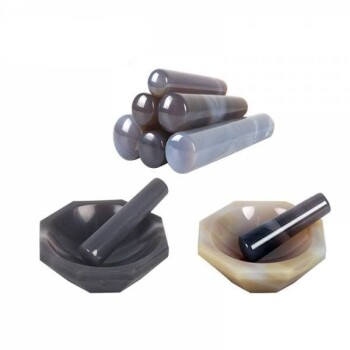
Agate is the preferred material for grinding sintered MAX phase blocks because it offers a critical combination of extreme hardness and chemical inertness. When pulverizing hard blocks into fine 300-mesh powders, softer grinding tools inevitably degrade, contaminating the sample with tool debris. Agate eliminates this risk, preventing metallic impurities from entering the mixture.
The use of agate is essential to prevent tool wear from contaminating your sample, ensuring the high purity required for sensitive downstream applications like MXene preparation.
The Imperative of Sample Purity
Preventing Metallic Contamination
When grinding hard materials, the mortar and pestle are subjected to intense friction. If the tool is made of metal or soft ceramics, microscopic particles will abrade off the tool and mix with your sample.
Ensuring Chemical Stability
Agate is chemically inert. It does not react with the MAX phase components, ensuring that the stoichiometry of your material remains unaltered throughout the mechanical breakdown process.
The Standard for MXene Precursors
The primary reference highlights that high purity is non-negotiable for preparing (V1/2Mo1/2)2CTx MXenes. Any introduced impurities during the grinding stage can severely impact the quality and electronic properties of the final MXene sheets.
Physical Requirements for Grinding
Withstanding Sintered Hardness
Sintered MAX phase blocks are dense and hard. To effectively reduce them to a 300-mesh particle size, the grinding medium must be significantly harder than the sample to avoid rapid degradation.
Achieving Fine Particle Sizes
Agate allows for the prolonged, vigorous grinding required to reach fine mesh sizes without shedding material. This durability ensures consistency across different batches of powder.
Understanding the Trade-offs
Impact Vulnerability
While agate is hard (resistant to scratching), it is also brittle. It excels at grinding via friction but can crack or shatter if used for heavy-impact crushing or hammering.
Cost vs. Performance
Agate mortars are significantly more expensive than porcelain or glass alternatives. However, for high-precision materials science, the cost is justified by the elimination of sample contamination.
Making the Right Choice for Your Goal
To ensure the success of your material synthesis, align your tool selection with your specific requirements:
- If your primary focus is high-purity synthesis (e.g., MXenes): You must use agate to prevent metallic contamination and ensure the integrity of your chemical precursor.
- If your primary focus is rough bulk reduction: You might use a hardened steel crusher initially, but you must switch to agate for the final fine grinding to minimize impurity uptake.
Investing in agate ensures that the data you generate reflects the properties of your material, not the debris of your tools.
Summary Table:
| Feature | Agate Mortar & Pestle | Standard Porcelain/Metal |
|---|---|---|
| Hardness (Mohs) | 6.5 - 7.0 (Superior) | Lower (Prone to wear) |
| Chemical Inertness | Highly Inert (No reaction) | Variable (Potential leaching) |
| Contamination Risk | Extremely Low | High (Metallic/Tool debris) |
| Best Used For | Fine grinding (300-mesh) | Rough bulk reduction |
| Ideal Application | MXene precursors & high-purity synthesis | General lab prep |
Elevate Your Material Synthesis with KINTEK Precision Tools
Don't let tool debris compromise your research. Whether you are preparing (V1/2Mo1/2)2CTx MXenes or processing advanced ceramics, KINTEK specializes in providing the high-purity laboratory equipment your workflow demands. From premium agate mortar and pestle sets to advanced crushing and milling systems, high-temperature furnaces (vacuum, CVD, atmosphere), and hydraulic pellet presses, we ensure your materials remain uncontaminated from start to finish.
Ready to achieve superior sample purity and consistent 300-mesh results?
Contact KINTEK Today for Expert Solutions
References
- Ruiqi Xu, Xiaohua Chen. Biomimetic Micro-Nanostructured Evaporator with Dual-Transition-Metal MXene for Efficient Solar Steam Generation and Multifunctional Salt Harvesting. DOI: 10.1007/s40820-024-01612-0
This article is also based on technical information from Kintek Solution Knowledge Base .
Related Products
- Nature Agate Mortar and Pestle for Grinding and Mixing
- Laboratory Jar Mill with Agate Grinding Jar and Balls
People Also Ask
- Why are agate mortars and pestles used for grinding iron oxide? Ensure Sample Purity for XRD Analysis
- What is the function of an agate mortar and pestle? Ensure Purity in Halide Solid-State Electrolyte Synthesis
- What is the primary function of an agate mortar and pestle? Optimize VO2+ CaZn2(PO4)2 Nanopowder Pre-Treatment
- Why is an agate mortar and pestle required for grinding Zr3(Al1-xSix)C2? Ensure Maximum Sample Purity
- Why is an agate mortar and pestle preferred for melamine condensates? Achieve Molecular Purity in Nanomaterial Synthesis