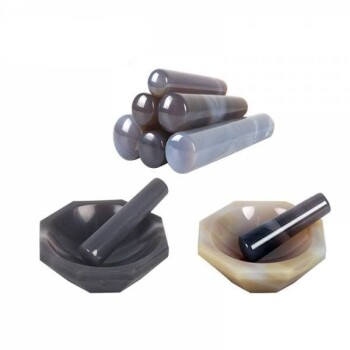
Agate mortars and pestles are the standard choice for grinding iron oxide primarily due to their extreme hardness and negligible wear rates. This specific material property ensures that hard iron oxide blocks are pulverized into fine powders without the mortar itself degrading and introducing metallic or environmental contaminants into the sample.
The selection of agate is a defensive measure for data integrity; it prevents equipment-derived contamination while achieving the specific physical homogeneity required for accurate X-ray diffraction (pXRD) analysis.
The Critical Role of Material Hardness
Resisting Sample Contamination
Iron oxides are relatively hard ceramic materials. If you were to grind them using a softer material, such as porcelain or glass, the mortar would abrade alongside the sample.
This abrasion introduces significant impurities into your powder. Agate possesses high hardness and an extremely low wear rate, ensuring that the final powder remains chemically pure.
Effective Pulverization
Synthesized iron oxides often dry into hard, aggregated blocks. Agate provides the mechanical durability required to crush these aggregates effectively.
This capability allows researchers to break down the bulk material into a physically homogenized state, which is the first step in preparing a viable sample for characterization.
Optimizing for X-Ray Diffraction (XRD)
Meeting Particle Size Requirements
For structural characterization via powder X-ray diffraction (pXRD), the sample must be a fine, uniform powder. Agate grinding facilitates the reduction of the sample to the necessary particle size range.
This physical uniformity is not just cosmetic; it is a fundamental requirement for the physics of diffraction to work correctly during the test.
Eliminating Preferred Orientation
While contamination prevention is critical, the geometry of the powder particles is equally important. Grinding the sample into an extremely fine powder ensures a random distribution of crystal grains.
This randomness eliminates "preferred orientation effects," where crystals align in a specific direction. By preventing this alignment, you ensure the diffraction patterns exhibit accurate intensities and clear peak shapes, allowing for a precise analysis of crystal phase purity.
Understanding the Trade-offs
Manual Variability
While agate tools prevent contamination, the grinding process is often manual. This introduces a variable of human error regarding the consistency of the grind time and pressure.
Inconsistent grinding can lead to variations in particle size distribution between different batches of the same material.
Cost and Care
Agate is significantly more expensive than standard laboratory ceramics. It requires careful handling to prevent chipping, which can compromise the smooth grinding surface essential for fine powder generation.
Making the Right Choice for Your Goal
To ensure your structural characterization yields valid data, align your preparation method with your analytical objectives:
- If your primary focus is Phase Purity (Chemical Analysis): Rely on agate to prevent the introduction of foreign elements that could appear as impurities or background noise in your data.
- If your primary focus is Rietveld Refinement (Structural Analysis): Grind the sample significantly to achieve random grain orientation, ensuring the peak intensities reflect the true crystal structure rather than particle alignment.
Agate provides the necessary balance of hardness and purity to turn raw synthesis products into reliable scientific data.
Summary Table:
| Feature | Benefit for Iron Oxide Characterization |
|---|---|
| Extreme Hardness | Effectively pulverizes hard ceramic aggregates without equipment wear. |
| Negligible Wear Rate | Prevents metallic or silica contamination, ensuring chemical purity. |
| Particle Size Control | Achieves the fine homogeneity required for accurate X-ray diffraction. |
| Random Orientation | Eliminates preferred orientation effects for precise Rietveld refinement. |
Elevate Your Material Characterization with KINTEK
Don't let sample contamination compromise your research data. KINTEK specializes in high-performance laboratory equipment, including premium agate mortars and pestles, precision crushing and milling systems, and sieving equipment designed for the most demanding structural analysis tasks.
Whether you are preparing iron oxides for pXRD or developing advanced battery materials, our comprehensive range of tools—from high-temperature furnaces and hydraulic pellet presses to PTFE consumables and ceramic crucibles—ensures your lab achieves unmatched consistency and purity.
Ready to optimize your sample preparation? Contact our technical experts today to find the perfect equipment solution for your specific application!
References
- Marcel G. Görn, Juraj Majzlan. Incorporation of Mo<sup>6+</sup> in Ferrihydrite, Goethite, and Hematite. DOI: 10.1007/s42860-021-00116-x
This article is also based on technical information from Kintek Solution Knowledge Base .
Related Products
- Nature Agate Mortar and Pestle for Grinding and Mixing
- Laboratory Jar Mill with Agate Grinding Jar and Balls
People Also Ask
- What is the function of an agate mortar and pestle? Ensure Purity in Halide Solid-State Electrolyte Synthesis
- What is the primary function of an agate mortar and pestle? Optimize VO2+ CaZn2(PO4)2 Nanopowder Pre-Treatment
- Why is an agate mortar and pestle required for grinding Zr3(Al1-xSix)C2? Ensure Maximum Sample Purity
- Why is an agate mortar and pestle preferred for grinding MAX phase? Ensure Sample Purity & Zero Contamination
- Why is an agate mortar and pestle preferred for melamine condensates? Achieve Molecular Purity in Nanomaterial Synthesis